
React Native has become a popular framework for building cross-platform mobile apps. To get the best results, developers must understand React Native architecture and apply a well-structured approach while building the app.
A strong React Native mobile app architecture helps developers organize code, manage data flow, and improve overall app performance. When teams follow a clear architecture of React Native, they can build applications that are easier to scale, maintain, and update.
Developers should not focus only on writing JavaScript. Instead, they should design a clear React Native app architecture that supports long-term growth and stability. A well-planned architecture of React Native acts as the foundation of a reliable application.
In this guide, we explore the architecture of React Native, explain key concepts, and discuss popular patterns used in modern projects. You will also learn how the React app architecture works and how the right architecture React Native approach helps you build scalable and maintainable mobile applications.
React Native mobile app architecture refers to the underlying structure and organization of your React Native app. It’s like the blueprint for your house, defining how different parts of the app interact and work together to create a smooth user experience.
A well-defined React Native mobile app architecture helps developers build scalable, maintainable, and high-performance mobile applications. When teams follow a clear architecture of React Native, they organize the project structure, manage data flow effectively, and maintain clean code across the application.
A structured React Native app architecture separates UI components, business logic, and data handling. This separation keeps the codebase clean and easy to understand. Developers can quickly identify where a feature belongs and modify it without affecting other parts of the application.
A strong React Native architecture allows applications to grow smoothly. Developers can add new features, modules, or integrations without restructuring the entire project. A scalable React Native mobile app architecture helps startups and enterprises expand their applications as user demand increases.
Good architecture React Native practices help developers optimize rendering and manage state efficiently. Developers can reduce unnecessary component updates and improve communication between the native layer and JavaScript. As a result, the application runs faster and delivers a better user experience.
When teams follow a clear React app architecture, developers can work on different modules at the same time. This structure reduces code conflicts and improves productivity. Each developer understands the project structure and contributes efficiently.
A well-defined architecture of React application makes testing easier. Developers can test each module independently and identify issues quickly. This modular approach improves reliability and ensures that new updates do not break existing functionality.
A structured React Native mobile app architecture helps teams maintain the application over the long term. Developers can update components, improve features, and fix bugs without rewriting large sections of code. This approach reduces technical debt and keeps the project sustainable.
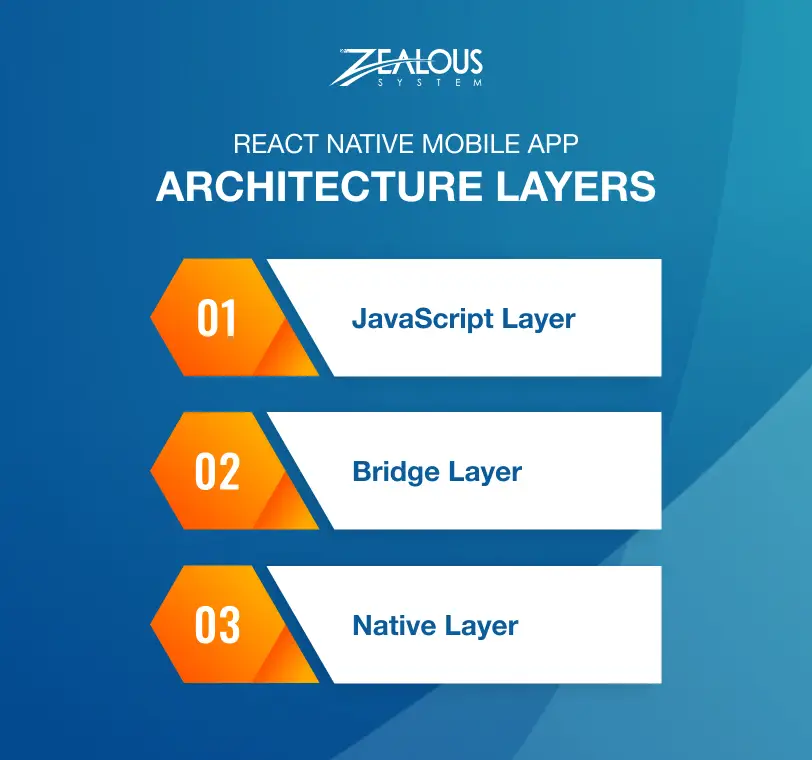
To build scalable and high-performance apps, developers must understand the React Native mobile app architecture. The architecture of React Native defines how different parts of the application communicate and work together.
In a typical React Native app architecture, the application consists of three main layers:
This layered structure allows developers to write most of the logic using JavaScript while still using the power of native mobile platforms. Many principles used in the architecture of React application on the web also influence the React Native architecture, which makes it easier for web developers to transition to mobile development.
The JavaScript layer forms the core of the React Native architecture. Developers write most of the application code in this layer using JavaScript and React.
Developers build the user interface using reusable components, following the same concepts used in the React app architecture for web applications. React Native uses a virtual DOM to update UI elements efficiently and keep the app responsive.
This layer also manages:
Because this layer works similarly to the architecture of React application, many React developers can quickly start building mobile apps using React Native.
The Bridge layer connects the JavaScript layer with the Native layer. It acts as a communication channel in the React Native mobile app architecture.
When JavaScript code needs to access native functionality, the bridge sends messages between the JavaScript thread and the native modules. This communication allows the app to use device capabilities such as:
The bridge makes the architecture React Native flexible because developers can write UI and logic in JavaScript while still accessing native platform features.
The Native layer contains platform-specific code that runs directly on the device. In the architecture of React Native, this layer ensures that the app behaves like a true native application.
Developers write native code using:
This layer renders native UI components and manages platform-specific functionality. Developers can also build custom native modules and integrate them into the React Native app architecture when the application requires advanced device capabilities.
The native layer ensures that the final app delivers smooth performance and a native user experience.
When designing a scalable React Native mobile app architecture, choosing the right architectural pattern is essential. A well-structured React Native architecture improves code maintainability, performance, and scalability. It also helps developers organize the architecture of React Native apps in a way that makes development faster and easier to manage.
Let’s explore some popular patterns used in React Native app architecture and the architecture of React applications.
The MVC pattern divides the React Native app architecture into three clear parts: Model, View, and Controller.
Model manages the application data and business logic.
View displays the UI components to users.
Controller handles user input and updates the Model or View accordingly.
This structure helps developers keep the architecture of React Native applications organized and easier to maintain. Many teams use MVC when building small to medium-sized apps. However, the controller can become complex as the application grows.
The MVVM pattern improves the React Native mobile app architecture by adding a ViewModel layer between the Model and the View.
Model manages the data and business rules.
View handles the UI and user interactions.
ViewModel connects the View with the Model and manages presentation logic.
This pattern simplifies testing and improves data handling in the architecture of React applications. It also helps developers separate UI logic from business logic. Many UI libraries follow MVVM concepts to keep the React Native architecture clean and modular.
Flux and Redux focus on unidirectional data flow, which makes the React app architecture more predictable.
In this structure:
This pattern improves debugging and state management in large React Native app architecture projects. Many development teams prefer Redux because it offers strong developer tools and a large community ecosystem.
MobX offers a simpler approach to state management in React Native architecture.
MobX uses observable state, which means the UI updates automatically when the data changes. Developers do not need to manually manage state updates in many cases.
This approach makes the architecture of React Native apps easier to implement, especially for small to medium projects where developers want faster development and less boilerplate code.
The new React Native architecture introduces modern improvements that enhance performance and scalability.
It includes:
These improvements strengthen the React Native mobile app architecture and allow developers to build high-performance applications. As adoption grows, this modern architecture React Native approach will play a major role in the future of mobile app development.
Explore the importance of a component-based approach, the Single Responsibility Principle (SRP), the significance of separation of concerns, and effective data flow and state management. These principles lay the groundwork for building robust and scalable applications.
A well-structured project improves the React Native architecture and makes development easier.
Developers organize components, screens, and services properly in the React Native mobile app architecture. This structure helps teams manage large projects and reuse code.
Version control tools like Git also support collaboration and help teams maintain a clean architecture React Native projects require.
State management plays an important role in the React Native architecture.
Developers use local state for small features within the React Native mobile app architecture. For complex applications, they use Redux to manage centralized data in the React Native app architecture.
Many teams also use the Context API in the architecture React Native projects adopt today. Each method supports efficient data handling in the architecture of React Native.
Navigation is a key part of the React Native mobile app architecture.
Developers use React Navigation to manage screen transitions in the React Native app architecture. They implement stack, tab, and drawer navigation to create smooth user experiences.
Proper navigation design improves usability and strengthens the overall React Native architecture.
Testing improves the reliability of the React Native architecture.
Developers use tools like Jest to test components and features in the React Native mobile app architecture. They also use debugging tools to detect issues and improve performance.
Regular testing ensures stability in the React app architecture.
API integration connects the frontend and backend in the React Native mobile app architecture.
Developers fetch data, handle asynchronous requests, and implement CRUD operations within the React Native app architecture. Efficient API integration improves the overall architecture of React Native applications.
Security is essential in any React Native architecture.
Developers secure API calls, encrypt sensitive data, and implement secure storage within the React Native mobile app architecture. These practices reduce risks and strengthen the architecture of React application.
CI/CD improves development efficiency in the React Native app architecture.
Developers automate testing, building, and deployment processes in the React Native architecture. A strong pipeline helps teams release updates faster while maintaining a stable React app architecture.
In conclusion, mastering React Native app architecture is a journey that pays off in the form of scalable, maintainable, and robust applications. By implementing the principles and practices discussed in this guide, you’ll be well-equipped to navigate the complexities of React Native development successfully.
If you’re looking to expedite your project or lack the in-house expertise, consider of to hire React Native app developer or partnering with a reputable offshore React Native app development company. Encourage a modular and scalable mindset, and leverage the resources provided for continuous learning and exploration. Happy coding!
Read Also:
Our team is always eager to know what you are looking for. Drop them a Hi!

Pranjal Mehta is the Managing Director of Zealous System, a leading software solutions provider. Having 10+ years of experience and clientele across the globe, he is always curious to stay ahead in the market by inculcating latest technologies and trends in Zealous.




Comments