Australian businesses in 2026 face a challenging risk environment. Cyber attacks and data breaches rank as the top concern, closely followed by regulatory changes and talent shortages.
These threats affect operations across finance, insurance, healthcare, mining, and construction. Strict oversight from APRA and ASIC continues to demand robust operational resilience, especially with standards like CPS 230 now in full effect since mid-2025.
Many organisations recognise that effective risk management software helps identify issues early and maintain compliance. Developing custom risk management software in Australia gives organisations a direct way to handle these challenges. It supports real-time monitoring, automates reporting, and helps teams respond faster with stronger mitigation strategies.
This guide explores key features, compliance considerations, development steps, and costs involved in risk management software development in Australia.
Risk management software is a specialised platform designed to help organisations systematically identify, evaluate, and address potential threats. These threats could impact operations, finances, compliance, or reputation.
It centralises data from different parts of the business, giving you a clear, consolidated view of all active risks. From there, teams can prioritise issues based on likelihood and potential impact, then assign mitigation steps and track progress.
Many modern solutions include automated workflows, real-time dashboards, and notification systems that alert users when risks change or thresholds are crossed.
In regulated environments, risk management software often builds in features to handle compliance demands, particularly from bodies like APRA and ASIC. This integration proves especially valuable for enterprises operating in heavily regulated industries such as finance, insurance, and healthcare.
Custom risk management software development in Australia takes this further by aligning the platform precisely with your organisation’s processes and sector-specific challenges. The result is a tool that moves risk handling from reactive problem-solving to forward-looking strategy.
If you lead a team in finance, insurance, healthcare, mining, or construction, you know how quickly risks can shift. One day, it’s a supply chain hold-up from overseas tensions. Next, ransomware demands locking critical systems.
Cyber incidents have held the top spot as the primary concern for Australian organisations in recent years, with data breaches and attacks growing more sophisticated. Regulatory changes come in close behind, especially as APRA and ASIC sharpen focus on areas like financial reporting, private credit practices, and operational resilience under standards such as CPS 230.
In sectors like mining, operational complexity adds another layer, from equipment failures to environmental pressures. Healthcare faces ongoing data security challenges, while construction deals with safety incidents and workforce shortages. Manual tracking with spreadsheets or siloed tools cannot keep pace. Risks slip through, responses slow down, and compliance gaps widen before anyone realises.
This is where risk management software in Australia makes a real difference. It pulls information together into one reliable view, so you can see emerging issues across the business without chasing reports from different teams.
Automated alerts flag rising threats early, whether it’s a cyber vulnerability or a regulatory update. Compliance tracking becomes straightforward, with built-in support for APRA and ASIC requirements, helping you document everything needed for audits or breach reporting.
Teams gain clear ownership of risks, reducing the blame game and speeding up mitigation. For smaller operations or startups, it levels the playing field by cutting down on administrative burden and human error.
When you move to custom risk management software development in Australia, the system fits your exact processes and sector demands, from safety protocols in mining to claims handling in insurance.
Australian enterprises choose different types of risk management software based on their size, industry, and main challenges. Each type focuses on specific areas while still covering the basics of identifying and handling risks.
This is the most comprehensive option. It gives a full view of risks across the entire organisation, from strategic to operational. Large banks, insurers, and mining companies often use ERM systems to connect risks in finance, operations, and compliance. The software helps leadership see how one risk can affect other areas.
GRC platforms put heavy emphasis on regulatory requirements. They are common in finance and insurance, where APRA and ASIC rules demand clear policies, controls, and audit trails. These tools manage policies, track obligations, and prepare reports for regulators.
This type targets day-to-day risks. Construction and mining firms use it to log safety incidents, near misses, and equipment issues on site. Field workers can report problems via mobile apps, and managers get instant updates to prevent repeat events.
With cyber threats rising, healthcare providers and financial institutions rely on these specialised tools. They scan for vulnerabilities, monitor networks, and manage incident response plans to protect sensitive data.
Many organisations start with one type and later add modules or integrate systems. Custom risk management software development in Australia often combines features from several types to create a single platform that fits local needs perfectly.
Demand for risk management software continues to grow as businesses look for tools that match both industry needs and regulatory expectations.
Good risk management software includes a set of core features that help teams handle threats effectively. These tools make the process clearer and faster for Australian enterprises dealing with strict regulations.
The foundation starts with a central risk register. It lets you log all potential risks in one place, from cyber threats to operational issues in mining sites. Teams can add details like causes and early warning signs.
You need ways to evaluate risks properly. Most platforms offer scoring based on likelihood and impact, often with custom scales. This helps prioritise what needs attention first, especially for APRA-mandated resilience planning.
Modern systems track key risk indicators continuously. When something crosses a threshold, automated alerts go out via email or app notifications. This quick response proves vital in fast-moving sectors like finance or healthcare.
Logging incidents and linking them to risks is standard. Workflows guide investigations, root cause analysis, and follow-up actions. This supports mandatory reporting to regulators like ASIC when breaches occur.
Built-in support for Australian standards stands out. Features include obligation tracking, policy management, and audit trails. Many prepare reports tailored for APRA CPS 230 or ASIC requirements.
Clear visuals make a big difference. Custom dashboards show risk heat maps, trends, and status updates. Executives get board-ready reports without manual compilation.
Field teams in construction or mining benefit from mobile apps for on-site reporting. Integrations with existing systems pull in data automatically(data migration).
When building custom risk management software in Australia, focus on these features to meet both business and regulatory needs. It often emphasises strong data security and local compliance support to handle sensitive information safely.
Australian organisations must follow key regulations for operational risk, especially in finance, insurance, and other supervised sectors. APRA and ASIC lead most of these rules.
This standard, fully effective since July 2025, requires strong frameworks to handle operational risks. Entities identify critical operations, set tolerances for disruptions, and manage third-party arrangements carefully. For existing contracts, full compliance applies from July 2026 at the latest.
Boards hold clear accountability for oversight. Regular testing and prompt notification of material incidents to APRA are mandatory.
ASIC emphasises market integrity, consumer protection, and proper governance. In 2026, priorities include private credit practices, insurance claims and complaints handling, financial reporting, and misleading pricing.
Sound risk cultures and timely breach handling remain essential across regulated activities.
The Privacy Act, updated in late 2024, strengthens safeguards for personal information. Enhanced enforcement powers apply now, with further changes like a children’s online privacy code due by late 2026.
Mining and construction operations follow work health and safety laws requiring ongoing hazard identification, risk assessments, and incident reporting. AML/CTF reforms expand in 2026, mandating documented risk assessments for more entities.
Common requirements across these rules include:
Risk management software in Australia needs features like audit trails and automated reporting to support these demands effectively.
Custom risk management software development in Australia should include built-in updates that keep pace with changing regulations and industry expectations.
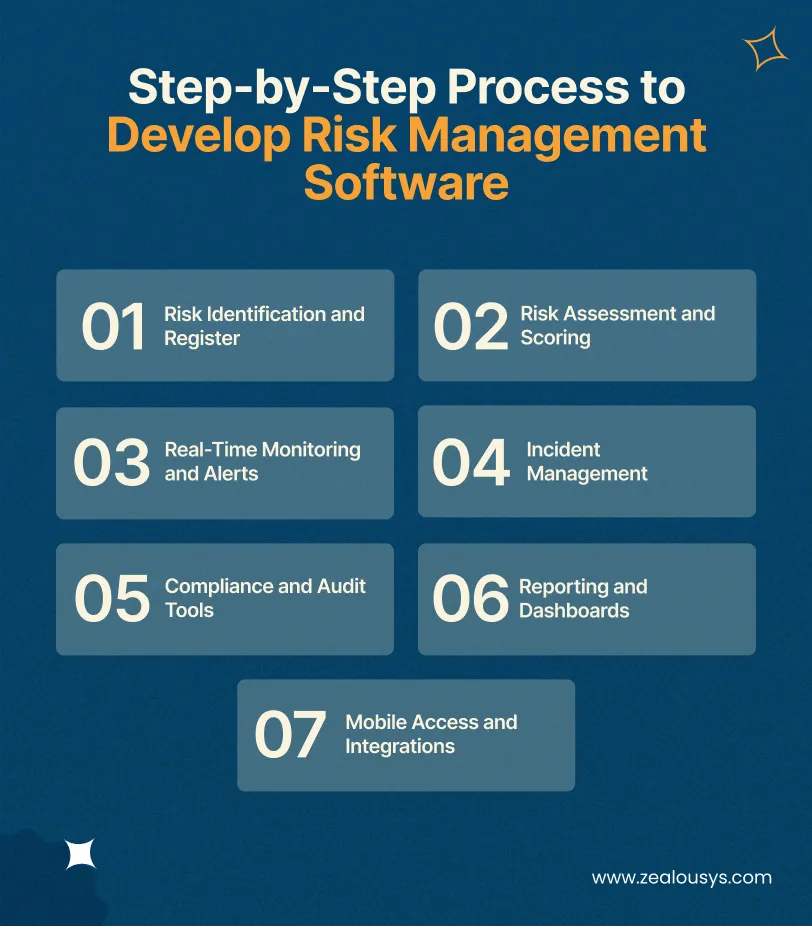
When you decide to build risk management software, the process follows several clear stages to ensure the final product meets regulatory expectations and business goals. Here is a straightforward look at the key steps, from planning to long-term support.
The first step involves bringing together your team to pinpoint exactly what the software must do. Discuss the risks unique to your sector, like cyber vulnerabilities in finance or safety hazards in construction, and how the tool can automate tracking them. Factor in compliance with APRA CPS 230 and ASIC rules right away, so nothing gets overlooked later.
Next, sketch out the overall structure of the system. Think about how data flows securely, using cloud setups that keep information within Australia for privacy compliance. Create intuitive dashboards and workflows that make it simple for users to log risks or generate reports, all while planning for easy integrations with your current tools.
In this phase, choose reliable technologies like secure frameworks for handling sensitive data. Start coding the core elements, such as risk registers and assessment tools, in iterative sprints to allow for quick adjustments. This keeps the development aligned with Australian data protection laws and scalable for future growth.
Now comes thorough testing to catch any flaws. Run scenarios that mimic real regulatory audits or breaches, ensuring features like alerts and reporting work flawlessly. Include user feedback loops here to refine usability, confirming the software stands up to privacy standards and operational demands.
Once tested, launch the software gradually, perhaps starting with a pilot group. Provide practical training sessions so everyone understands how to use it for daily risk management. Monitor the initial rollout closely to address any hiccups promptly.
The last step focuses on keeping the system current. Schedule regular reviews to incorporate new regulations or emerging threats, like updated AML/CTF rules. This ensures your risk management software in Australia remains effective and compliant over time.
Custom risk management software development in Australia thrives on this methodical approach, delivering a tool that truly supports your operations.
The cost to develop risk management software in Australia varies based on features, compliance depth, and system scale. Australian businesses often need secure and regulation-ready platforms, which increases the overall investment.
A basic risk management software (MVP) focuses on risk identification, simple risk assessments, and standard reporting. It suits SMEs and early-stage startups that want to digitize risk tracking without heavy compliance complexity. This solution typically includes risk registers, basic risk scoring, simple dashboards and reports, and user roles with access control. The approximate cost to develop a basic risk management MVP in Australia ranges between AUD 15,000 and AUD 40,000, depending on feature scope and customization needs.
A mid-level risk and compliance software supports structured risk monitoring and compliance workflows for growing businesses and regulated SMEs. This solution helps organizations manage operational risks while maintaining regulatory alignment. It typically includes risk assessment and mitigation workflows, compliance management modules, APRA- and ASIC-aligned reporting, audit trails, alerts, and approval workflows. The approximate cost to develop mid-level risk and compliance software in Australia ranges between AUD 40,000 and AUD 70,000, depending on feature depth and integration requirements.
An enterprise risk management (ERM) and GRC software platform handles complex risk, governance, and compliance needs for large enterprises and highly regulated industries. This solution supports organization-wide risk visibility, advanced analytics, and cross-department collaboration. It typically includes ERM modules, governance, risk, and compliance features, advanced reporting and dashboards, multi-department access, third-party system integrations, and enterprise-grade security and scalability. The approximate cost to develop ERM and GRC software in Australia starts from AUD 75,000 and can exceed more, based on customization, compliance depth, and system scale.
Custom risk management software development in Australia pays off when the scope matches your current and future needs. It becomes a worthwhile investment once you weigh these costs against the benefits of better compliance and risk control.
Australian enterprises partner with Zealous because we build secure and scalable risk management software that meets real business and compliance needs. We understand Australian regulatory environments and design systems that support risk assessment, monitoring, and reporting with clarity. Our team focuses on usability, security, and performance to help enterprises manage risk with confidence.
We follow a collaborative and transparent development approach. We work closely with CROs, CIOs, CTOs, and compliance managers to understand operational risks and compliance goals. Our software developers create custom risk and GRC software with clear workflows, real-time dashboards, audit trails, and role-based access to support better decision-making.
Enterprises also choose Zealous to reduce software development costs without reducing quality. Our offshore delivery model helps Australian businesses build high-quality risk management software within budget. We ensure clear communication, timely delivery, and long-term support to help enterprises scale their risk and compliance platforms successfully.
Developing risk management software in Australia gives your enterprise the edge in handling uncertainties, from cyber threats to regulatory demands. You’ve seen how key features like real-time alerts and compliance tools, paired with a clear software development process, create systems that fit sectors such as finance, healthcare, and mining. Costs align with complexity, but the payoff comes in stronger operations and fewer surprises.
As a custom software development company in Australia, Zealous specializes in building these custom solutions. We draw on experience in regulatory compliance for finance and safety enhancements in mining to deliver software that meets APRA and ASIC standards without hassle. This approach helps you protect assets and drive decisions with confidence.
In the end, investing in custom risk management software development in Australia builds resilience for whatever lies ahead.
It automates compliance with APRA and ASIC rules, reduces manual errors, and detects threats like cyber risks early. This saves time and resources for growth.
Custom versions align with specific Australian regulations and industry workflows, unlike generic off-the-shelf tools. They offer better integration and scalability for your operations.
Staying current with APRA CPS 230 resilience rules, ASIC governance requirements, and Privacy Act updates. Ensuring audit trails and third-party assessments while keeping the design simple.
Yes, through customizable modules for financial, operational, and data risks across sectors like insurance, construction, and healthcare.
3-9 months, depending on scope: 3-5 for basics, 6-9 for advanced features with testing and compliance checks.
Our team is always eager to know what you are looking for. Drop them a Hi!

Ruchir Shah is the Microsoft Department Head at Zealous System, specializing in .NET and Azure. With extensive experience in enterprise software development, he is passionate about digital transformation and mentoring aspiring developers.




Comments