Many businesses still rely on legacy PHP applications to run critical operations, but these systems often struggle to meet modern performance, security, and scalability demands. Outdated PHP codebases increase technical debt, slow down development, and expose applications to security risks. CTOs, IT managers, and product owners now look for reliable ways to modernize legacy PHP applications without disrupting business continuity.
Laravel offers a proven and future-ready framework to handle legacy PHP application modernization effectively. By choosing to migrate a PHP application to Laravel, businesses gain a clean architecture, built-in security, and better scalability. Laravel helps enterprises and SMEs upgrade legacy PHP applications while improving performance, maintainability, and integration capabilities. This approach allows teams to modernize systems incrementally instead of rebuilding from scratch.
This blog explains how to modernize legacy PHP applications using Laravel through practical strategies, migration approaches, and best practices. It also helps decision-makers evaluate Laravel migration strategies, reduce long-term technical debt, and identify when to hire Laravel developers or a Laravel development company for professional PHP application modernization services.
A PHP application becomes legacy when it can no longer support modern business, performance, or security requirements. Many organizations now choose to modernize legacy PHP applications using Laravel instead of continuing to patch outdated systems.
Legacy PHP applications often run on older PHP versions that no longer receive security updates or performance improvements. These outdated environments increase security risks and make it difficult to scale or integrate modern features.
Many legacy PHP systems use a tightly coupled monolithic architecture. This structure slows development, complicates maintenance, and limits scalability. Businesses often migrate PHP applications to Laravel to adopt modular and API-driven architectures.
Older PHP applications usually lack modern security practices such as encryption, role-based access control, and secure authentication. This gap exposes applications to vulnerabilities and compliance risks, pushing businesses toward Laravel legacy application modernization.
Legacy PHP systems often rely on hardcoded logic with minimal documentation. This approach increases technical debt, slows onboarding, and raises maintenance costs. You can upgrade your legacy PHP application with Laravel to dramatically improve code structure, scalability, and long-term maintainability.
Many legacy PHP applications operate without automated testing or CI/CD pipelines. This limitation increases deployment risks and slows innovation. Companies use PHP application modernization services to implement testing, automation, and faster release cycles with Laravel.
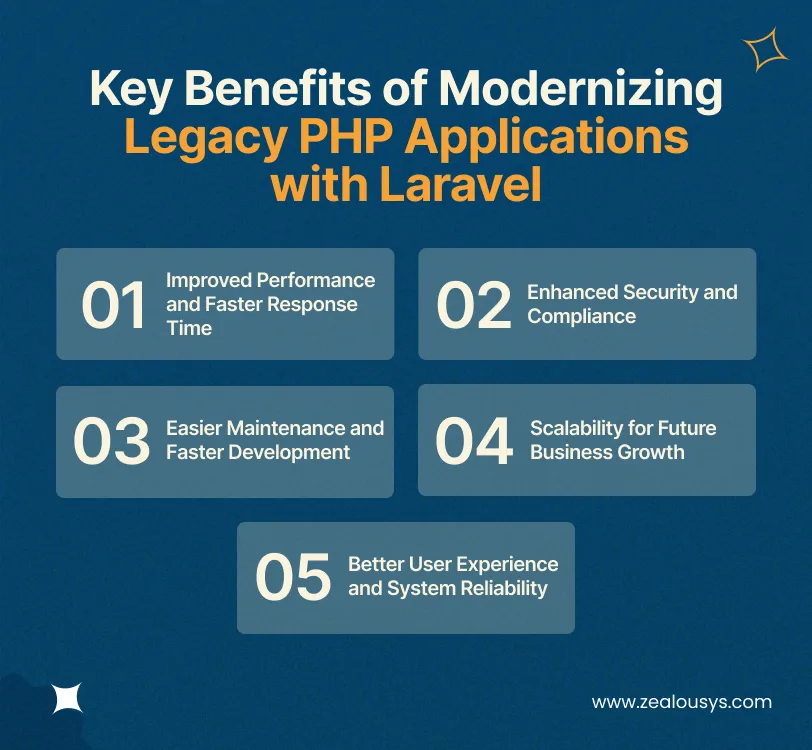
When you modernize legacy PHP applications using Laravel, you significantly improve system performance and response time. Laravel optimizes code execution, supports caching and queues, and reduces load on servers, helping businesses run faster and more efficiently.
Laravel strengthens application security by offering built-in protection against common vulnerabilities. When you migrate PHP applications to Laravel, you reduce security risks, protect sensitive data, and meet modern compliance requirements with confidence.
Legacy PHP systems often slow down development due to messy code and outdated structures. Laravel legacy application modernization simplifies maintenance, improves code readability, and enables teams to build, test, and deploy features faster.
Laravel supports modular and scalable architectures that grow with your business. By choosing a Laravel migration strategy, enterprises and SMEs can handle increasing users, transactions, and integrations without rebuilding the application.
Modernizing PHP applications with Laravel improves system stability and user experience. Faster load times, smoother workflows, and fewer system failures help businesses deliver reliable digital experiences that users trust.
Modernizing legacy PHP applications is not just a technical upgrade; it is a strategic decision that affects business continuity, data, and long-term scalability. CTOs, IT managers, and product owners often face several challenges when planning to modernize legacy PHP systems using Laravel.
Legacy PHP applications often support critical business operations. During modernization, teams must ensure uninterrupted service while migrating the system to Laravel. Poor planning can cause downtime, disrupt users, and impact revenue, especially for enterprises running high-traffic applications.
Data migration remains one of the biggest challenges in legacy PHP modernization. Older databases often contain inconsistent structures, duplicated records, or outdated schemas. Teams must carefully migrate data when they modernize legacy PHP applications using Laravel to maintain accuracy, security, and compliance.
Many businesses want to upgrade legacy PHP applications quickly without increasing costs. Tight deadlines and limited budgets create pressure on development teams. A well-defined Laravel migration strategy helps control scope, reduce risk, and deliver measurable results on time.
Legacy PHP systems rely heavily on old libraries and unsupported frameworks. These dependencies limit performance, increase security risks, and slow down development. Migrating PHP applications to Laravel allows teams to replace outdated components with modern, secure, and well-supported alternatives.
Teams often hesitate to move away from familiar legacy systems. Stakeholders may worry about training costs, workflow changes, or long-term stability. Clear communication and a phased Laravel legacy application modernization approach help teams adopt modern architecture with confidence.
Modernizing legacy PHP applications requires a structured approach that reduces risk while improving performance, security, and scalability. Laravel provides the right foundation to upgrade outdated systems without disrupting business operations.
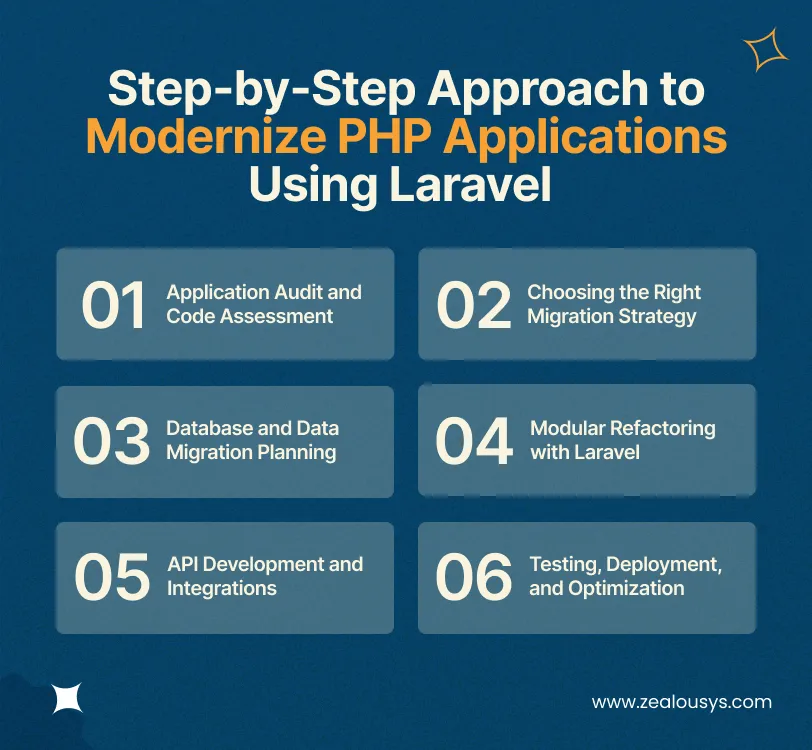
We start by auditing the existing PHP application to identify technical debt, security gaps, and performance bottlenecks. This assessment helps businesses understand which parts of the system require refactoring, replacement, or optimization.
A detailed audit allows teams to plan legacy PHP modernization using Laravel with clarity and confidence.
Every legacy system requires a tailored approach. We help businesses choose between a full rewrite or an incremental PHP to Laravel migration based on system complexity, timelines, and budget.
This step ensures organizations modernize legacy PHP applications without risking system stability or business continuity.
We carefully plan database restructuring and data migration to maintain data accuracy and integrity. Laravel’s ORM and migration tools simplify schema upgrades and data transformations.
Proper planning ensures a smooth transition while upgrading legacy PHP applications to Laravel-based architectures.
We refactor legacy code into modular, maintainable components using Laravel’s MVC architecture. This approach improves code readability, reduces maintenance effort, and supports future scalability.
Modular refactoring plays a key role in Laravel legacy application modernization and long-term system stability.
We build secure and scalable APIs to connect third-party services, payment gateways, and enterprise systems. Laravel simplifies API development and supports seamless integrations.
This step enables businesses to extend functionality while modernizing PHP applications for modern digital ecosystems.
We perform automated and manual testing to ensure system reliability, security, and performance. We then deploy the application using optimized workflows and modern DevOps trends.
Continuous optimization helps businesses achieve faster load times, better user experience, and a future-ready Laravel application.
Modernizing legacy PHP applications requires a structured and reliable approach. When businesses modernize legacy PHP applications using Laravel, they reduce technical debt while improving performance, security, and long-term scalability.
Teams modernizing legacy PHP systems should apply domain-driven design to organize business logic clearly. Laravel helps development teams separate core business rules from infrastructure code, which simplifies maintenance and accelerates future improvements during PHP application modernization.
Laravel allows teams to improve performance by using queues, caching, and background jobs. These features help businesses migrate PHP applications to Laravel without slowing down user-facing processes. Background jobs handle heavy tasks efficiently while caching reduces database load.
Security plays a critical role in legacy PHP modernization using Laravel. Laravel provides built-in tools for role-based access control, which helps enterprises protect sensitive data and meet compliance requirements. This approach ensures only authorized users access critical system features.
Successful PHP to Laravel migration strategies protect existing users and workflows. Development teams ensure backward compatibility by modernizing modules incrementally and maintaining existing APIs. This approach reduces business disruption while upgrading legacy PHP applications.
Laravel supports automated testing and CI/CD pipelines that improve code quality and deployment reliability. Teams using automated testing identify issues early, reduce risks, and deliver stable releases. This practice helps businesses modernize legacy PHP applications with confidence and long-term stability.
Businesses across industries modernize legacy PHP applications using Laravel to improve performance, security, and scalability without rebuilding systems from scratch. The following real-world use cases show how Laravel modernization delivers measurable business value.
Organizations modernize legacy PHP dashboards with Laravel to gain real-time visibility and better system performance. Laravel allows structured data handling, secure access control, and seamless API integrations. Teams use Laravel to upgrade outdated dashboards into scalable platforms that support analytics, reporting, and decision-making.
Companies upgrade legacy PHP ERP and internal systems using Laravel to reduce technical debt and simplify maintenance. Laravel improves system reliability by introducing modular architecture and role-based access control. Businesses rely on Laravel for legacy systems to improve workflows, improve data accuracy, and support future growth.
Startups and enterprises migrate PHP applications to Laravel to modernize SaaS platforms and scale faster. Laravel supports multi-tenant architecture, secure APIs, and performance optimization. Product teams use Laravel legacy application modernization to improve user experience and reduce time-to-market.
FinTech companies modernize legacy PHP applications using Laravel to meet security, compliance, and performance requirements. Laravel provides built-in security features and supports complex data processing. Businesses adopt Laravel migration strategies to build reliable, scalable, and data-driven financial applications.
Zealous assists businesses in modernizing legacy PHP applications by leveraging strong Laravel expertise and a structured migration approach. As an experienced Laravel development company, we analyze existing PHP systems, identify performance and security gaps, and refactor outdated code into clean, scalable Laravel architectures. This approach allows businesses to modernize without rebuilding applications from scratch.
Our team follows a proven PHP to Laravel migration strategy that reduces risk and ensures business continuity. Zealous focuses on security-first development by implementing modern authentication, role-based access control, and secure data handling practices. We modernize legacy PHP applications using Laravel to improve performance, maintainability, and long-term scalability.
Zealous also enables businesses to scale development efficiently by offering the option to hire remote Laravel developers for modernization projects. Our dedicated Laravel teams work closely with CTOs, founders, and IT managers to deliver enterprise-grade solutions aligned with business goals, timelines, and budgets.
Modernizing legacy PHP applications using Laravel helps businesses eliminate performance issues, security risks, and growing technical debt. By migrating PHP applications to Laravel, organizations gain a scalable architecture, improved security, and easier maintenance without rebuilding systems from scratch.
Laravel legacy application modernization delivers long-term value by improving performance, supporting future growth, and reducing development costs. With the right Laravel migration strategy and experienced Laravel developers, businesses can transform outdated PHP systems into secure, future-ready applications built to scale.
Our team is always eager to know what you are looking for. Drop them a Hi!

Raj Kewlani is a Project Manager and Mobile & Open Source Development Lead at Zealous System, specializing in agile-driven digital solutions. He focuses on delivering high-quality mobile apps and open-source projects that align with business goals.




Comments