
Healthcare organizations now demand seamless data exchange across EHRs, patient apps, labs, and insurance systems. Healthcare startup founders, HealthTech product managers, and CTOs must build products that support secure and scalable interoperability from day one. FHIR API Integration enables healthcare companies to connect systems using modern, standardized APIs instead of relying on outdated messaging frameworks. If you plan healthcare API integration for EHR platforms or digital health solutions, you need a clear and practical roadmap.
Many teams still struggle with how to integrate FHIR API into existing architectures. Technical leads compare FHIR vs HL7 integration and often choose HL7 FHIR API development to improve flexibility and speed. Hospital IT administrators and digital health consultants focus on healthcare interoperability solutions that reduce manual work and eliminate data silos. Compliance officers also demand HIPAA-compliant FHIR integration and NHS FHIR integration UK readiness to meet strict data protection regulations.
This FHIR implementation guide explains FHIR integration in healthcare software in a simple, step-by-step way. Healthcare SaaS founders building EHR or EMR systems can use this guide to plan an FHIR API for EHR integration with confidence. Investors evaluating healthcare software scalability can also understand how strong interoperability architecture supports long-term growth. You will learn healthcare API integration best practices that help you build secure, compliant, and future-ready healthcare platforms.
Healthcare systems generate massive amounts of clinical data every day. Healthcare startup founders and HealthTech product managers need secure and scalable ways to exchange that data. FHIR API Integration solves this challenge by enabling structured and standardized communication between healthcare systems.
FHIR stands for Fast Healthcare Interoperability Resources. HL7 developed FHIR to simplify healthcare data exchange through modern web technologies. FHIR uses RESTful APIs, JSON, and XML formats, which makes integration easier for CTOs and technical teams.
FHIR API for EHR integration allows healthcare SaaS founders to connect applications with EHR and EMR systems in a consistent way. NHS FHIR integration UK initiatives also promote standardized frameworks to improve healthcare interoperability solutions across public and private systems.
When you integrate FHIR APIs, you enable healthcare platforms to securely share patient records, lab results, prescriptions, and clinical notes in real time.
Many hospital IT administrators still rely on older HL7 v2 or v3 standards. Traditional HL7 integration often requires complex messaging formats and custom interfaces. Teams spend more time handling data mapping and compatibility issues.
FHIR vs HL7 integration shows a clear difference in approach. HL7 uses message-based communication, while FHIR uses resource-based REST APIs. FHIR implementation guide documentation provides structured resources such as Patient, Observation, Encounter, and Medication. Developers can quickly use these predefined resources in HL7 FHIR API development projects.
FHIR reduces integration complexity and improves scalability. Investors evaluating healthcare software scalability often prefer FHIR integration in healthcare software because it supports modern cloud-based architecture.
FHIR API Integration standardizes how healthcare systems exchange data. Developers use defined resources and data models to ensure consistency. Compliance officers can better monitor HIPAA-compliant FHIR integration because structured data improves auditability and traceability.
FHIR uses modern web standards, which speed up development. Teams can follow a clear FHIR implementation guide instead of building custom connectors from scratch. HealthTech product managers can launch interoperability features faster and reduce time to market.
FHIR supports RESTful healthcare API integration best practices. Developers can design scalable microservices and cloud-based systems around FHIR endpoints. Healthcare SaaS founders can build modular platforms that integrate with multiple EHR systems without heavy customization.
FHIR improves secure access to patient information across systems. Hospitals can retrieve lab results, imaging data, and clinical history through standardized APIs. NHS FHIR integration UK frameworks encourage secure patient data exchange while maintaining GDPR compliance.
FHIR integration in healthcare software enables real-time data sharing between providers, insurers, and digital health apps. This approach improves care coordination and enhances patient outcomes.
Healthcare organizations adopt FHIR API Integration to build secure, scalable, and interoperable systems. Founders, product managers, CTOs, and compliance leaders use FHIR standards to simplify data exchange and meet HIPAA and GDPR requirements. Below are the most common and high-impact use cases.
Healthcare SaaS founders use FHIR API for EHR integration to connect applications with leading EHR and EMR systems. FHIR integration in healthcare software allows structured data exchange, such as patient records, lab results, medications, and clinical notes.
Teams use HL7 FHIR API development to replace outdated HL7 v2 interfaces with modern REST-based APIs. Developers standardize resources like Patient, Observation, and Encounter to ensure consistent data flow. Organizations achieve true healthcare interoperability solutions by enabling real-time access to clinical data across systems.
This approach reduces manual data entry, improves care coordination, and supports scalable healthcare platforms.
Telehealth providers use how to integrate FHIR API frameworks to integrate virtual care platforms with hospital management systems. FHIR integration in healthcare software enables doctors to access patient history, prescriptions, and lab reports during online consultations.
Product managers implement HIPAA-compliant FHIR integration to protect sensitive health information. Teams secure APIs using OAuth 2.0 and SMART on FHIR protocols. Healthcare companies improve patient outcomes by enabling seamless data exchange between telemedicine apps and EHR systems.
This integration strengthens remote care delivery and supports long-term digital health growth.
Healthcare IT decision-makers deploy FHIR API Integration to build secure and interactive patient portals. Portals use standardized FHIR resources to display appointments, test results, care plans, and billing details.
Developers follow a structured FHIR implementation guide to ensure accurate data mapping and secure access control. Compliance officers enforce GDPR and HIPAA policies during integration. Organizations empower patients by providing real-time access to their medical records.
This strategy improves transparency and increases patient engagement.
Startups and digital health consultants use FHIR integration in healthcare software to power mobile health applications. Mobile apps connect to backend systems using RESTful FHIR APIs.
Teams implement healthcare API integration best practices to maintain performance and data security. Developers design a scalable architecture that supports wearable device data, remote patient monitoring, and AI-driven insights. Investors evaluate scalability by reviewing how well the app integrates with EHR systems using standardized APIs.
This approach ensures flexibility, faster innovation, and seamless interoperability.
Insurance providers use FHIR API for EHR integration to automate claims processing and eligibility verification. FHIR APIs enable the structured exchange of coverage, claims, and payment data.
Organizations compare FHIR vs HL7 integration approaches and choose FHIR for its simplicity and API-driven design. Teams reduce administrative workload by automating billing workflows. Compliance leaders ensure secure data handling with HIPAA-compliant FHIR integration frameworks.
This integration accelerates reimbursement cycles and improves financial efficiency.
Healthcare providers in the UK adopt NHS FHIR integration UK standards to align with NHS Digital requirements. IT leaders implement FHIR API Integration to connect systems with NHS Spine services and national healthcare platforms.
Developers follow official interoperability frameworks to support secure patient data exchange. Teams ensure GDPR compliance and NHS data governance standards. Healthcare organizations modernize legacy infrastructure by using standardized healthcare interoperability solutions.
This strategy strengthens nationwide digital health initiatives and supports scalable, compliant healthcare software development.
Also Read: How to Integrate AI with Existing EHR & EMR Systems: A Complete Guide
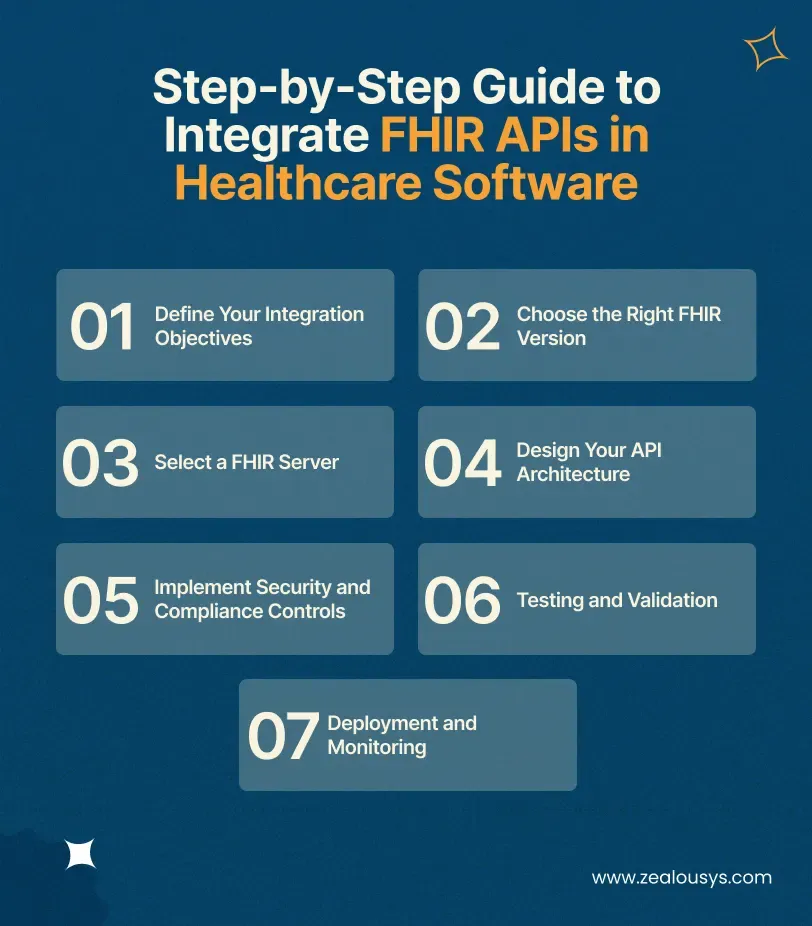
Healthcare leaders demand secure and scalable systems that exchange data without friction. You must follow a structured approach to ensure successful FHIR API Integration in your healthcare software. This FHIR implementation guide explains how to integrate the FHIR API step by step while meeting compliance and interoperability goals.
You must clearly define why you need FHIR integration in healthcare software. You should identify what type of data you want to exchange, such as patient records, lab results, prescriptions, or billing data. You must document your data exchange requirements before you start HL7 FHIR API development.
You should also define your compliance scope at this stage. US-based healthcare SaaS founders must align with HIPAA requirements. UK healthcare providers must follow NHS DSPT and GDPR standards. Compliance officers should review privacy risks early to ensure HIPAA-compliant FHIR integration. Clear objectives reduce delays and control development costs.
You must select the correct FHIR version before development begins. You can choose from DSTU2, STU3, or R4. Most healthcare interoperability solutions adopt FHIR R4 because it offers better stability and broader industry support.
You should evaluate your existing systems before finalizing the version. Many NHS FHIR integration UK projects prefer R4 due to strong community adoption and vendor compatibility. You must confirm version compatibility with EHR vendors to avoid future integration issues.
You need a reliable FHIR server to manage and store healthcare data. You can choose between open-source and cloud-based FHIR servers.
Open-source servers provide flexibility and customization options. Cloud-based servers offer faster deployment and managed scalability. Healthcare startup founders often choose cloud solutions to reduce infrastructure complexity.
You must evaluate scalability, performance, and security before selecting a server. Hospital IT administrators should ensure the server supports secure APIs, high availability, and strong access controls. A scalable server supports long-term healthcare API integration best practices.
You must design a clear and secure API architecture to support the FHIR API for EHR integration. You should build your APIs using RESTful principles because FHIR uses REST standards by design.
You must implement strong authentication using OAuth 2.0 and SMART on FHIR protocols. These standards help you control secure access to patient data. You should also define a structured data mapping strategy to convert legacy HL7 messages into FHIR resources.
CTOs and technical leads must ensure that the architecture supports modular services and future expansion. A well-designed architecture improves performance and simplifies FHIR vs HL7 integration challenges.
You must prioritize security from the beginning of your FHIR integration in healthcare software. You should encrypt data in transit using TLS protocols. You must also encrypt sensitive healthcare data at rest.
You should implement role-based access control to restrict unauthorized access. Compliance officers must define user roles clearly to protect patient privacy. You should enable audit logging to track system activity and detect suspicious behavior.
These controls ensure HIPAA-compliant FHIR integration in the US and GDPR-aligned systems in the UK and EU. Strong security builds trust among investors evaluating healthcare software scalability.
You must test your FHIR API Integration before production deployment. You should perform conformance testing to ensure your system follows official FHIR standards. You must verify that each resource and endpoint behaves correctly.
You should conduct interoperability testing with external EHR systems and third-party healthcare platforms. HealthTech product managers must validate real-world data exchange scenarios.
You should use sandbox environments to simulate live integrations safely. Proper testing reduces integration risks and ensures smooth healthcare interoperability solutions.
You must plan your deployment strategy carefully. You should select secure cloud hosting environments that meet healthcare compliance requirements. Many organizations prefer HIPAA-ready or NHS-approved cloud infrastructure.
You must optimize performance to handle large patient datasets and concurrent API requests. Technical teams should monitor API response time and server load continuously.
You should implement continuous monitoring tools to detect security threats and performance bottlenecks. Ongoing monitoring ensures stable healthcare API integration and long-term system reliability.
Also Read: How to Build a HIPAA-Compliant EMR App for Your Healthcare Practice
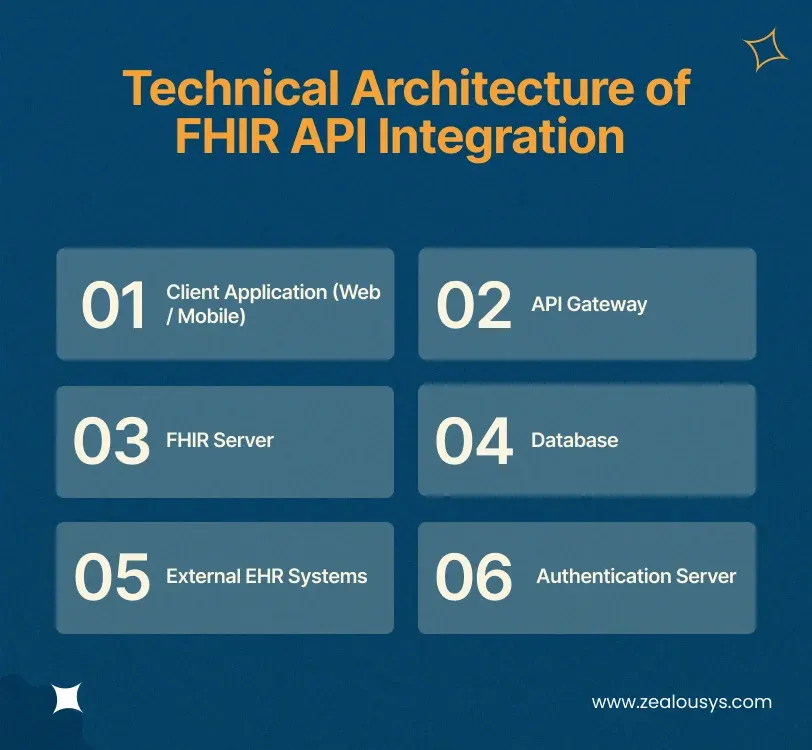
A strong technical foundation ensures successful FHIR API Integration in modern healthcare software. When you plan how to integrate FHIR API correctly, you create secure, scalable, and compliant healthcare interoperability solutions. Below is a simple breakdown of the core architectural components used in FHIR integration in healthcare software.
The client application acts as the front-end interface for doctors, patients, administrators, and healthcare staff. You can build this as a web platform, mobile app, or both.
The application sends and receives patient data using standardized FHIR resources. It communicates with the backend using RESTful APIs. In the FHIR API for EHR integration, the client securely requests patient records, appointments, prescriptions, and lab reports.
The API Gateway manages all incoming and outgoing API requests. It acts as a secure entry point between the client application and backend systems.
The gateway routes requests to the correct FHIR server. It controls traffic, enforces rate limits, and applies security policies. In HL7 FHIR API development, the API Gateway simplifies request management and improves performance.
Healthcare IT decision-makers often use this layer to maintain control over integrations with external systems. The gateway also helps maintain compliance with HIPAA-compliant FHIR integration requirements and GDPR standards.
The FHIR Server forms the core of the entire architecture. It stores and processes healthcare data using standardized FHIR resources such as Patient, Observation, Encounter, and Medication.
The server follows global FHIR standards and enables structured data exchange. In FHIR vs HL7 integration, FHIR uses modern RESTful APIs, which makes integration faster and more flexible than traditional HL7 messaging.
Healthcare SaaS platforms and NHS FHIR integration UK projects commonly use FHIR R4 for better stability and scalability. The server validates incoming data and ensures it follows the FHIR specification. This layer plays a key role in building reliable healthcare interoperability solutions.
The database stores structured healthcare records securely. The FHIR Server connects directly to the database to read and write data.
Developers can use relational databases or NoSQL databases depending on scalability needs. The system encrypts data at rest to meet compliance requirements. Compliance officers and hospital IT administrators must ensure the database follows GDPR and HIPAA standards.
A properly structured database supports long-term scalability, which investors and enterprise healthcare companies often evaluate when reviewing healthcare software architecture.
External EHR systems connect to the FHIR server through secure APIs. These systems may include hospital EHR platforms, laboratory systems, insurance platforms, and third-party health applications.
In the FHIR API for EHR integration, the system maps legacy data formats to standardized FHIR resources. This process ensures smooth data exchange between different healthcare providers.
For NHS FHIR integration UK projects, interoperability remains critical. The architecture must allow secure data sharing between private healthcare providers and public health systems. Strong mapping and validation logic reduce integration errors and improve data consistency.
The authentication server protects patient data and controls system access. It manages user identities, tokens, and access permissions.
Most modern healthcare platforms use OAuth 2.0 and SMART on FHIR standards. The system verifies users before granting access to sensitive healthcare data. This process supports HIPAA-compliant FHIR integration and meets strict GDPR guidelines.
CTOs and technical leads must prioritize secure authentication from the beginning. Proper identity and access management reduces security risks and builds trust with healthcare organizations.
Understanding the cost of FHIR API Integration helps healthcare startup founders, product managers, and technical leaders plan realistically. The investment depends on system complexity, compliance scope, and scalability goals. When you plan FHIR integration in healthcare software, you must evaluate integration depth, security controls, and long-term interoperability needs.
Below is a practical cost breakdown based on project scale.
For a straightforward integration that connects to a single EHR system, most organizations can expect to invest somewhere between $15,000 and $30,000. This type of FHIR integration is often a good fit for early-stage healthcare SaaS founders who are building EHR- or EMR-enabled platforms and need reliable interoperability without overcomplicating things.
Typically, the focus is on integrating core data like patient records, appointments, and clinical observations using standard HL7 FHIR API practices. The team works from a clear FHIR implementation guide and sets up secure REST APIs with proper authentication to ensure data is exchanged safely.
It’s a practical, controlled way to enable interoperability while keeping both development timelines and infrastructure costs under control.
A mid-scale integration that connects systems like EHR, billing, laboratory, and telehealth platforms typically costs between $30,000 and $60,000. At this stage, the focus shifts from simple connections to building a more complete interoperability framework across the organization.
Teams usually expand FHIR API integration beyond basic EHR connectivity to ensure different healthcare systems can exchange data smoothly and reliably. This involves more advanced data mapping, API orchestration, and thorough conformance testing to make sure everything communicates as it should.
For organizations operating in the UK, it’s also important to align with NHS FHIR standards and meet GDPR requirements. Stronger security measures are often added as well, particularly to support HIPAA-compliant FHIR integration for multi-clinic setups or cross-border operations where data protection becomes even more critical.
Enterprise-grade interoperability typically requires an investment starting from $60,000 and can exceed $150,000 depending on system complexity. Large hospitals, national health networks, and global healthcare SaaS platforms usually choose this level. Organizations often modernize legacy systems during FHIR vs HL7 integration transitions to allow scalable, API-driven architecture.
Teams design custom FHIR resource extensions, high-availability infrastructure, audit logging systems, and advanced role-based access controls. Investors evaluating healthcare software scalability often view enterprise-grade FHIR integration as a strategic infrastructure investment rather than a simple development cost.
The table below shows a practical cost comparison for FHIR API integration in healthcare software based on project scale.
| Integration Level | Cost Range | Best Fit For |
|---|---|---|
| Basic Integration (Single EHR System) | $15,000 – $30,000 | Early-stage healthcare startups or SaaS products that need basic EHR or EMR connectivity |
| Mid-Scale Integration (Multi-System) | $30,000 – $60,000 | Growing healthcare platforms integrating EHR, billing, lab, or telehealth systems |
| Enterprise-Grade Interoperability | $60,000 – $150,000+ | Large hospitals, health networks, or enterprise healthcare SaaS platforms requiring full interoperability |
Several technical and compliance factors directly impact the final budget.
Standard FHIR resources reduce complexity. Custom extensions increase development time. When teams build specialized clinical workflows, they must create custom mappings. This process increases testing and validation effort.
Security requirements significantly affect cost. HIPAA-compliant FHIR integration requires encryption, access control policies, audit logging, and breach monitoring. GDPR compliance in the UK and EU markets adds additional data governance requirements.
Stronger security architecture increases development time but reduces long-term risk.
Cloud-based FHIR servers reduce infrastructure management overhead. On-premise deployments require additional setup and maintenance. Enterprise organizations often choose hybrid models for sensitive patient data.
Your hosting strategy directly impacts scalability and long-term operational costs.
Some EHR vendors charge API access fees. Licensing costs vary by provider and usage volume. Teams must include these recurring expenses in the total integration budget.
Integrating FHIR APIs into healthcare systems looks straightforward on paper, but real-world implementation brings technical and compliance challenges. Healthcare startup founders, CTOs, and HealthTech product managers must plan carefully to ensure successful FHIR API integration without disrupting clinical operations.
Below are the most common obstacles teams face during FHIR integration in healthcare software.
Many hospitals and clinics still use older EHR and EMR systems built on traditional HL7 standards. These systems often lack modern RESTful APIs, which makes the FHIR API for EHR integration more complex.
Technical teams must build middleware layers or custom connectors to bridge legacy databases with modern FHIR resources. This process increases development time and testing efforts. NHS and private healthcare IT decision-makers in the UK and EU often deal with hybrid environments where both HL7 and FHIR systems run together. Teams must carefully plan FHIR vs HL7 integration to avoid data loss or workflow disruption.
Healthcare interoperability solutions must support both legacy and modern systems during the transition phase.
FHIR provides structured resources, but existing healthcare data rarely follows clean standards. Different systems store patient records, lab reports, and billing data in different formats.
Developers must map internal data models to standardized FHIR resources during HL7 FHIR API development. This mapping process requires deep domain knowledge and careful validation. HealthTech product managers must allocate enough time for data normalization and transformation.
Without proper mapping, FHIR implementation may result in inconsistent or incomplete data exchange. Strong healthcare API integration best practices help reduce this risk.
Healthcare data contains highly sensitive patient information. Any FHIR API integration must protect this data from unauthorized access.
Technical leads must implement encryption in transit and at rest. Teams must use OAuth 2.0 and SMART on FHIR for secure authentication. Compliance officers must verify that the system supports HIPAA-compliant FHIR integration in the US and GDPR-aligned security controls in the UK and EU.
Poor API security can expose healthcare organizations to data breaches and legal penalties. Secure architecture must remain a priority from the first development sprint.
Healthcare software operates under strict regulations. NHS FHIR integration UK projects must align with NHS Digital standards and GDPR requirements. US-based platforms must follow HIPAA guidelines.
CTOs and compliance officers must document every data flow, access control policy, and audit log. Investors evaluating healthcare software scalability also assess regulatory readiness before funding.
Regulatory complexity increases when platforms operate across multiple countries. Teams must design flexible compliance frameworks during FHIR API integration to handle regional variations.
FHIR evolves regularly. Different EHR vendors and healthcare platforms may use different versions, such as DSTU2, STU3, or R4.
Developers must confirm version compatibility before starting FHIR integration in healthcare software. Version mismatch can break API calls and disrupt real-time data exchange. Healthcare SaaS founders building scalable EHR systems must standardize on widely adopted versions like R4 to reduce long-term risk.
Clear documentation and early testing reduce compatibility issues during implementation.
Successful FHIR API integration requires clear planning, technical discipline, and strong compliance alignment. Healthcare startup founders, HealthTech product managers, CTOs, and NHS IT decision-makers must focus on long-term interoperability, not just short-term connectivity.
Below are practical and proven best practices that help you implement FHIR APIs the right way.
Start your FHIR implementation with a focused MVP integration instead of connecting every system at once. Define a clear use case, such as FHIR API for EHR integration, patient record access, or lab result exchange.
When you start small, you reduce risk and control costs. You also validate how your FHIR integration in healthcare software performs in real clinical environments. Healthcare SaaS founders building EHR or EMR systems should test core FHIR resources first before expanding into full healthcare interoperability solutions.
An MVP approach helps investors evaluate scalability without committing to large upfront infrastructure costs.
Use standardized FHIR resources like Patient, Observation, Encounter, and MedicationRequest instead of building custom data structures. Standardization ensures smooth HL7 FHIR API development and improves compatibility across healthcare systems.
When you follow the official FHIR implementation guide, you reduce integration errors and simplify long-term maintenance. NHS and private healthcare IT decision-makers in the UK should align their systems with NHS FHIR integration UK profiles to ensure compliance and interoperability.
Standardized resources also make FHIR vs HL7 integration comparisons clearer and help legacy systems transition smoothly.
Security must remain a top priority in every healthcare API integration best practice. You must implement encryption for data in transit and at rest. You should also enforce strong authentication protocols such as OAuth 2.0 and SMART on FHIR.
Compliance officers must verify that your architecture supports HIPAA-compliant FHIR integration and GDPR requirements for the UK and EU markets. You should implement role-based access control and detailed audit logs to protect sensitive patient data.
When you design security early, you avoid costly redesigns and regulatory penalties later.
Design your system with scalability in mind. Healthcare data volumes grow quickly, especially in multi-clinic or cross-border environments.
You should deploy your FHIR server on a scalable cloud infrastructure and use a modular API architecture. This approach supports future expansion into advanced healthcare interoperability solutions without major rework.
CTOs and technical leaders must ensure that their FHIR API integration strategy supports performance optimization, monitoring, and version upgrades. A scalable foundation helps investors assess long-term product viability.
Select developers who understand both technology and healthcare regulations. Experienced teams know how to handle how to integrate FHIR API correctly while aligning with HIPAA, GDPR, and NHS standards.
Skilled API developers anticipate challenges in FHIR vs HL7 integration, legacy system mapping, and data normalization. They also follow proven healthcare API integration best practices to reduce deployment risks.
When you work with experts in FHIR integration in healthcare software, you accelerate development timelines and ensure compliance readiness from the start.
Zealous System is a trusted healthcare software development company that understands both technical and regulatory needs. We help startup founders, product managers, and CTOs implement FHIR API Integration with clarity and structure. Our team builds secure healthcare interoperability solutions that connect EHR, EMR, and third-party platforms smoothly. We follow healthcare API integration best practices to ensure reliable FHIR integration in healthcare software.
Our team manages complete HL7 FHIR API development, including FHIR API for EHR integration and legacy upgrades. We guide organizations on how to integrate FHIR API frameworks using scalable architecture and secure authentication. We support NHS FHIR integration UK projects and deliver HIPAA-compliant FHIR integration aligned with GDPR standards. We also simplify FHIR vs HL7 integration decisions based on your business goals.
Zealous System provides dependable software integration services for hospitals, consultants, and healthcare SaaS companies. We design scalable systems that support compliance, security, and long-term growth. Our experts turn your FHIR implementation guide into a secure and production-ready healthcare platform.
1. What is FHIR API integration in healthcare?
FHIR API Integration connects healthcare systems using the HL7 FHIR standard. It enables secure and structured data exchange between EHRs, EMRs, mobile apps, and other healthcare platforms.
2. How long does FHIR integration take?
A basic FHIR API for EHR integration takes 6 to 12 weeks. Multi-system or NHS FHIR integration UK projects may take 3 to 9 months, depending on complexity and compliance needs.
3. Is FHIR integration HIPAA compliant?
FHIR is a standard, not a certification. You must build HIPAA-compliant FHIR integration with encryption, secure access control, and audit logging. UK and EU projects must also meet GDPR requirements.
4. What is the difference between HL7 and FHIR?
HL7 uses older messaging formats for healthcare data exchange. FHIR uses modern RESTful APIs, which make healthcare API integration faster, simpler, and more scalable.
5. What is the cost of integrating FHIR APIs?
Basic FHIR API Integration starts around $15,000. Mid-scale healthcare interoperability solutions range from $30,000 to $60,000. Enterprise projects cost more based on complexity and compliance needs.
Our team is always eager to know what you are looking for. Drop them a Hi!

Pranjal Mehta is the Managing Director of Zealous System, a leading software solutions provider. Having 10+ years of experience and clientele across the globe, he is always curious to stay ahead in the market by inculcating latest technologies and trends in Zealous.




Comments