
Many healthcare startups do not fail because their ideas are weak. They fail because they spend months and large budgets building full-scale platforms before knowing what patients, clinicians, and real users actually need. In fact, 42% of healthcare startups fail within the first year due to premature scaling without market validation, per a 2024 CB Insights report on digital health failures.
Regulations tighten, compliance demands rise, development slows, and the product still lacks proof that it truly works in real clinical settings. A focused healthcare MVP development approach changes that by helping you build something practical, secure, and usable early, without wasting time on assumptions.
If you are working on a telemedicine solution, remote patient monitoring system, wellness platform, or any digital health product, an MVP is not simply a shortcut. It is a disciplined way to control cost, reduce risk, protect patient data, and validate your concept with real users while staying aligned with HIPAA and healthcare standards. It also strengthens your position with investors because you are not presenting ideas, you are presenting evidence.
In this blog, we will cover what a healthcare MVP really means, must-have features, a step-by-step development approach, the right tech stack, realistic cost ranges, and common mistakes to avoid. The goal is to help you build something secure, usable, and ready for genuine market feedback.
A healthcare MVP is the most basic version of your product that still provides real value to users while addressing the strict requirements of the industry. It centers on one primary problem, such as enabling virtual doctor visits or allowing patients to monitor key health metrics from home, and delivers a working solution without unnecessary additions. This focused approach sets healthcare MVP development apart from standard apps, where compliance and security cannot be afterthoughts.
At its core, the minimum viable product for healthcare includes only the critical elements needed to test your idea in real conditions. Patient data protection starts from day one, typically with HIPAA-compliant features like encrypted storage and secure authentication. The result is a product you can release quickly, show to early users, and use to confirm whether your concept solves an actual need.
Founders often use a healthcare MVP to bridge the gap between idea and market reality. It gives you tangible proof of demand, helps refine the user experience based on direct input, and lays a solid base for future growth in digital health MVP development.
Healthcare products carry higher stakes than most software ventures. Patient outcomes, data privacy, and regulatory approval all come into play, making it costly and risky to build a complete platform before knowing if users truly need it.
Jumping into full development without validation can drain budgets and leave you with a platform few people actually want. An MVP for healthcare startups offers a smarter path: test the essential idea first, learn quickly, and adjust before major commitments.
Here are the key reasons founders choose this route in healthcare MVP development:
You invest only in core functionality. If the concept needs pivoting, you discover it early, avoiding sunk costs on features users ignore.
Real patients and providers start using your product within months. Their input shows exactly what improves engagement and outcomes, guiding your next steps.
A working healthcare MVP with early traction demonstrates market demand far better than pitch decks alone. It turns conversations from “what if” to “here’s proof.”
Addressing HIPAA and security from the start prevents expensive rewrites later. Your MVP becomes a compliant base ready to scale.
In digital health MVP development, this focused approach has helped many teams move from idea to funded growth without unnecessary detours.
Every strong healthcare MVP starts with a tight set of features that deliver immediate value and earn user trust right away. Skipping these fundamentals often leads to usability, trust, and compliance problems later. Patients and providers expect security and usability from the first interaction. These elements form the heart of effective healthcare MVP development and set you up for real feedback in digital health MVP development.
Here’s what belongs in nearly every healthcare MVP:
Patients and doctors need confidence that their accounts stay protected. Multi-factor authentication combined with role-based access (separating patient, provider, and admin views) stops unauthorized entry and guards sensitive health data from the start.
Users want quick access to the essentials. Profiles hold key details like demographics, allergy lists, current medications, medical history highlights, and provider credentials—all organized clearly so interactions feel personal and informed.
This is the feature that makes your product unique. A telemedicine MVP lives on appointment booking and secure video calls. Remote patient monitoring shines with real-time vital signs dashboards. Wellness apps thrive on personalized goal tracking and daily logs. Focus here delivers the main benefit users came for.
Quick, private conversations matter in healthcare. An encrypted in-app messaging system lets patients ask follow-up questions or share updates while keeping every exchange fully logged and compliant.
Privacy isn’t optional, but the foundation. End-to-end encryption, secure cloud storage, detailed access logs, and clear patient consent tools protect health information and keep you on the right side of regulations.
Life gets busy, and health routines slip easily. Timely push notifications or emails remind users about appointments, medications, or urgent alerts, helping them stay on track without cluttering the experience.
You need visibility into how people actually use your product. A clean internal dashboard tracks active users, session patterns, popular features, and where users drop off—giving you hard data to guide the next improvements.
These healthcare MVP features create a product that feels reliable and focused from day one. Get them right, and early users will stick around long enough to tell you exactly what comes next.
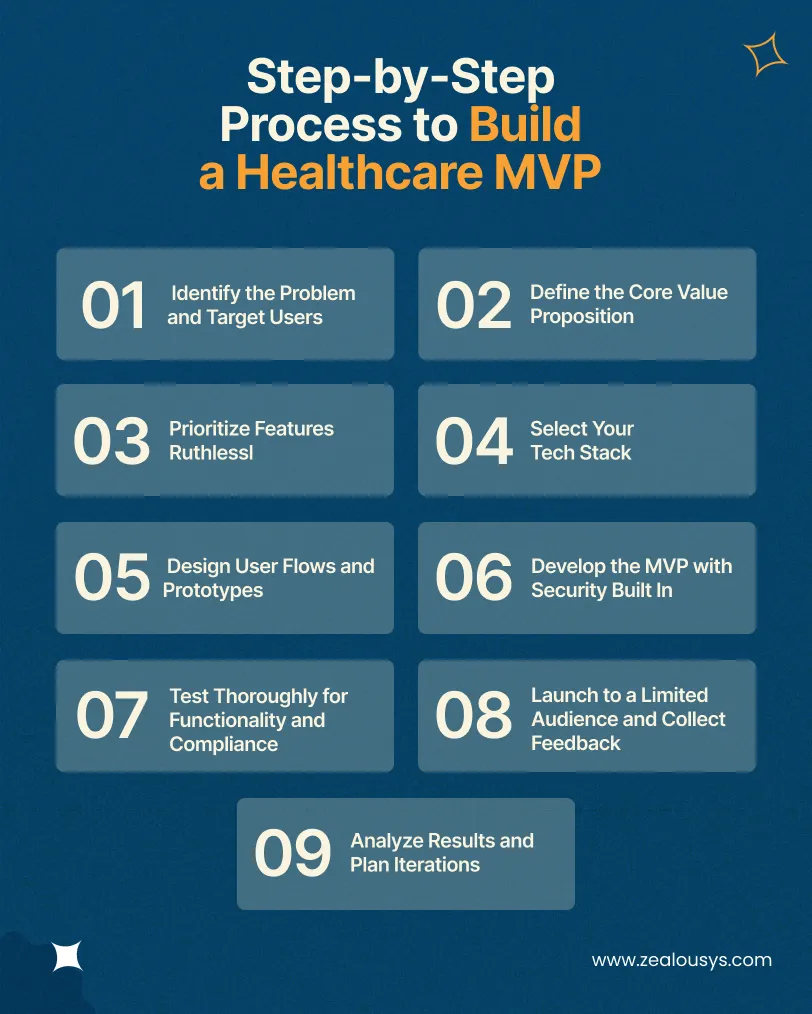
Healthcare MVP development demands a clear, disciplined path to balance speed, compliance, and user needs. Each phase builds on the last, helping you avoid common pitfalls while creating something patients and providers can actually use. Here’s the practical sequence most successful teams follow.
The first step is pinning down the exact issue your product solves. Conduct interviews or surveys with patients, doctors, nurses, or clinic staff to understand their daily frustrations. Build clear user personas and confirm the problem affects enough people to support a viable business.
Next comes sharpening your idea into one clear outcome. Decide what success looks like for your users, perhaps finishing a virtual consultation quickly or spotting health changes early. Write a single statement that guides every choice you make moving forward.
In this phase, you list all possible features and then cut most of them. Separate must-haves from nice-to-haves using a simple ranking system. Keep only four to seven essentials that directly support your core value proposition.
Now you choose the tools that will bring your MVP to life. Go for frameworks that enable fast builds and easy scaling, such as React Native for apps or Node.js for the backend. Focus on options with built-in security and ready HIPAA-compliant hosting.
This step focuses on mapping the user journey from start to finish. Sketch key screens, create wireframes, and build a clickable prototype. Share it with potential users early to spot confusing parts and fix them before writing code.
Here, the actual building begins. Form a small team, code in short sprints, and bake in authentication and encryption from day one. Integrate any necessary third-party services early so surprises surface quickly.
Before launch, you put everything through rigorous checks. Run technical tests, usability sessions with real healthcare professionals, and security audits. Verify every compliance requirement meets HIPAA standards to protect patient data.
The launch starts small. Invite a controlled group of beta users or partner with a few clinics. Add simple feedback tools inside the app and track usage patterns closely. Watch for both technical issues and user reactions.
Finally, review the data after several weeks of real use. Study retention, feature adoption, and direct comments to see what works best. Use these insights to decide your next improvements and prepare for wider release.
Following this flow keeps your digital health MVP development on track and delivers a product ready for genuine validation.
The cost of healthcare MVP development depends on several technical and business factors. Most healthcare startups and providers build an MVP to validate ideas while controlling budget and risk. On average, a healthcare MVP can cost $10,000 to $150,000, depending on features, compliance needs, and technology choices.
This level suits basic healthcare applications such as patient portals, appointment scheduling apps, or wellness tracking solutions. Core features include secure user authentication, patient profiles, messaging, and notifications. Developers use standard frameworks and minimal integrations to keep development efficient. The simple healthcare MVP development cost ranges from $10,000 to $20,000, with a development timeline of 3 to 4 months.
This category fits telemedicine platforms and basic remote patient monitoring apps. These solutions include video consultations, calendar synchronization, limited EHR integration, real-time dashboards, and enhanced data security. The added features increase testing and compliance efforts. The mid-level healthcare MVP cost falls between $25,000 and $50,000, with a timeline of 4 to 6 months.
This level supports advanced healthcare systems such as AI-powered clinical alerts, deep EHR-integrated platforms, and multi-device remote monitoring solutions. These projects require custom integrations, advanced security frameworks, and detailed compliance audits. The complex healthcare MVP development cost typically ranges from $50,000 to $150,000 or more, with a development timeline of 6 to 9 months.
Several factors influence the healthcare MVP development cost and timeline. Understanding these factors helps startups and healthcare providers plan budgets and build a healthcare MVP efficiently.
Basic features such as user registration, dashboards, and appointment booking keep the healthcare MVP cost low. Advanced features like AI analytics, remote patient monitoring, and EHR integration increase development effort and overall cost.
Healthcare MVP development must meet standards like HIPAA and GDPR. Security measures such as data encryption and access control increase cost but protect patient data and ensure compliance.
A simple technology stack reduces the cost to build a healthcare MVP and shortens development time. Cloud platforms, AI components, and third-party healthcare APIs raise costs but improve scalability and performance.
An experienced healthcare app development team delivers faster results and reduces rework. Offshore or hybrid development teams often lower healthcare MVP development costs while maintaining quality.
A clean and intuitive UI reduces design time and cost. Custom UX for patients, doctors, and administrators increases development effort and budget.
Many healthcare MVP projects stumble for the same preventable reasons. Founders often bring assumptions from other industries, only to discover that healthcare demands stricter discipline around compliance, user needs, and scope. Recognizing these pitfalls early saves time, money, and credibility during healthcare MVP development.
Here are the most common mistakes teams make, and how to steer clear:
Some teams treat security as a final checkbox. In reality, retrofitting encryption, audit logs, or consent flows after development costs far more and delays launch. Build compliant architecture into your foundation.
Trying to include every idea leads to longer timelines and diluted focus. Users rarely need everything at once. Stick to the core problem and launch with 4–7 essential features in your digital health MVP development.
Building based on assumptions instead of interviews with doctors, nurses, or patients creates solutions nobody wants. Engage target users during discovery and prototyping to confirm the problem and proposed fix.
Connecting to EHR systems, wearables, or payment processors often takes longer than expected. Overlooking API limitations or security requirements causes major setbacks. Research and prototype integrations upfront.
Healthcare serves diverse groups like elderly patients, busy clinicians, and administrators. Complex interfaces drive abandonment. Prioritize simple, intuitive design and test with actual end users across age and tech comfort levels.
Picking trendy tools without considering HIPAA-eligible hosting or long-term maintenance creates headaches later. Select proven, secure options that support growth without forcing a rebuild.
Rushing to market with inadequate QA or security checks risks data exposure and loss of trust. Allocate proper time for functional, usability, and penetration testing, especially when patient data is involved.
Avoiding these errors keeps your healthcare MVP on track, compliant, and positioned for genuine market feedback. Learn from others’ missteps, and your launch becomes smoother and more impactful.
Healthcare MVP development requires a partner who truly understands the intersection of technology, compliance, and real-world clinical needs. At Zealous System, the focus stays on delivering secure, scalable solutions that help startups validate ideas quickly and move toward growth with confidence.
Here’s what makes the approach effective:
Founders benefit from a straightforward partnership that prioritizes practical results over hype. The goal remains simple: turn your digital health concept into a reliable, compliant MVP ready for real users.
A well-executed healthcare MVP can transform your idea into a validated product that attracts users, feedback, and funding. By focusing on essential features, following a disciplined process, and addressing compliance early, you position your startup for sustainable growth in a competitive field. The effort you put into planning and execution directly impacts how quickly you reach market and adapt to real needs.
Whether you’re building a telemedicine solution, remote monitoring tool, or patient engagement platform, the principles remain the same: start lean, prioritize security, and iterate based on actual usage. Partnering with an experienced MVP development company focused on custom healthcare software development services, web app development, and Mobile app development helps navigate the complexities without unnecessary risks or delays.
Start with a focused MVP, validate it in real clinical settings, strengthen security from day one, and scale with confidence.
Our team is always eager to know what you are looking for. Drop them a Hi!

I am currently working as a business analyst at Zealous System. I am experienced in working with stakeholders and managing project requirements, Documentation of requirements, and planning of product backlog.




Comments