Leading an enterprise in Australia means balancing distance, regulation, and constant operational demands. Teams operate across large distances. Compliance rules set clear boundaries in key sectors like finance, resources, and healthcare.
That is why generative AI use cases in Australia are drawing real interest from leaders like you. They take over the tasks behind document review, data checks, and early customer responses. They align closely with local business realities and regulatory demands.
This article lays out the leading generative AI applications Australian enterprises are adopting now. It examines examples from major industries, highlights the advantages that matter most, and outlines practical steps for responsible rollout.
Generative AI creates new content based on patterns it has learned from large amounts of data. It can produce text, summaries, code snippets, or even structured reports from a simple prompt. The system does not copy existing material. Instead, it builds fresh outputs that fit the context you provide.
Traditional tools analyse information or spot patterns. Generative AI takes the next step by assembling something original. For enterprise teams, this shift means less time spent on routine drafting and more focus on review and decision-making.
In Australian organisations, this matters because of the practical realities you face every day. Teams work across time zones and large distances. Generative AI supports faster document handling and clearer internal communications without adding layers of complexity. Recent CSIRO analysis for the Australian AI Industry Capability Report- Austrade confirms the momentum: over 50% of Australian organisations are already using AI, with nearly half of Australians having used generative AI, a rate that outpaces the US and UK.
It also aligns with the compliance demands common in finance, mining, and government sectors here. The technology can draft reports that follow set formats and highlight areas that need human oversight. This reduces manual checks while keeping control firmly with your teams.
This is exactly where generative AI begins to make sense for enterprise leaders. They focus on measurable improvements in daily workflows rather than broad promises.
Australian organisations face unique demands that shape how they approach new technology. Teams coordinate across vast distances. Compliance standards require careful oversight in every sector. Generative AI use cases in Australia address these realities directly by handling repetitive tasks and freeing people for higher-value work.
According to AWS’s 2025 Unlocking Australia’s AI Potential report, 50% of Australian businesses, 1.3 million in total, now regularly use AI, up 16% year-on-year, with one new business adopting every three minutes. Here are the most common applications taking hold across the country right now.
Enterprise teams spend considerable time pulling together reports, policies, and summaries. Generative AI drafts these materials from raw inputs such as meeting notes, data sets, or sensor logs. The output follows required formats and includes clear placeholders for review.
In finance, banks use this capability to prepare APRA-aligned risk and compliance documents. Mining operations generate safety incident reports and environmental summaries from field data. The process cuts manual effort while keeping full accountability with human experts.
This use case suits Australia’s regulatory environment particularly well. Teams maintain control through structured prompts and final approval steps. The result is faster turnaround without compromising accuracy or audit trails.
Customer teams handle queries that range from simple to highly specific. Generative AI powers chat interfaces and response suggestions that draw on approved knowledge bases. Agents receive context-aware drafts they can refine before sending.
Major banks have rolled out tools that assist frontline staff with policy-compliant replies. Retail groups create tailored product recommendations and follow-up messages. The technology respects privacy rules and stays within brand guidelines at every step.
For organisations serving customers across multiple states and territories, this brings consistency. Remote teams deliver the same standard of support as those in major cities. Human oversight ensures every interaction meets Australian consumer expectations.
Development cycles in large enterprises often stretch because of legacy systems and integration needs. Generative AI suggests code snippets, explains functions, and helps document changes. Developers review and adapt the output to fit internal standards.
Developers spend less time wiring APIs or drafting test scripts and more time solving architectural problems. Enterprise architects use it to map system updates more quickly. The focus remains on collaboration, with AI acting as an assistant rather than a replacement.
In Australia’s competitive sectors, this helps teams deliver projects on tighter timelines. It also supports knowledge sharing when experienced staff is spread thin across locations.
Onboarding new team members and keeping skills current takes significant resources. Generative AI creates training modules, procedure guides, and quick-reference documents from existing policies and examples. Content stays up to date as rules or processes change.
Organisations in healthcare and government use this to produce role-specific materials that reflect local regulations. Mining companies develop site-specific safety briefings that incorporate current conditions. The materials include simple language and clear examples suited to diverse workforces.
Teams gain flexibility to update resources without waiting for external writers. This keeps information accurate and accessible no matter where employees are based.
Large volumes of data arrive daily from operations, customers, and partners. Generative AI turns tables and logs into plain-language summaries and scenario outlines. Analysts receive focused narratives they can verify and expand.
Energy and resources firms use it to review exploration data and draft planning notes. Finance teams summarise transaction patterns for risk discussions. The technology highlights connections that might otherwise stay buried in spreadsheets.
Australian enterprises benefit from this because decisions often involve inputs from distant sites. Clear summaries help leaders align quickly across regions and maintain governance standards.
Despite industry differences, they share one common thread. They support existing workflows rather than replace them. Each requires clear governance, human review, and alignment with local compliance needs to deliver lasting value.
Australian enterprises adjust generative AI to the distinct conditions of each sector. Regulations differ. Operational distances vary. Workforce demands shift. These generative AI applications Australia enterprises adopt reflect those realities and keep human judgment at the centre of every process.
Banks and financial institutions handle high volumes of customer interactions and compliance obligations. Generative AI assists by drafting response templates that align with policy wording and regulatory formats. This trend is especially strong in FinTech, where 67% of Australian firms deploy AI and 45% already use generative AI, figures above global averages, for compliance and knowledge work.
Commonwealth Bank applies the technology to generate real-time safety alerts in customer messaging. The system flags unusual transaction patterns and suggests protective wording while staff retains final approval. Similar tools help draft internal reports that meet APRA expectations without repeated manual rewriting.
This approach supports consistency across branches in capital cities and regional centres alike. It reduces routine drafting time so teams can focus on complex customer situations that require experience and empathy.
Operations in the resources sector run across remote locations with limited on-site expertise. Generative AI processes geological data and produces initial interpretations for specialist review. Teams feed in drill logs, sensor readings, or image sets and receive structured summaries that highlight key observations.
At sites such as Carrapateena in South Australia, models examine hyperspectral core images and identify structural details that might otherwise need longer manual assessment. Geologists then verify and refine the findings before planning proceeds. The same capability helps draft safety and environmental reports that follow site-specific requirements.
Leaders in these organisations value the speed of insight across vast lease areas. It supports expert judgment, but never substitutes for the field experience required on-site.
Hospitals and clinics manage heavy administrative loads alongside direct patient care. Generative AI serves as a scribe that listens to consultations and creates draft clinical notes, care plans, and referral letters. Clinicians edit the content to ensure accuracy and completeness.
Implementations in Queensland Health and South Australian public hospitals show how this integration works with existing electronic records. Privacy controls remain strict, and outputs stay within approved systems. The result is less time spent on documentation and more time available for patients.
Enterprise architects in healthcare groups see this as a way to ease workload pressure while maintaining clinical standards. The approach scales across metropolitan and regional facilities where staffing levels fluctuate.
Agencies at the federal and state levels deal with large-scale information handling and citizen services. Generative AI platforms designed for government use help summarise lengthy documents, prepare briefing notes, and draft routine correspondence. All activity occurs inside secure environments that meet Australian data requirements.
The GovAI Chat service gives public servants a controlled way to generate content that follows style guides and classification rules. Human reviewers check every piece before it moves forward. This supports faster internal coordination without compromising accountability.
IT directors in these organisations note how the tools fit within existing governance frameworks. The focus stays on service reliability and transparency for citizens across every state and territory.
These examples highlight how generative AI use cases in Australia stay anchored in sector realities. They address compliance demands, geographic spread, and workforce pressures in ways that deliver practical gains. Decision-makers review each application against their own risk profile and operational priorities before scaling.
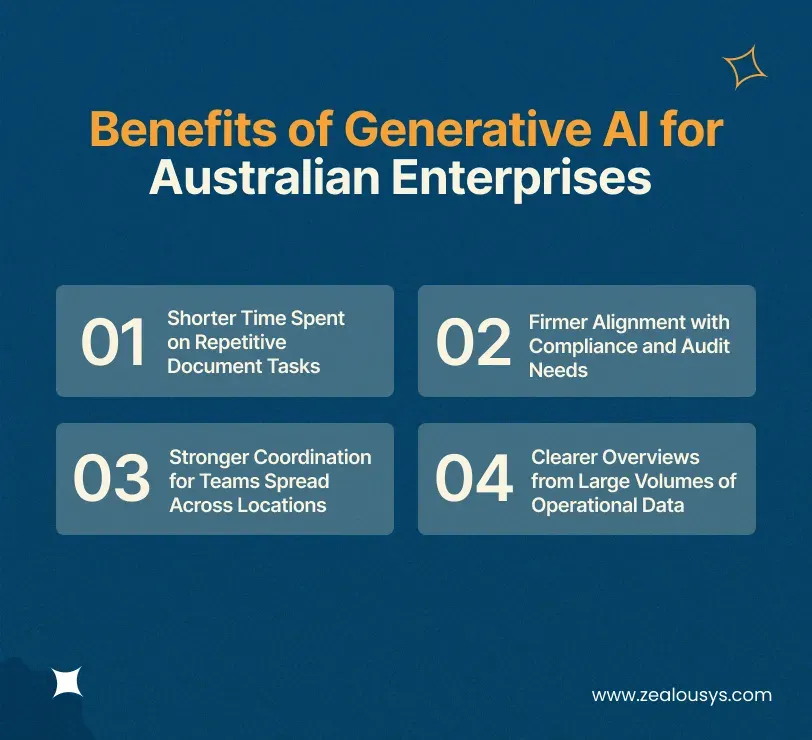
Australian enterprises notice tangible gains from generative AI for Australian enterprises when the technology fits their daily realities. Teams manage operations across wide distances and under tight regulatory oversight. The advantages show up most clearly in areas that support existing processes rather than overhaul them.
Generative AI creates first drafts of reports, policies, and summaries from meeting notes or data files. Teams check and adjust the content in minutes instead of hours. This leaves more time for analysis and decisions that need human judgment. In fact, 86% of AI-adopting Australian businesses report clear productivity gains.
The system follows exact templates set by your organisation and flags sections for review. Every output includes clear audit trails. Human specialists make the final approval, so standards stay consistent across states and territories.
Generative AI pulls key points from shared documents and produces short, clear updates. Teams in Sydney, Perth, or remote sites receive the same information in straightforward language. Leaders resolve issues faster without repeated calls or travel. This matters particularly because generative AI could automate or augment up to 44% of Australian workers’ task hours.
It converts tables, logs, and sensor readings into plain-language summaries. Analysts review the narratives and add context before discussions begin. This turns large data volumes into focused insights that support quicker planning. Organisations also see strong financial returns, with 95% reporting average revenue increases of 34% and AWS forecasting 38% average cost savings.
That steady value is why more mid-to-large organisations are moving from pilots to wider adoption. Each benefit builds on existing processes and respects local requirements. Looking further ahead, generative AI could contribute $115 billion annually to Australia’s economy by 2030.
Mid-to-large Australian organisations face several practical obstacles when they start working with generative AI. These issues arise from the need to protect sensitive information, maintain existing systems, and meet local rules.
Australian enterprises also report barriers such as trust in AI, which still lags global levels, and skills gaps, even though 44% are already piloting AI in finance, according to KPMG’s 2025 study. Leaders address them early to keep projects on track.
Australian privacy laws require strict control over where data moves and how it is stored. Generative AI processing can trigger questions about cross-border flows and third-party access. Teams set up private environments and run detailed risk checks before any live use.
Many core platforms in Australian enterprises were built years ago for reliability rather than flexibility. Generative AI needs clean, structured data feeds to function properly. Integration work demands careful mapping and repeated testing to prevent downtime in daily operations.
Experts who combine AI knowledge with a deep understanding of Australian industry rules are hard to find, a gap highlighted in recent trust and adoption studies. Internal staff require targeted training on prompt design, output review, and governance steps. Without this internal capability, initiatives often slow down or lose direction.
Finance, healthcare, and government sectors are subject to detailed oversight from APRA, the OAIC, and similar bodies. Generative AI outputs must satisfy exact documentation and accountability standards. Organisations invest extra time to map every step against current compliance frameworks.
Models can generate content that sounds correct but contains errors or omissions. In high-stakes Australian environments, this adds extra layers of human review. Teams build validation routines, so final decisions always rest with qualified people.
When these risks are managed upfront, adoption becomes far more predictable. Organisations that plan for them from day one move forward with greater confidence and fewer setbacks.
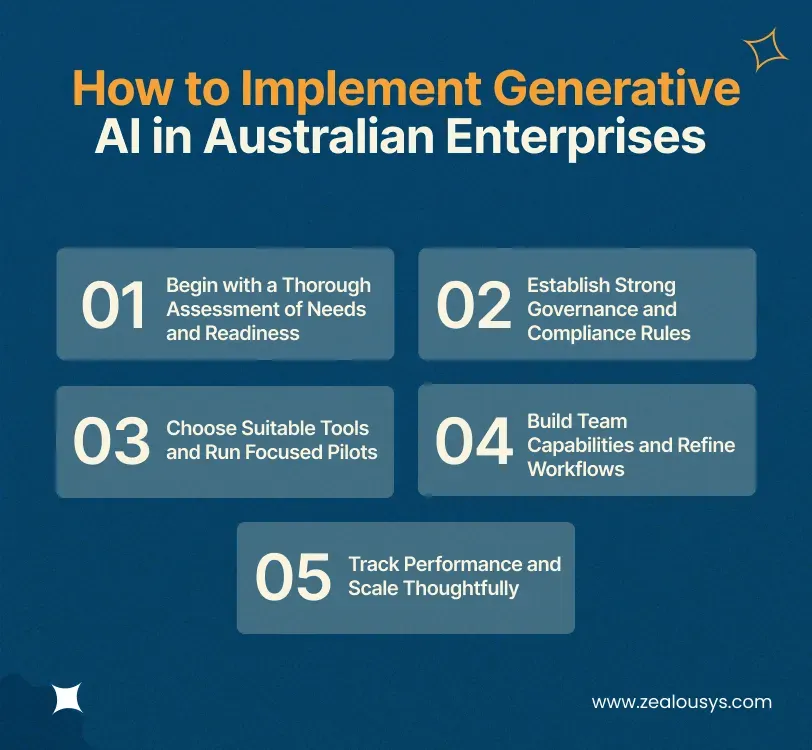
Australian enterprises move forward successfully when they treat generative AI implementation as a structured, controlled process. The focus stays on solving specific operational problems while respecting data rules and team realities from the very first step.
The first step is to review your current workflows and identify repetitive tasks that consume the most time and resources. Bring together IT, compliance, and business leaders to evaluate data quality, system compatibility, and team capacity so priorities stay realistic and focused.
Next, create clear policies that define data handling, model access, and required human approval steps. This ensures every decision meets Australian privacy laws and sovereignty requirements before any live testing begins.
In this step, select platforms that connect cleanly with your existing systems and allow secure local deployment. Start with one or two narrow pilots, such as document drafting or data summaries, then measure results against your own success criteria.
After the initial pilots, deliver targeted training on writing effective prompts and reviewing outputs accurately. Update everyday processes with quick validation checkpoints so the technology supports rather than disrupts how your teams already work.
The last step is to monitor accuracy, speed, and compliance on a regular schedule. Gather direct feedback from users, adjust as needed, and expand only to additional areas once the approach has proven reliable in your environment.
If followed carefully, these steps turn experimentation into dependable results.
Australian enterprises need partners who combine deep technical capability with a clear understanding of operational realities. We bring a structured, accountable process that fits the way large organisations work across distances and regulatory requirements.
We handle every stage from initial consulting and strategy workshops to custom model development, integration, testing, and ongoing maintenance. This single-point accountability removes the usual coordination headaches many organisations face when working with multiple vendors.
We connect generative AI tools directly to your existing legacy platforms and data sources without causing downtime or major overhauls. Our engineers have completed dozens of such integrations for global enterprises, ensuring your teams continue working with familiar systems.
We design every solution with built-in controls that meet OAIC, APRA, and other local requirements from day one. Human review checkpoints and full audit trails stay in place so your governance teams retain complete oversight.
We run hands-on training sessions and create clear documentation so your own staff can manage and refine the solutions long after go-live. This approach reduces dependency and helps your teams grow their expertise at a pace that suits your organisation.
We provide 24/7 technical assistance and regular performance reviews to keep models accurate as your data and needs change. Many of our clients in resources and financial services continue working with us years after the first project because the results keep delivering.
Explore Our App Development Services in Australia:
This is why enterprise teams choose us when the priority is controlled rollout, not rushed experimentation.
Generative AI has become a practical tool that fits the daily realities of Australian enterprises. The use cases and applications discussed here address real pressures around compliance, distance, and team coordination in a direct way.
Without structure, pilots stall. With it, measurable gains follow. When organisations assess needs carefully, set clear governance, and build internal skills, adoption stays controlled and effective.
We support this journey as a trusted generative AI development company with strong AI consulting expertise. Our role is to provide guidance that aligns solutions with Australian requirements from the outset.
For leaders who approach it with discipline, generative AI becomes a practical asset rather than a passing experiment.
1. What are the main generative AI use cases in Australia for enterprises?
Generative AI use cases in Australia centre on practical tasks such as drafting reports, summarising operational data, assisting with code, and preparing customer responses. These applications help teams working across large distances while respecting local compliance needs.
2. Which Australian industries benefit most from generative AI?
Mining and resources, financial services, healthcare, and government agencies currently lead adoption. Each sector applies the technology to its own workflows, from safety reporting in remote sites to clinical note drafting in hospitals.
3. How does generative AI support compliance requirements in Australia?
It follows approved templates and flags areas for human review. This keeps full accountability with your teams and creates clear audit trails that align with APRA, OAIC, and other local standards.
4. What are the biggest challenges when adopting generative AI in Australian enterprises?
Common issues include integrating with legacy systems, maintaining data sovereignty, and building internal skills for proper oversight. Addressing these early through structured planning prevents delays and reduces risk.
5. How should an enterprise begin implementing generative AI?
Start by mapping repetitive tasks that consume time, then establish governance rules and run small pilots. Follow each step with clear human checkpoints so the technology supports rather than replaces existing processes.
6. When is the right time to engage AI consulting for generative AI projects?
When internal teams need guidance on strategy, secure integration, or scaling across departments. Expert support helps accelerate progress while ensuring solutions remain practical and fully aligned with Australian enterprise realities.
7. How can partnering with a trusted generative AI development company make a difference?
It provides end-to-end delivery, seamless system connections, and ongoing knowledge transfer to your staff. This approach delivers controlled results without the coordination issues that often arise when working with multiple providers.
Our team is always eager to know what you are looking for. Drop them a Hi!

Pranjal Mehta is the Managing Director of Zealous System, a leading software solutions provider. Having 10+ years of experience and clientele across the globe, he is always curious to stay ahead in the market by inculcating latest technologies and trends in Zealous.




Comments