
Figuring out the FinTech software development cost in Canada often raises big questions for those building or upgrading financial tools. You might wonder how to balance robust features with tight security, all while staying within a reasonable budget. Costs fluctuate based on your project’s scope, from straightforward MVPs to intricate platforms that integrate advanced tech.
Understanding where the money actually goes is what separates realistic FinTech planning from guesswork. We’ll cover essential elements like compliance needs and feature sets that shape pricing in the Canadian market. Expect practical breakdowns to help you plan effectively, ensuring your FinTech solution delivers value without unexpected overruns.
Canada’s FinTech sector shows strong momentum, with steady investments fueling new ventures in payments, lending, and beyond. The opportunity is real, but so is the risk of overspending early, especially when compliance and infrastructure are treated as afterthoughts. In the first half of 2025, funding totaled US$1.62 billion across 60 deals, showing resilience amid broader economic shifts.
Digital banking plays a central role in this expansion. Consumers increasingly favor online platforms, pushing the market forward. As per Grand View Research, Open banking alone generated USD 1.45 billion in 2024, with expectations to hit USD 6.69 billion by 2030.
Companies like Wealthsimple demonstrate success by prioritizing user-friendly designs. For anyone budgeting a project, these developments underscore the value of scalable solutions that adapt to market demands.
FinTech software is financial technology applications designed to improve and automate the delivery of financial services. It includes tools like mobile banking apps, payment processors, and investment platforms that make handling money easier for users and businesses. In the context of FinTech software development cost in Canada, understanding this foundation helps you gauge what goes into building these systems securely and efficiently.
In practice, FinTech software connects financial rules with software logic, whether that means approving a loan in seconds or flagging a risky transaction before it clears. For instance, it powers quick peer-to-peer transfers or automated lending decisions. Developers focus on user needs, ensuring the end product is intuitive yet robust against threats.
Common examples range from digital wallets like PayPal to robo-advisors for investments. In Canada, where regulations emphasize data protection, FinTech software often incorporates features for seamless compliance. This integration can influence overall project timelines and expenses.
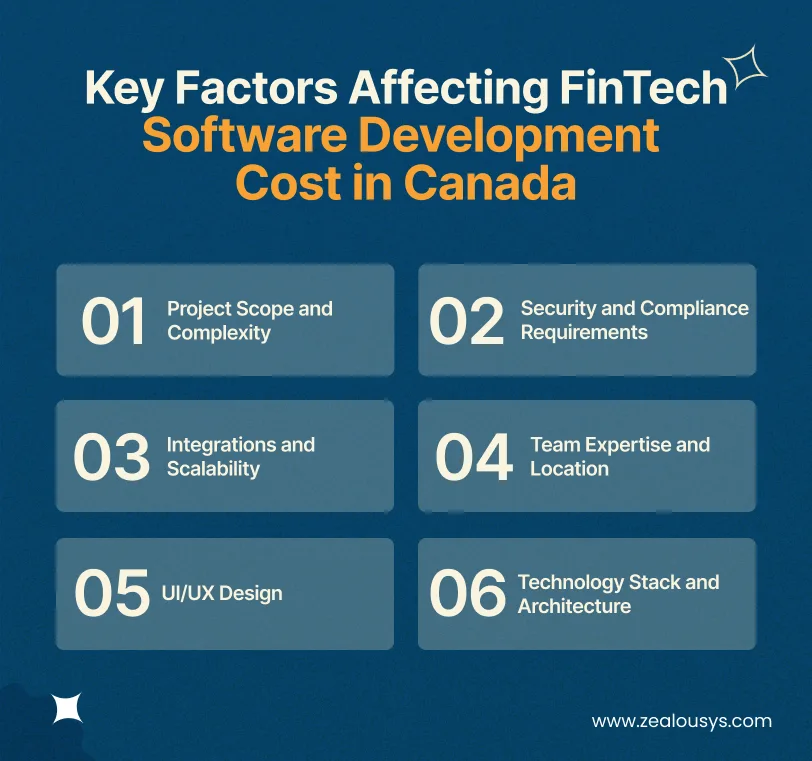
Several elements shape the FinTech software development cost in Canada, from regulatory demands to technical choices. Ignoring these factors early almost always leads to rework, delays, and unplanned spend later. Below, we outline the main ones with details on their influence.
The breadth of your app’s functions, such as including multiple user roles or advanced workflows, directly impacts timelines and resources. More intricate designs require deeper planning and testing, leading to higher overall expenses.
Canadian regulations like PIPEDA for data privacy and PCI DSS for payments necessitate strong protections and audits. These standards demand specialized implementations, which extend development phases and add to the budget.
Linking to banking APIs, third-party services, or legacy systems ensures seamless operations but involves complex data mapping. Building for growth with scalable architectures further increases engineering efforts and associated costs.
Skilled developers familiar with FinTech and local rules command premium rates, especially in hubs like Toronto, where hourly figures range from CAD 70 to 200. Shortages in talent can delay projects, prompting considerations for hybrid teams to manage spending.
Creating intuitive interfaces through prototypes and accessibility testing enhances user adoption. Custom designs tailored to financial tasks require iterative work, contributing to the project’s financial outlay.
Choices like microservices or cloud-native setups affect efficiency and maintenance. Selecting advanced tools for real-time features demands expertise, influencing the total investment needed.
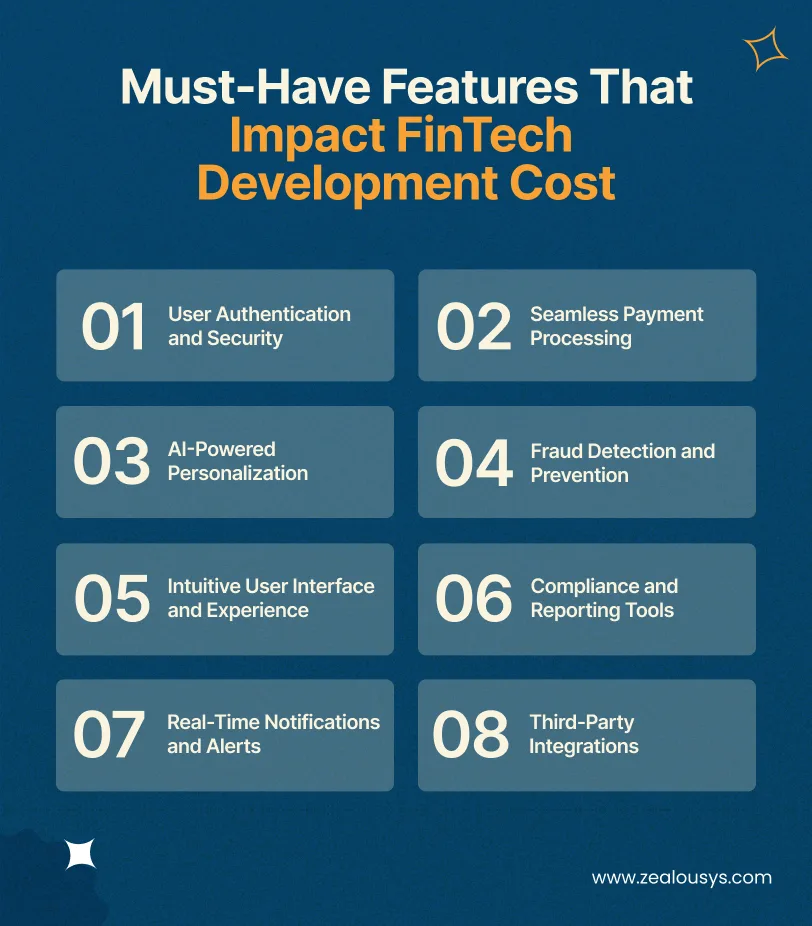
Certain features define successful FinTech software, combining functionality with user trust in Canada’s regulated environment. These elements ensure the platform meets practical needs while influencing the FinTech software development cost in Canada through their implementation demands. Selecting them thoughtfully creates a balanced, effective solution.
Multi-factor authentication and biometric options provide robust access control. They protect accounts from breaches and maintain data integrity throughout interactions.
Integration with gateways enables quick transfers and bill payments across methods. It supports real-time handling of various currencies and transaction types.
Machine learning service adds measurable value, but it also increases costs through data modeling, training, and ongoing tuning. It adapts recommendations for budgets, investments, and spending patterns dynamically.
Real-time monitoring identifies unusual activities using advanced algorithms. It blocks potential threats proactively to secure operations.
Responsive designs offer clear navigation on multiple devices. They simplify complex tasks and improve overall accessibility.
Automated systems handle identity verification and transaction logging. They align with regulations to ensure ongoing transparency.
Instant updates keep users informed about account changes and security events, helping them respond quickly through different channels.
Connections to external services expand capabilities like data sharing. They allow complete features through seamless API links.
FinTech platforms in Canada operate under strict guidelines to protect users and maintain system integrity. These mandates cover data handling, financial monitoring, and risk management, directly affecting how software gets built. These requirements shape the budget long before the first line of code is written.
The Personal Information Protection and Electronic Documents Act governs data privacy, requiring consent for collection and secure storage practices. It mandates breach reporting and user rights to access information, ensuring platforms handle personal details responsibly.
Anti-money laundering and anti-terrorist financing rules demand robust programs to detect and report suspicious activities. Firms must implement ongoing monitoring and record-keeping to prevent illicit flows through their systems.
Know Your Customer protocols verify user identities through documents and checks to mitigate fraud risks. They include risk assessments and enhanced due diligence for high-risk cases, forming a core part of onboarding.
The Financial Transactions and Reports Analysis Centre requires submissions of large cash transactions and suspicious behavior. This involves detailed records and timely filings to support national security efforts.
For payment processing, the Payment Card Industry Data Security Standard enforces encryption and access controls. It protects cardholder data across networks, with regular audits to maintain compliance.
Depending on activities, registration with bodies like the Ontario Securities Commission applies to investment-related FinTech. These rules focus on disclosure and fair dealing to safeguard market participants.
This international standard for information security management systems helps establish controls against cyber threats. In Canada, it complements local laws by promoting risk assessments and continual improvement.
Breaking down the FinTech software development cost in Canada gives a clearer picture of what to expect across different project scales. These estimates are based on industry benchmarks, local regulatory requirements, and talent rates. Costs typically vary depending on scope and complexity and are commonly grouped into three levels: simple MVP, mid-level standard, and enterprise-grade solutions.
Simple FinTech MVP development in Canada focuses on validating an idea quickly by building core features such as basic user registration, a single transaction type like payments, and minimal security measures such as two-factor authentication. This approach suits startups testing market demand with limited integrations and single-platform support, with development costs usually ranging from CAD $20,000 to $40,000 (USD $15,000 to $30,000).
Mid-level standard FinTech software development offers a more comprehensive setup, including multiple transaction options, cross-platform compatibility, and stronger compliance features such as KYC verification. It often includes analytics dashboards and third-party integrations to improve user engagement and operational efficiency. For growing businesses, this level typically requires an investment of CAD $40,000 to $70,000 (USD $30,000 to $50,000).
Enterprise-grade FinTech software development in Canada supports complex, large-scale operations with features like AI-driven fraud detection, multi-jurisdiction compliance, and scalable architecture designed for high user volumes. These platforms include advanced admin controls, real-time processing, and continuous security monitoring, making them suitable for established firms planning expansion. Costs at this level generally start from CAD $70,000 and can exceed $200,000+ (USD $50,000 to $150,000+), depending on customization and scale.
Managing the FinTech software development cost in Canada calls for strategic choices that preserve high standards in protection and reliability. Focus on methods that simplify processes while embedding strong security from the outset. The goal is not cutting corners, but deciding where precision matters most and where flexibility is acceptable.
Launch with core functions to test the waters and gather user input before expanding. This limits initial spending on non-essential parts and allows iterative improvements based on real feedback. Security remains intact by concentrating resources on vital protections during the early phase.
Break work into sprints for flexible adjustments and quicker releases. Teams catch issues early through regular reviews, reducing rework. Built-in security checks at each stage ensure compliance without added layers later.
Integrate proven libraries for features like encryption and authentication to speed up builds. These options cut licensing fees while offering community-vetted security. Regular updates from contributors help maintain defenses against emerging threats.
Partner with specialized firms for non-core elements like UI design or testing. This taps into global talent pools at competitive rates, freeing your team for strategic work. Choose providers with proven Canadian compliance expertise to uphold security standards.
Shift to scalable services that charge based on usage, avoiding upfront hardware costs. Providers offer built-in security like firewalls and monitoring. This setup supports growth without overprovisioning, keeping expenses aligned with needs.
Employ tools for continuous integration and automated checks to spot vulnerabilities fast. This reduces manual effort and prevents costly fixes down the line. In FinTech, it ensures consistent adherence to regulations like PIPEDA without inflating budgets.
Rank elements by user impact and regulatory must-haves to avoid scope creep. Develop in phases, adding advanced options only when justified. This keeps the project focused, safeguarding security investments where they matter most.
FinTech projects tend to break down at the same fault lines: compliance gaps, delayed releases, and budgets that drift once development begins. Zealous System is built to prevent those failures, not react to them.
With more than a decade of experience, we design and build FinTech platforms that meet Canadian regulatory standards without slowing down product momentum. Our work spans digital banking, payments, lending, and wealth management, with a clear focus on security, scalability, and cost control from day one.
We handle the full development lifecycle, from product strategy and architecture to deployment and long-term support. Our team handles everything from custom apps and software integrations to modernization, using technologies like AI, blockchain, and cloud computing to deliver systems that perform reliably under real-world financial workloads. This approach helps clients manage FinTech software development costs in Canada while avoiding expensive rework later.
Choosing Zealous System means working with a FinTech development partner that treats compliance, performance, and cost as a single design problem. The result is software that launches with confidence and scales without surprises.
The journey through planning FinTech software development cost in Canada highlights how thoughtful decisions around features, security, and budgeting pave the way for lasting success. Smart prioritization and a focus on compliance help avoid pitfalls while creating platforms that truly serve users in this dynamic market.
When the time comes to move forward, partnering with an experienced FinTech software development company makes all the difference. We bring proven expertise in building secure, compliant platforms that grow with your business. Whether you need to hire full-stack developers for a custom build or seek end-to-end guidance, our team stands ready to deliver results that align with your vision and budget.
Treat cost planning as a design decision, not a finance task, and the rest of the build becomes far easier to control. A well-structured approach today leads to a stronger, more competitive FinTech product tomorrow.
Costs typically range from CAD 25,000 to CAD 150,000+, depending on project scope. A simple MVP starts around CAD 25,000–40,000, mid-level apps run CAD 40,000–70,000, and enterprise-grade solutions often exceed CAD 150,000. Factors like compliance and integrations drive higher expenses in regulated environments.
A basic FinTech MVP usually falls between CAD 25,000 and CAD 40,000. This covers essential features like user authentication, basic transactions, and core security. Starting lean allows quick market testing while meeting initial compliance needs.
Security and compliance add 20–30% or more to the budget due to requirements like PIPEDA, PCI DSS, and AML rules. Implementing encryption, audits, and fraud detection is essential, but it increases the time for testing and specialized work.
Yes, you can. Start with an MVP, use agile methods, leverage cloud services, and consider hybrid teams. Prioritizing core features first and automating testing helps control expenses while maintaining strong security and compliance.
Higher local developer rates (CAD 100–200 per hour) and strict regulations contribute to elevated costs. Outsourcing select tasks to experienced providers can balance expertise with budget constraints.
Timelines vary: MVPs take 3–6 months, mid-level apps 6–12 months, and complex enterprise solutions 12+ months. Early planning for compliance and integrations helps keep projects on track.
Our team is always eager to know what you are looking for. Drop them a Hi!

Pranjal Mehta is the Managing Director of Zealous System, a leading software solutions provider. Having 10+ years of experience and clientele across the globe, he is always curious to stay ahead in the market by inculcating latest technologies and trends in Zealous.




Comments