If you manage a safari operation, own a lodge, or lead a tourism startup in Namibia, you see how travelers now expect fast, reliable digital tools. They want quick bookings, real-time wildlife updates, and custom itineraries at their fingertips. A dedicated tourism app gives travelers a faster way to book while helping your business rely less on third-party platforms.
By 2026, Namibia’s tourism sector has moved well beyond recovery and into a phase of steady, demand-driven growth. In late 2025, the African Tourism Board recognized the country as Africa’s most authentic destination, underscoring its appeal for conservation-focused and adventure travel. Hotel occupancy rates reached highs like 67.55% in August 2025 and 65.9% in the third quarter, often surpassing pre-pandemic levels in peak periods.
This guide provides practical 2026 estimates on the cost to build a tourism app in Namibia. It includes breakdowns by app complexity, type, and key features to support your planning decisions.
Namibia is currently riding a wave of strong, authentic tourism appeal. The African Tourism Board officially named it Africa’s most authentic tourism destination in December 2025. This reflects a wider shift in traveler preferences toward wide-open landscapes, responsible wildlife experiences, and genuine cultural engagement.
Several factors make 2026 a practical moment to invest in a tourism app:
Travelers planning trips to remote areas like the Skeleton Coast or Fish River Canyon already expect mobile access to bookings, real-time updates, and offline-capable maps.
An app allows safari operators, lodges, and tour companies to reduce third-party commissions and take more bookings directly from guests.
International arrivals from core markets (Germany, France, the US, UK) remain solid, and the sector continues to attract high-value, intentional travelers who plan far in advance.
As more operators move online, businesses that offer fast availability checks and well-structured itineraries are easier for travelers to choose.
Planning for tourism app development costs in Namibia is no longer optional for operators who want to grow direct bookings and retain repeat guests.
Development costs for a tourism app in Namibia remain competitive in 2026, thanks to skilled local and regional talent in Southern Africa. Rates for experienced mobile developers typically fall between NAD 300 – 600 per hour (roughly $18 – $36 USD), influenced by team location, expertise, and project scope. These figures reflect regional benchmarks from Southern Africa, where labor markets and operating costs closely align with Namibia’s.
Costs vary mainly by complexity, from a simple MVP used to test demand, to mid-scale apps with bookings and maps, and full enterprise platforms built for high traffic and analytics. Cross-platform tools like Flutter or React Native often help keep expenses lower by targeting both iOS and Android efficiently.
A basic MVP focuses on core essentials, user login, simple listings of tours or accommodations, basic search, and contact forms. This approach works well for startups or small operators who want early user input before expanding features.
Expect to budget NAD 200,000 – 500,000 (approximately $12,000 – $30,000 USD). This covers initial design, core development, basic testing, and launch, usually in 2 – 4 months.
Mid-scale apps add practical integrations like in-app bookings, maps with offline support, push notifications, and secure payments, ideal for growing tour operators or lodges needing reliable tools.
Costs typically range from NAD 500,000 – 1,200,000 (about $30,000 – $73,000 USD). The added features and testing extend timelines to 4 – 7 months.
Enterprise-level apps include sophisticated elements: AI recommendations, multi-language support, admin dashboards, real-time analytics, high-security features, and scalability for large traffic.
These projects start at NAD 1,200,000 and can reach NAD 3,000,000+ (roughly $73,000 – $182,000+ USD). Development often spans 7 – 12+ months with thorough quality assurance.
| App Category | Cost in NAD | Cost in USD (Approx.) | Typical Timeline |
|---|---|---|---|
| Basic MVP | 200,000 – 500,000 | $12,000 – $30,000 | 2 – 4 months |
| Mid-Scale App | 500,000 – 1,200,000 | $30,000 – $73,000 | 4 – 7 months |
| Advanced Enterprise | 1,200,000 – 3,000,000+ | $73,000 – $182,000+ | 7 – 12+ months |
These are realistic 2026 estimates based on regional rates and typical tourism app scopes. Actual figures depend on your exact requirements, chosen tech stack, and whether you opt for local Namibian teams, South African partners, or hybrid approaches.
Different tourism apps serve very different needs, from managing lodge reservations to guiding travelers through remote parks. Overall cost shifts based on the features required, such as secure booking transactions or offline tools for areas with limited signal. Developers in the region, including those in Windhoek and nearby South African hubs, charge competitive rates (often NAD 300 – 600 per hour in 2026), which keeps projects accessible for local operators.
These ranges come from regional benchmarks and typical scopes for tourism apps. Cross-platform approaches frequently cut expenses compared to building separate iOS and Android versions.
These solutions manage room searches, availability checks, reservations, guest information, and payments, making them ideal for lodges aiming to increase direct bookings. Typical development costs range from NAD 250,000 to 1,500,000 (approximately $15,000 to $91,000 USD), depending on complexity.
Core features usually include advanced search filters, calendar synchronization, secure payment gateways, user reviews, and essential admin tools for property managers, with simpler setups on the lower end and more advanced options like virtual tours or loyalty tracking at the higher end. Development timelines generally range from 3 to 6 months.
This app is designed for tour operators in regions such as Etosha or the Namib, these solutions support tour scheduling, wildlife viewing experiences, and real-time updates in low-connectivity environments.
Safari & wildlife tour app development costs typically range from NAD 300,000 to 2,000,000 (approximately $18,000 to $122,000 USD), depending on feature depth. Core functionality includes booking calendars, real-time tracking, photo sharing, offline maps, and alerts for wildlife sightings or weather conditions, with simpler listing-based versions at the lower end and advanced live coordination or group management tools at the higher end. Development timelines usually span 4 to 8 months.
These solutions help users discover attractions, create itineraries, and access local tips, making them ideal for companies promoting hidden destinations across the country.
Travel guide & itinerary app development costs typically range from NAD 200,000 to 1,300,000 (approximately $12,000 to $79,000 USD), depending on functionality. Core features include interactive maps, attraction listings, custom itinerary builders, local tips sections, and optional multilingual support, with static guides keeping costs lower and advanced options like dynamic planning or AR features increasing investment. Most projects are completed within 3 to 6 months.
These solutions are well suited for hiking, conservation, and sustainable tourism activities, with a strong focus on safety and environmental information.
Adventure and eco-tourism app development costs typically range from NAD 280,000 to 2,200,000 (approximately $17,000 to $134,000 USD), depending on feature depth and interactivity. Core features often include trail information, weather checks, eco-badges, safety guidelines, and, in some cases, community forums or sensor integrations, with basic listing apps on the lower end and interactive trails or group features increasing overall costs. Development timelines usually fall between 4 and 9 months.
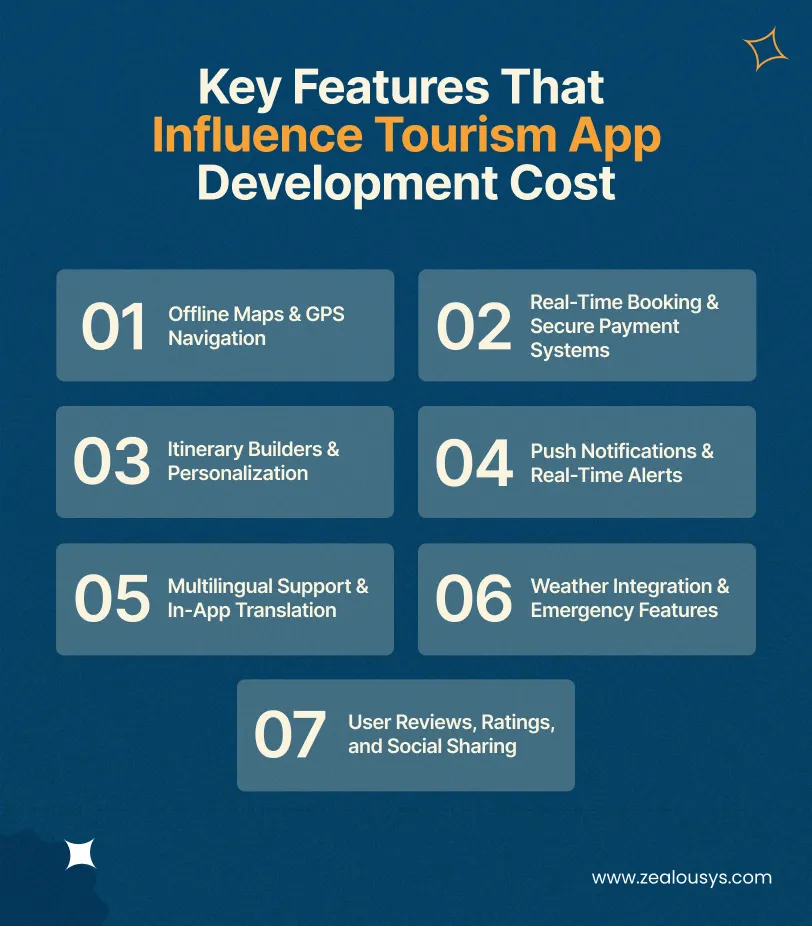
Some features require more development effort when you build a tourism app for Namibia’s travel landscape. Namibia has large remote areas such as the Namib Desert and Etosha National Park, where connectivity remains limited. Developers must focus on offline access, secure systems, and reliable performance in these conditions. These requirements increase development time and technical complexity.
Travelers need accurate directions even when mobile networks are unavailable. The app must store maps on the device and manage cached routes. Developers also ensure GPS works smoothly without internet access. This feature demands extra work on storage, performance, and regular updates.
Travel apps allow users to book lodges, safaris, and tours directly. The app must connect with payment gateways and handle multiple currencies. Developers also add encryption and security checks to protect user data. These integrations require careful API setup and extensive testing.
Users like to create personalized travel plans with places, timings, and preferences. Basic planners follow simple logic, while advanced ones suggest activities based on user behavior. This feature needs backend logic and secure data handling, which increases development effort.
Apps send alerts for booking updates, weather changes, or safety notices. Developers set up servers, manage permissions, and ensure reliable message delivery. This feature adds backend development and monitoring work.
Namibia attracts tourists from many countries. The app must support multiple languages and adapt layouts for different scripts. Developers manage translated content and adjust the UI to maintain a smooth user experience across languages.
Tourism apps often show live weather updates and safety information. Developers connect the app to weather APIs and add location-based alerts. Emergency features such as SOS buttons need stable location tracking and admin control.
Reviews help travelers make informed decisions. Developers build rating systems, moderation tools, and social sharing options. These features increase trust and improve user engagement.
Different tourism businesses should prioritize different features. Safari operators often focus on offline navigation and safety alerts, while hotels prioritize bookings and payments. Starting with essential features in an MVP helps control development effort. You can add advanced features later based on user feedback and real demand in Namibia’s tourism market.
Longer timelines increase costs because teams spend more hours building, coordinating changes, and testing each release. In Namibia’s context, local or regional teams help keep schedules efficient due to aligned time zones and market knowledge.
Timelines align closely with app complexity and directly influence your tourism app development cost in Namibia:
Quick focus on core functions means lower total hours and expenses. Ideal for fast market testing.
Extra time for integrations like payments or maps adds hours, pushing costs up moderately.
Extensive phases for AI, security, scalability, and heavy testing drive the highest budgets.
Clear requirements from the start cut revisions and shorten timelines by 10 – 20%. Cross-platform tools (Flutter, React Native) often speed up delivery compared to native builds. After launch, it’s sensible to plan for yearly updates at roughly 15 to 20% of the initial build cost to keep the app stable and secure.
In Namibia’s tourism market, where remote locations and connectivity issues shape daily operations, the right development partner matters. We address these realities through focused expertise in travel and tourism apps.
We include offline maps, cached routes, guides, and tips so users stay connected in parks, deserts, or coastlines with poor signal.
Safari booking and scheduling tools, hotel/lodge reservation systems, itinerary planners, travel guides with local tips, wildlife tracking features, and integrated platforms linking operators, lodges, and agencies.
Cross-platform development using Flutter and React Native efficiently covers iOS and Android. Where appropriate, we integrate AI-driven chat support, voice-based booking assistance, and analytics that help teams track demand patterns.
We follow agile methods: clear scope first, sprint planning, daily updates, full QA testing, and ongoing support after launch. Our offshore teams deliver quality results at reasonable costs.
Higher direct bookings, lower third-party fees, automated tasks, better guest satisfaction through personalized options, and smoother daily operations in a market focused on authentic, sustainable travel.
If you need a partner familiar with Namibia’s tourism industry who focuses on practical, reliable mobile solutions, this is the work we deliver consistently.
For tourism businesses in Namibia, a well-built app now plays a central role in how travelers research, book, and plan their trips.
In 2026, this kind of investment supports direct revenue, repeat guests, and a more stable position in a competitive tourism market. Zealous System, as a travel app development company skilled in Southern Africa’s tourism needs, supports businesses like yours with dependable apps suited to local challenges.
From here, the focus should be on clarifying requirements and understanding what level of investment aligns with your business goals.
A basic MVP with essential functions like user login and simple listings starts at NAD 200,000 to 500,000 (about $12,100 to $30,250 USD). This fits startups testing the market quickly.
Key features like offline maps add NAD 150,000 to 400,000, while secure payments can increase it by NAD 200,000 to 500,000. Prioritize must-haves to stay within budget.
Mid-scale apps take 4 to 7 months, including integrations for bookings and notifications. Clear scopes help avoid delays and control costs.
Cross-platform development keeps costs similar at NAD 200,000 to 1,200,000 for both. Native single-platform builds start lower but limit reach.
Set aside 15 to 20% of the initial budget yearly for updates, bug fixes, and server maintenance. This ensures the app stays secure and functional.
Our team is always eager to know what you are looking for. Drop them a Hi!

Raj Kewlani is a Project Manager and Mobile & Open Source Development Lead at Zealous System, specializing in agile-driven digital solutions. He focuses on delivering high-quality mobile apps and open-source projects that align with business goals.




Comments