Enterprises across healthcare, FinTech, LegalTech, manufacturing, government, and B2B SaaS are actively exploring how to build a private LLM for enterprise use. CTOs, CIOs, IT Directors, VP Engineering leaders, and Enterprise Architects want more control over data, security, and long-term AI strategy. Public AI tools offer speed, but many organizations now prefer a secure enterprise AI model that runs in a controlled environment. As AI adoption grows, decision-makers focus more on privacy, compliance, and scalable enterprise AI architecture.
A private LLM for enterprise allows organizations to build a custom LLM development strategy tailored to internal data, workflows, and compliance needs. AI and Innovation Heads, Product Managers, Data Engineering Leaders, and AI/ML teams increasingly evaluate options like on-premise LLM deployment, private cloud setups, and hybrid models. Many teams compare private LLM vs OpenAI API for enterprises to understand control, cost, and security trade-offs. Businesses that handle sensitive data, especially in HIPAA-regulated healthcare or financial services, prioritize enterprise AI data security before moving forward.
In this complete guide, we explain how to build a private large language model, design an enterprise generative AI solution, and plan proper LLM implementation for enterprises. We also break down topics like enterprise RAG architecture with private LLM, internal business use cases, and the cost to build an enterprise LLM system. Whether you lead AI strategy, manage infrastructure, or evaluate innovation initiatives, this guide will help you make informed and secure decisions.
A private LLM for enterprise is a large language model that an organization builds, customizes, and deploys within its own controlled infrastructure. Companies use it as a secure enterprise AI model to process internal data, automate workflows, and power intelligent applications.
When you build a private large language model, you train or fine-tune it using your business data, domain knowledge, and internal documents. You host it on your own cloud, private cloud, or use on-premise LLM deployment to maintain full control over access, security, and compliance.
Many enterprises choose custom LLM development to create a private GPT for business that understands internal policies, technical documentation, customer records, and industry-specific terminology. This approach supports a scalable enterprise generative AI solution that aligns with your architecture and long-term AI strategy.
A well-designed enterprise AI architecture integrates the private model with databases, APIs, ERP systems, CRMs, and internal applications. Teams often combine it with an enterprise RAG architecture with private LLM to retrieve accurate company-specific knowledge in real time.
Many organizations start with public LLM APIs because they offer quick access and easy integration. However, enterprises soon evaluate the trade-offs when they compare a private LLM vs OpenAI API for enterprises.
Public LLM APIs process data on third-party infrastructure. You send prompts and receive responses, but you do not control the underlying model, training data, or hosting environment. This setup limits customization and may raise concerns around enterprise AI data security, compliance, and long-term scalability.
In contrast, enterprise LLM development gives you full ownership and flexibility. You control:
When you focus on LLM implementation for enterprises, you design the system around your governance policies, security standards, and integration requirements. You can also optimize performance and cost based on usage patterns and business goals.
For CTOs, CIOs, and IT Directors, this control becomes critical. For AI/ML teams and Data Engineering Leaders, private models allow deeper tuning, better monitoring, and tighter integration with internal pipelines.
Enterprise leaders prioritize security, compliance, and reliability. A private model helps them meet these expectations.
Healthcare organizations handling HIPAA-sensitive AI workloads protect patient data by deploying a secure enterprise AI model inside a controlled infrastructure. FinTech companies building document intelligence platforms reduce risk by avoiding unnecessary exposure of financial data. LegalTech firms protect confidential contracts and case files by using private environments.
Manufacturing companies use private LLMs to analyze internal operational data without sharing proprietary information. Enterprise SaaS companies embed a private GPT for business inside their products to deliver AI features while maintaining customer trust. Government and public sector organizations rely on private infrastructure to meet strict regulatory requirements.
When enterprises evaluate the cost to build an enterprise LLM system, they also consider the long-term value of ownership, security, and customization. A private deployment supports stronger enterprise AI architecture, better compliance alignment, and predictable scalability.
For VP Engineering, Enterprise Architects, and Compliance & Security Officers, a controlled environment reduces risk and improves governance. For SaaS Founders (B2B) and Product Managers, it creates differentiation and trust in competitive markets.
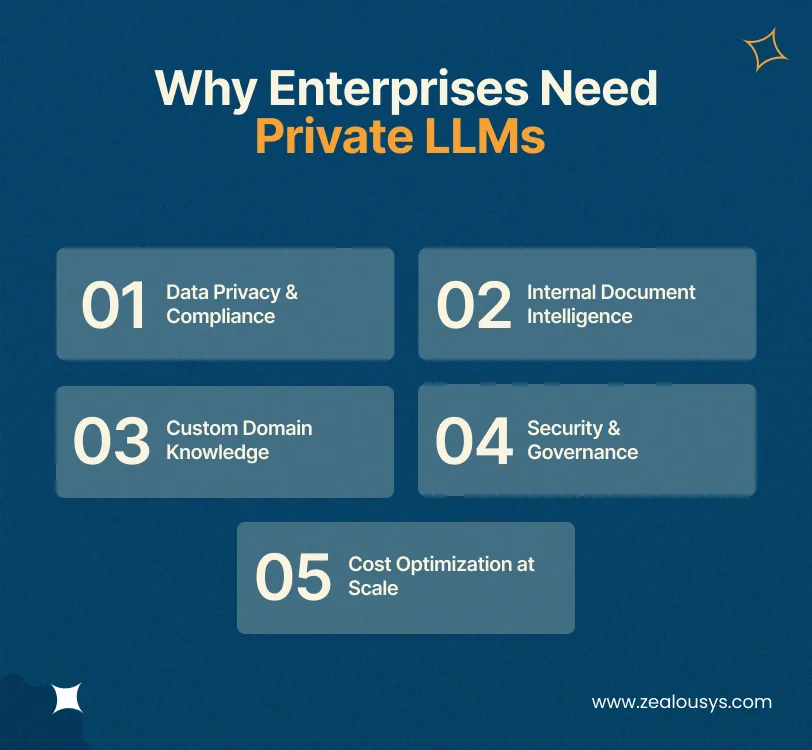
Enterprises across healthcare, FinTech, LegalTech, manufacturing, government, and enterprise SaaS are actively investing in a private LLM for enterprise use cases. CTOs, CIOs, and AI leaders want stronger control, better compliance, and long-term scalability from their AI systems. A secure enterprise AI model gives organizations full ownership of data, infrastructure, and performance.
Here’s why private deployment makes strategic sense.
Enterprises handle sensitive data every day. Healthcare teams protect patient records, FinTech firms manage financial data, and government bodies secure confidential information.
When you build a private large language model, you keep data inside your controlled environment. You can choose on-premise LLM deployment or private cloud infrastructure based on compliance needs. This setup strengthens enterprise AI data security and reduces regulatory risk.
Many leaders evaluate private LLM vs OpenAI API for enterprises and choose private models for stronger compliance and governance.
Enterprises generate large volumes of internal documents, including contracts, reports, policies, and technical files. Teams struggle to extract insights quickly.
A private LLM for enterprise connects securely to internal systems and enables intelligent search and summarization. With a proper enterprise RAG architecture with private LLM, organizations turn scattered data into actionable insights.
This approach improves productivity across product teams, data engineering leaders, and AI/ML teams.
Every industry operates with unique terminology and workflows. Public AI models provide general responses but lack business-specific context.
With custom LLM development, enterprises train models on proprietary data. A private GPT for business understands internal processes, industry language, and compliance rules.
This customization improves accuracy and builds trust in your enterprise generative AI solution.
Security remains a top priority for IT Directors and compliance officers. Enterprises must control access and monitor AI usage.
A strong LLM implementation for enterprises includes role-based access, encryption, audit logging, and monitoring. A private model aligns better with enterprise security frameworks and governance policies.
This level of control supports long-term enterprise LLM development strategies.
Public APIs may seem affordable initially, but enterprise-wide adoption increases usage costs quickly.
When organizations evaluate the cost to build an enterprise LLM system, they often find that private deployment offers better long-term predictability. A well-planned enterprise AI architecture allows optimized infrastructure and controlled scaling.
For high-volume enterprise use cases, private models often deliver better cost efficiency over time.
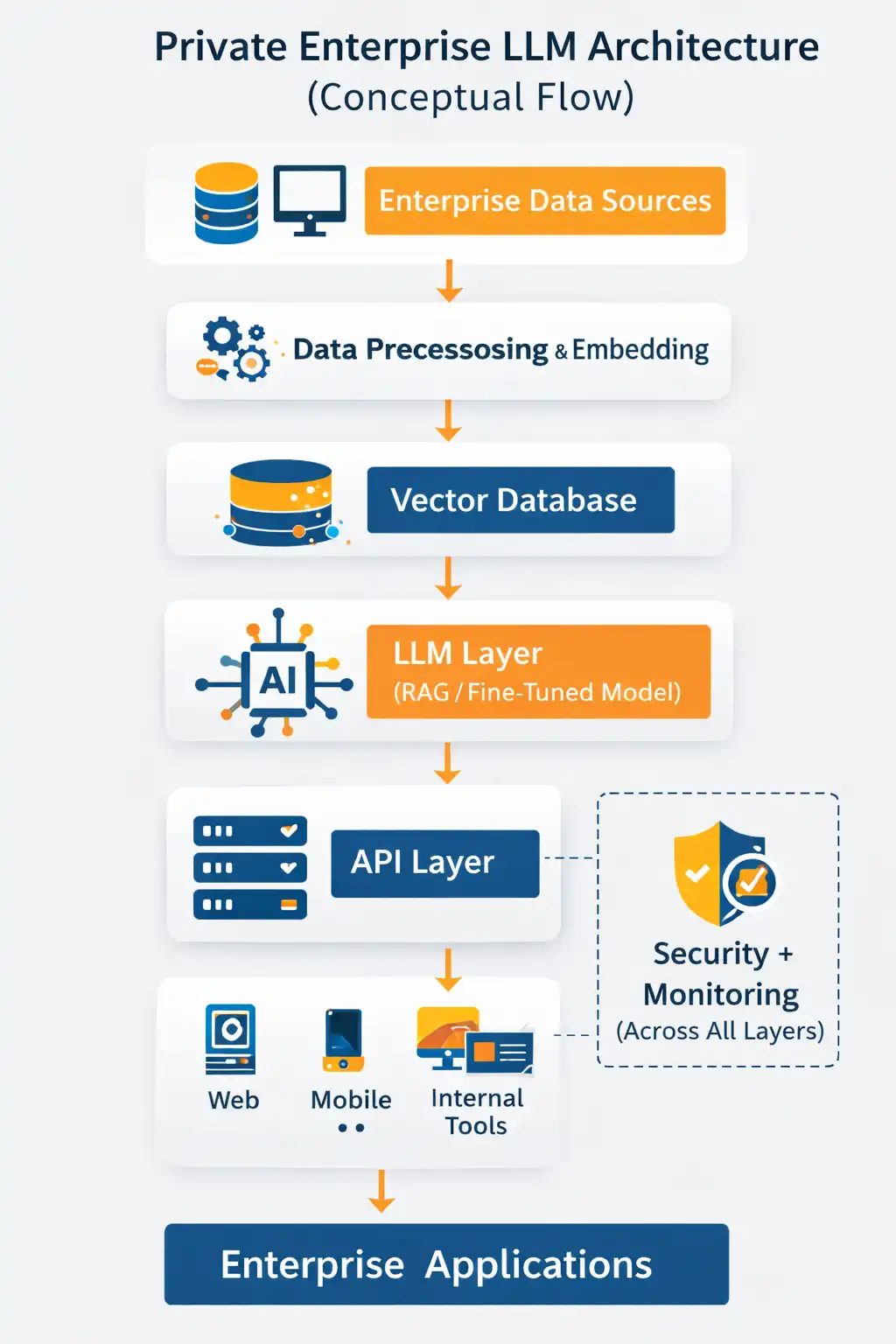
When CTOs, CIOs, Enterprise Architects, and AI/Innovation Heads plan a private LLM for enterprise, they must design a secure and scalable architecture. A strong enterprise AI architecture ensures performance, compliance, and long-term flexibility.
Below is a simple technical breakdown of how to build a private large language model for internal business use.
Every enterprise generative AI solution starts with data.
You collect structured and unstructured data from:
For industries like Healthcare, FinTech, LegalTech, and Government, you must keep this data inside your controlled environment. This step forms the foundation of a secure enterprise AI model.
If you plan an on-premise LLM deployment, you store and process all sensitive data within your internal infrastructure to maintain enterprise AI data security.
Raw enterprise data cannot directly work with an LLM.
Your AI/ML teams must:
This step improves accuracy and reduces hallucination risks.
When companies compare private LLM vs OpenAI API for enterprises, they often choose private deployment because they want full control over how data gets processed and embedded.
Proper preprocessing ensures reliable LLM implementation for enterprises, especially in regulated sectors like Healthcare (HIPAA-sensitive AI) and FinTech.
After creating embeddings, you store them inside a vector database.
A vector database:
For example:
This layer ensures your private GPT for business delivers context-aware answers.
This layer powers the intelligence of your system.
You can:
Enterprise Architects and VP Engineering teams often evaluate the cost to build enterprise LLM systems at this stage. Model choice directly affects infrastructure and GPU requirements.
For most enterprises, RAG-based architecture reduces cost while maintaining control. Fine-tuning works best when you need domain-specific reasoning.
This layer transforms your system into a true custom LLM development solution.
The API layer connects your private LLM to applications.
You integrate the model with:
This layer enables seamless enterprise LLM development across departments.
Product Managers and SaaS Founders use this layer to embed AI features directly into their platforms. It ensures your enterprise generative AI solution becomes part of daily workflows.
Security defines the success of a private LLM for enterprise.
You must implement:
Compliance & Security Officers require strict governance policies before approving deployment.
A strong secure enterprise AI model protects sensitive information and prevents unauthorized data exposure.
This layer makes private deployment safer than public APIs for regulated industries.
After deployment, you must monitor system performance.
You track:
Data Engineering Leaders and AI/ML teams use monitoring tools to optimize performance and reduce infrastructure waste.
Continuous monitoring ensures long-term success of your LLM implementation for enterprises.
When you build a private LLM for enterprise, choosing the right deployment model is just as important as selecting the model itself. CTOs, CIOs, IT Directors, and Enterprise Architects must align deployment with security, compliance, scalability, and cost goals.
Below are the main deployment options for enterprise LLM development, explained in simple terms with clear pros and cons.
In an on-premise setup, you host the secure enterprise AI model inside your own data center. Your internal IT team manages the infrastructure, security, and access controls.
Many healthcare, FinTech, LegalTech, and government organizations prefer this model because it gives them full control over sensitive data.
Best for:
Healthcare (HIPAA-sensitive AI), Government, Financial institutions, Compliance-heavy enterprises
Pros:
Cons:
In private cloud deployment, you host your enterprise generative AI solution on a dedicated cloud environment. You use providers like AWS, Azure, or Google Cloud, but you isolate the environment for your organization only.
Many SaaS founders, VP Engineering leaders, and AI/ML teams choose this approach because it balances control and flexibility.
Best for:
Enterprise SaaS companies, FinTech, B2B platforms, AI-driven startups
Pros:
Cons:
Private cloud deployment supports faster custom LLM development while maintaining enterprise-grade control.
Hybrid architecture combines on-premise systems with cloud infrastructure. You store sensitive data internally while you run model training or inference workloads in the cloud.
Enterprise Architects and Data Engineering Leaders often prefer this model when they modernize legacy systems.
For example, you can:
Best for:
Manufacturing, Enterprise SaaS, Healthcare networks, Large enterprises with legacy systems
Pros:
Cons:
Hybrid architecture works well when enterprises want flexibility without compromising control.
Edge deployment runs the private GPT for business closer to the data source, such as factory devices, IoT systems, or local servers.
Manufacturing and industrial companies often use this approach for real-time decision-making.
For example, manufacturers can combine IoT systems with a secure enterprise AI model to analyze machine data locally without sending it to the cloud.
Best for:
Manufacturing, Smart factories, Industrial IoT, Real-time AI systems
Pros:
Cons:
Edge deployment makes sense when speed and local processing matter more than centralized scaling.
| Deployment Type | Security | Scalability | Cost Control | Best For |
|---|---|---|---|---|
| On-Premise LLM Deployment | Very High | Medium | High Upfront | Healthcare, Government |
| Private Cloud | High | Very High | Flexible | SaaS, FinTech |
| Hybrid Architecture | Very High | High | Optimized | Large Enterprises |
| Edge Deployment | High | Limited | Hardware-Based | Manufacturing |
When you build a private LLM for enterprise, you must decide how the model will access and learn your business data. Most organizations choose between Retrieval-Augmented Generation (RAG) and fine-tuning, or sometimes a combination of both.
CTOs, CIOs, IT Directors, and Enterprise Architects often ask this question during enterprise LLM development:
Should we use RAG, fine-tune the model, or combine both approaches?
The right answer depends on your data sensitivity, compliance requirements, performance goals, and long-term AI strategy.
Let’s break it down in simple terms.
RAG (Retrieval-Augmented Generation) allows your secure enterprise AI model to fetch relevant information from your internal data sources before generating a response.
Instead of training the model on your entire dataset, you connect your private GPT for business to:
This approach forms the foundation of modern enterprise RAG architecture with private LLM systems.
RAG keeps your data outside the core model and retrieves it only when needed. This structure improves enterprise AI data security and reduces retraining costs.
Enterprises should use RAG when they need:
If your teams update documents frequently, RAG allows your LLM implementation for enterprises to access the latest data instantly. You do not need to retrain the model every time information changes.
Healthcare organizations handling HIPAA-sensitive AI systems often prefer RAG because it keeps protected health information secure and separate.
Compliance and Security Officers prefer RAG because it supports strict access control. You can manage permissions at the data layer inside your enterprise AI architecture.
Government and public sector projects also benefit from this approach, especially during on-premise LLM deployment.
If you want to control the cost to build an enterprise LLM system, RAG usually offers a faster and more cost-efficient start compared to deep fine-tuning.
Many Enterprise SaaS companies use RAG to launch a secure enterprise generative AI solution quickly without heavy model training.
FinTech and LegalTech platforms often rely on RAG to analyze secure documents, contracts, and policies. The model retrieves context first and then generates accurate answers.
In these cases, RAG works better than training the model on sensitive financial or legal datasets.
Fine-tuning modifies the model’s internal behavior. You train the model on specific domain data so it learns tone, structure, and specialized knowledge.
You should consider fine-tuning when:
Manufacturing companies building predictive AI systems often fine-tune models to understand industry-specific terminology.
AI/ML teams use fine-tuning to create a secure enterprise AI model that reflects unique workflows.
If your B2B SaaS product requires consistent tone, compliance-friendly language, or structured responses, fine-tuning helps maintain that standard.
Product Managers and VP Engineering leaders often choose fine-tuning when they build customer-facing AI tools.
If your organization supports strict on-premise LLM deployment, fine-tuning can work well within private infrastructure.
This approach helps enterprises build private large language model systems that fully align with internal standards.
Fine-tuning improves model performance for specific tasks such as classification, summarization, or technical document generation.
However, fine-tuning increases development complexity and infrastructure cost compared to RAG.
When you build a private LLM for enterprise, you must treat security and compliance as core architecture layers, not optional add-ons. CTOs, CIOs, IT Directors, and Enterprise Architects expect strong controls before approving any enterprise LLM development initiative.
A secure enterprise AI model protects sensitive data, ensures regulatory compliance, and builds long-term trust across teams and customers. Whether you plan an on-premise LLM deployment or a private cloud setup, you must design security into your enterprise AI architecture from day one.
Let’s break down the key areas.
Data encryption protects your organization at every stage of LLM implementation for enterprises.
You must encrypt:
When you build a private large language model, your system often processes internal documents, financial records, customer data, or healthcare reports. Strong encryption ensures no unauthorized party can access this information.
For industries like Healthcare and FinTech, encryption plays a critical role in maintaining enterprise AI data security. If you plan a private GPT for business use cases such as internal knowledge assistants or document intelligence, encryption must remain mandatory.
Role-based access control ensures that users only access what they truly need.
Your enterprise generative AI solution should:
Separate admin, developer, and end-user privileges
For example, Compliance & Security Officers may need monitoring access, while AI/ML teams may need model configuration rights. Product Managers and SaaS Founders may only require dashboard-level visibility.
When you design enterprise AI architecture, you must integrate identity management systems such as SSO, OAuth, or enterprise IAM tools. This approach strengthens security while supporting scalable enterprise LLM development.
Audit logging builds transparency and accountability in your system.
Your private LLM system should log:
These logs help AI/Innovation Heads and Data Engineering Leaders monitor usage patterns and detect anomalies. They also support forensic investigations if any security issue occurs.
When enterprises compare private LLM vs OpenAI API for enterprises, audit control often becomes a deciding factor. Public APIs limit visibility, while a secure enterprise AI model gives full monitoring control.
You should also implement:
These features protect long-term system integrity.
AI governance defines how your organization uses, monitors, and improves AI responsibly.
You should establish clear policies for:
Strong governance protects your company when you build a private LLM for internal business use. It also reassures Enterprise Architects and Compliance Officers that the system follows structured oversight.
Governance frameworks also help organizations estimate the cost to build enterprise LLM systems, because structured management reduces risk and rework.
Different industries demand different compliance standards. Your custom LLM development strategy must align with regulatory requirements.
Healthcare (HIPAA)
Healthcare organizations must protect patient data under HIPAA regulations. A private LLM for enterprise in healthcare must:
This setup ensures safe deployment of HIPAA-sensitive AI systems.
FinTech companies handle financial records and identity data. They must comply with:
A well-structured enterprise AI data security model supports both compliance and investor confidence.
When CTOs, CIOs, and Enterprise Architects evaluate a private LLM for enterprise, cost becomes a key strategic factor. Many organizations compare private LLM vs OpenAI API for enterprises before deciding whether to invest in a fully controlled system.
If you plan to build a private large language model for internal business use, you must understand the four major cost components.
Infrastructure forms the backbone of your enterprise AI architecture.
For on-premise LLM deployment, you need:
On-premise setups provide stronger enterprise AI data security, which matters for Healthcare, FinTech, LegalTech, and Government organizations.
If you deploy in a private cloud, your cost includes GPU instances, storage, container orchestration, and secure networking.
Infrastructure often represents a significant share of your total investment in an enterprise generative AI solution.
Model training cost depends on your approach.
If you fine-tune a model, you must invest in:
If you implement an enterprise RAG architecture with private LLM, you reduce heavy training costs but increase spending on embeddings and vector databases.
Highly regulated industries often spend more on data preparation to ensure compliance and accuracy.
Development converts the model into a usable business system.
This stage includes:
If you build a private GPT for business, your team must also optimize performance, reduce hallucinations, and secure data access.
Custom integrations increase the cost of enterprise LLM development, but they significantly improve business value.
After deployment, continuous monitoring becomes essential.
Maintenance includes:
A proper LLM implementation for enterprises requires a structured MLOps setup.
AI/ML teams and Data Engineering Leaders must continuously optimize the system to maintain reliability and efficiency.
The final cost to build an enterprise LLM system depends on:
Enterprises that require a secure enterprise AI model usually invest more upfront but gain stronger control, privacy, and long-term scalability.
When CTOs, CIOs, IT Directors, and Enterprise Architects plan a private LLM for enterprise use, they often focus on architecture and security first. However, real-world execution brings practical challenges. Whether you are leading enterprise LLM development, managing AI/ML teams, or evaluating a secure enterprise AI model for healthcare, FinTech, LegalTech, manufacturing, or government systems, you must prepare for the following hurdles.
Your private large language model performs only as well as the data you provide. Many enterprises struggle with scattered, inconsistent, or outdated internal data. If your organization stores documents across multiple systems, shared drives, ERPs, and CRMs, your enterprise AI architecture becomes harder to manage.
Poor data structure directly affects the accuracy of your enterprise generative AI solution. For example:
Healthcare and FinTech companies face additional challenges because they must maintain strict compliance and structured data controls. Compliance and security officers must ensure data sanitization before any LLM implementation for enterprises begins.
To solve this issue, data engineering leaders should:
When you build a private LLM for internal business use, always treat data preparation as a core phase, not a secondary task.
Large language models sometimes generate confident but incorrect answers. This issue becomes critical when you deploy a private GPT for business in industries like healthcare, government, or financial services.
Hallucinations can:
CTOs and AI/Innovation Heads must design safeguards within their secure enterprise AI model. Many organizations reduce hallucination risks by implementing an enterprise RAG architecture with private LLM, where the model retrieves verified internal documents before generating responses.
You should also:
When you compare private LLM vs OpenAI API for enterprises, you will notice that private systems give you more control over grounding and data verification. That control reduces hallucination risks significantly.
Model drift occurs when your AI system gradually becomes less accurate over time. As your enterprise data evolves, your model must adapt. Many organizations overlook this during enterprise LLM development.
For example:
If you fail to update embeddings and retrain your system, your enterprise generative AI solution will provide outdated answers.
Data engineering leaders and AI/ML teams must establish:
When you plan the cost to build an enterprise LLM system, you must include long-term maintenance and monitoring. Model drift does not disappear after deployment. It requires active lifecycle management.
Most enterprises do not operate in greenfield environments. IT Directors and VP Engineering teams often manage complex legacy systems, including ERP, CRM, document management platforms, and internal APIs.
Integrating a private LLM for enterprise into these systems can become technically challenging.
Common integration challenges include:
When you design enterprise AI architecture, you must plan integration from day one. Many enterprises prefer on-premise LLM deployment or hybrid models to maintain tighter system control.
You should:
Enterprise Architects must ensure that the custom LLM development process aligns with existing workflows instead of disrupting them.
Technology adoption does not succeed without organizational alignment. SaaS founders, Product Managers, and AI leaders must address internal resistance when deploying a private GPT for business.
Employees often question:
Change management becomes especially important in government, healthcare, and financial sectors where decision accuracy matters deeply.
To drive adoption, leadership teams should:
When you build a private large language model, you do not only deploy software. You introduce a new operational capability. Strong communication and governance improve adoption rates and ROI.
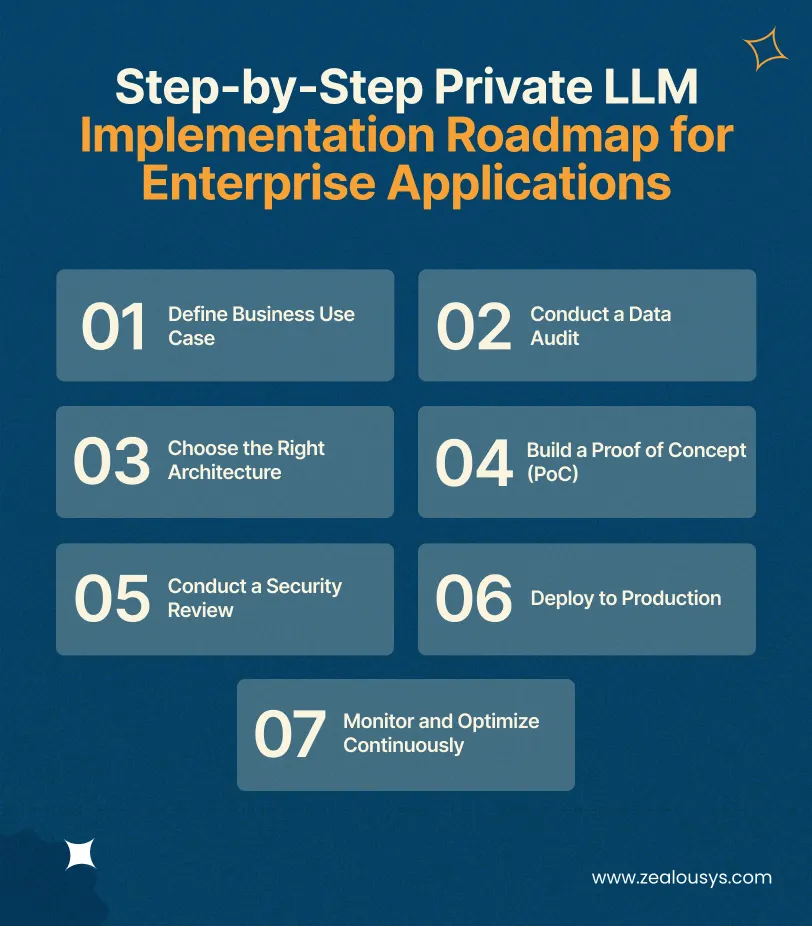
Building a private LLM for enterprise applications requires a structured and secure approach. CTOs, CIOs, IT Directors, VP Engineering, Enterprise Architects, AI/Innovation Heads, SaaS Founders, Product Managers, Data Engineering Leaders, AI/ML teams, and Compliance Officers must align technology with business goals from day one.
Below is a practical roadmap to help you successfully plan and execute enterprise LLM development.
Start by clearly defining why you want to build a private large language model.
Identify the exact problem your enterprise wants to solve. You may want to improve internal knowledge search, automate document processing, improve customer support, or build a private GPT for business. Focus on measurable outcomes like reducing support tickets, speeding up document review, or improving employee productivity.
Healthcare organizations may need a secure enterprise AI model for HIPAA-sensitive data. FinTech companies may require intelligent fraud analysis or document verification. Manufacturing companies may want AI-powered internal assistants. Government and public sector teams may need controlled AI systems for confidential workflows.
When you define the use case clearly, you reduce scope confusion and improve ROI. A strong use case lays the foundation for successful LLM implementation for enterprises.
Your data determines the success of your enterprise generative AI solution.
Audit your internal data sources. Review structured databases, PDFs, emails, knowledge bases, CRM records, and policy documents. Remove duplicate, outdated, and low-quality data. Clean and normalize content before feeding it into your model.
Ensure your data meets enterprise AI data security standards. Classify sensitive information and define access controls. Compliance and security officers should review regulatory requirements such as HIPAA, GDPR, or financial compliance frameworks.
A proper data audit ensures your private LLM for enterprise delivers accurate and context-aware responses.
Now design your enterprise AI architecture.
Decide whether you will use:
Most enterprises prefer Retrieval-Augmented Generation (RAG) because it keeps data internal and reduces hallucination risks. RAG connects your LLM with a secure knowledge base using embeddings and vector databases.
Next, decide your deployment strategy:
Compare private LLM vs OpenAI API for enterprises based on data sensitivity, cost, scalability, and compliance needs. Highly regulated industries like Healthcare, LegalTech, FinTech, and Government often choose private deployment for security reasons.
Your architecture choice directly impacts scalability, cost, and performance.
Start small before scaling.
Develop a focused PoC that solves one defined business problem. Use limited datasets and controlled user groups. Measure performance, response accuracy, latency, and user feedback.
Your AI/ML teams should test prompt engineering, model tuning, and retrieval performance. Product Managers should validate business impact. Data Engineering Leaders should monitor infrastructure behavior.
A PoC helps you evaluate the real cost to build an enterprise LLM system and identify technical challenges early. This step reduces financial risk and ensures your custom LLM development aligns with business expectations.
Security remains critical for every secure enterprise AI model.
Review:
Compliance and Security Officers should validate regulatory requirements. IT Directors and CIOs should assess system vulnerability and infrastructure risks.
Strong governance builds trust in your enterprise generative AI solution and protects sensitive enterprise data.
After successful validation, move to full LLM implementation for enterprises.
Scale infrastructure to handle real workloads. Configure load balancing and monitoring tools. Integrate the LLM with existing ERP, CRM, SaaS platforms, or internal systems.
Enterprise SaaS companies should ensure seamless API integration. Healthcare and FinTech organizations should verify compliance alignment before going live. Manufacturing and Government sectors should test system stability under high-load scenarios.
Production deployment requires collaboration between AI teams, DevOps engineers, and enterprise architects.
Enterprise AI systems require ongoing improvement.
Monitor:
Use MLOps practices to retrain models when needed. Update knowledge bases regularly. Optimize embeddings and retrieval pipelines.
Track operational expenses carefully to manage the cost to build enterprise LLM system over time. Optimize compute usage and storage to maintain cost efficiency.
Continuous monitoring ensures your private LLM for internal business use remains secure, scalable, and valuable.
Building a private LLM for enterprise applications gives organizations full control over data, security, and performance. By working with an experienced AI development company, businesses can strengthen enterprise AI data security and build a scalable enterprise AI architecture. A secure private model reduces reliance on public APIs and supports long-term growth with the help of reliable AI software development services.
For industries like Healthcare, FinTech, LegalTech, Manufacturing, Enterprise SaaS, and Government, private LLMs ensure compliance and governance. A skilled AI development company can implement secure frameworks aligned with regulations. Whether you choose on-premise deployment or a controlled cloud setup, combining enterprise generative AI with the right RAG architecture allows secure integration of internal data and systems through structured AI software development services.
If you plan to build a private LLM for internal use, define a clear use case and prepare the right infrastructure. Evaluate the cost and choose the right enterprise LLM implementation strategy. Partnering with an AI development company that offers end-to-end AI software development services will help you deploy a secure, scalable, and future-ready AI solution.
Our team is always eager to know what you are looking for. Drop them a Hi!

Ruchir Shah is the Microsoft Department Head at Zealous System, specializing in .NET and Azure. With extensive experience in enterprise software development, he is passionate about digital transformation and mentoring aspiring developers.




Comments