Insurance companies are rapidly moving beyond basic automation and exploring how to build an AI agent for insurance that can handle real operational workflows. CTOs, CIOs, and innovation leaders are evaluating AI-driven systems that automate claims processing, improve underwriting decisions, and reduce fraud risks. Unlike traditional chatbots, modern insurance AI agents act as autonomous decision-making systems that analyze policy data, trigger workflows, and integrate directly with core insurance platforms.
For InsurTech founders and enterprise digital transformation teams, custom AI insurance agent development offers a strategic advantage. These intelligent agents support AI claims processing automation, underwriting optimization, and enterprise AI integration with legacy systems. By leveraging machine learning in insurance, vector database integration, and RAG-based AI agents, companies can streamline operations while maintaining compliance and data security.
However, successfully implementing AI agent development for insurance requires clarity around system architecture, development cost, and implementation timeline. Decision-makers want to understand how to build an AI agent for insurance that delivers measurable ROI, reduces operational costs, and scales across enterprise environments. This guide explores the architecture, cost breakdown, and deployment roadmap required to develop a secure and scalable custom AI insurance agent.
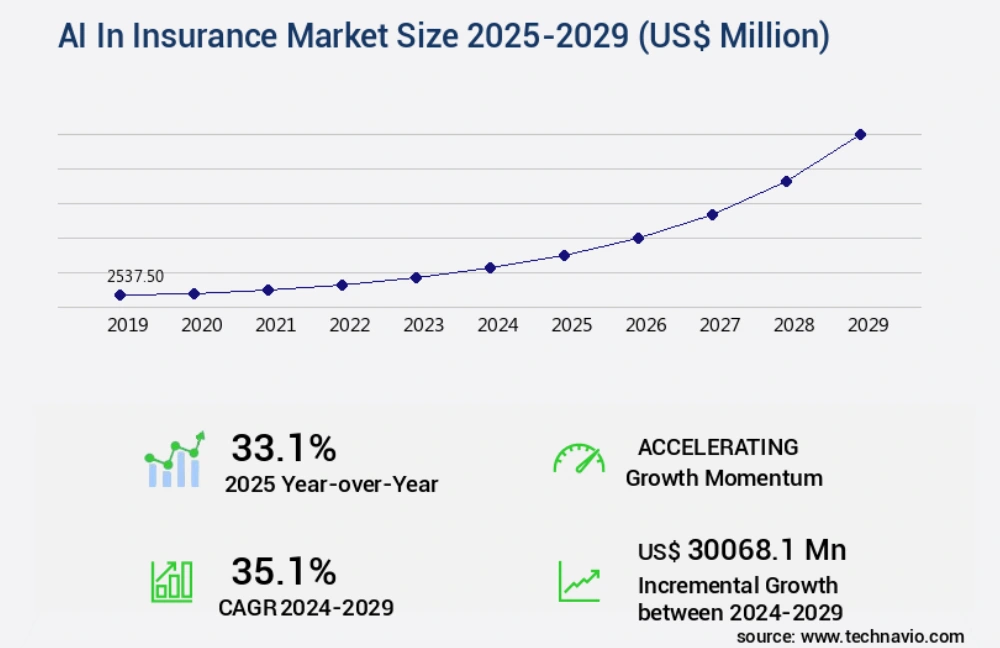
The ai in insurance market size is valued to increase by USD 30.07 billion, at a CAGR of 35.1% from 2024 to 2029. Imperative for operational efficiency and cost reduction will drive the ai in the insurance market.
An AI agent in insurance is an intelligent software system that can analyze data, make decisions, and execute tasks automatically without constant human supervision. Unlike traditional automation tools, an insurance AI agent does not just follow fixed rules. It learns from historical data, adapts to new inputs, and improves outcomes over time.
In simple terms, AI agent development for insurance focuses on building autonomous AI systems that can handle complex workflows such as claims processing, underwriting evaluation, fraud detection, and policy servicing. These agents combine machine learning in insurance, AI decision-making systems, and enterprise AI integration to operate within existing insurance ecosystems.
For CTOs, CIOs, and InsurTech founders, this means deploying intelligent automation that works across core insurance platforms, CRMs, and legacy systems while maintaining compliance and security.
Insurance companies operate in a highly competitive and regulated environment. They face rising operational costs, increasing claim volumes, and growing customer expectations. These pressures push enterprise leaders to invest in AI agent development for insurance to modernize operations and improve efficiency.
Insurance providers process millions of claims every year. Natural disasters, health events, and property incidents continue to increase claim frequency across markets. Teams struggle to handle this growing volume using manual workflows. Delays reduce customer satisfaction and increase operational costs.
Insurance companies deploy AI agents in insurance to automate claim intake, document validation, and case routing. AI agents analyze data instantly and reduce processing time significantly. Automation enables insurers to scale operations without expanding headcount.
Many insurers still rely on legacy systems and fragmented databases. Employees manually transfer data between systems, review documents, and validate policy details. These repetitive tasks slow down operations and increase the risk of errors.
Organizations implement insurance automation using AI to eliminate manual bottlenecks. AI agents execute repetitive workflows, extract information from documents, and update systems automatically. Intelligent automation improves underwriting speed and improves productivity across departments.
Insurance fraud costs the industry billions of dollars annually. Fraudulent claims increase loss ratios and reduce profitability. Traditional rule-based detection systems fail to identify complex fraud patterns.
Modern AI claims processing automation systems use machine learning in insurance to detect anomalies and suspicious behaviors in real time. AI decision making systems analyze historical claims data and flag high-risk cases before payouts. This proactive approach reduces financial losses and strengthens risk management.
Insurance companies operate under strict regulatory frameworks. Regulators demand transparency, data protection, and explainable decision-making processes. Organizations must maintain detailed audit trails and ensure compliance with data privacy laws.
Enterprises invest in robust insurance AI architecture that supports secure data handling and model explainability. Modern AI insurance software development frameworks include encryption, access controls, and compliance monitoring tools. These capabilities help insurers maintain trust and regulatory alignment.
Policyholders expect quick responses and seamless digital experiences. Customers prefer insurers who settle claims within days instead of weeks. Slow processing damages brand reputation and reduces retention rates.
AI agents respond instantly to customer queries, validate documents automatically, and accelerate approvals. Companies deploy AI underwriting automation and intelligent servicing agents to deliver faster claim settlements and real-time updates.
Enterprise decision makers evaluate technology investments carefully. Leaders assess AI insurance implementation cost and long-term returns before committing to deployment. AI agents reduce manual labor, lower error rates, and minimize claim leakage.
Organizations that implement scalable, autonomous AI systems achieve measurable cost savings and operational improvements. Enterprise AI integration allows insurers to modernize legacy systems without complete infrastructure replacement.
Insurance leaders invest in AI agent development for insurance to solve operational bottlenecks and drive measurable ROI. Enterprise AI automation enables insurers to move from manual workflows to intelligent automation that integrates with legacy systems.
Below are the most impactful use cases structured for decision-makers.
Business Problem
Manual claims processing slows down settlements and increases operational costs. Human reviewers struggle during peak claim periods. Delays reduce customer satisfaction.
AI Agent Solution
An insurance AI agent automates claim intake, document verification, and policy validation. The agent extracts data using NLP and validates it against policy rules. It uses computer vision to assess uploaded damage images. It recommends approval, rejection, or escalation automatically.
Business Impact
AI claims processing automation reduces settlement time significantly. The system lowers operational expenses and improves claim accuracy. Enterprise AI integration ensures seamless connection with core insurance systems and CRM platforms.
Business Problem
Traditional underwriting depends on manual risk assessment and fragmented data sources. Underwriters spend excessive time reviewing documents.
AI Agent Solution
An AI underwriting automation system analyzes customer data, historical claims, and external risk indicators. The insurance AI agent calculates risk scores using machine learning in insurance. It generates underwriting recommendations based on predefined rules.
Business Impact
AI agents in insurance improve underwriting speed and consistency. The system reduces bias and increases transparency with AI decision making systems. CTOs gain scalable architecture that supports real-time policy issuance.
Business Problem
Fraudulent claims increase loss ratios and damage profitability. Manual fraud detection fails to identify complex patterns.
AI Agent Solution
A custom AI agent development approach uses anomaly detection and behavioral analysis. The agent scans claims data and flags suspicious patterns. RAG-based AI agents retrieve historical case references. Vector database integration allows fast similarity searches.
Business Impact
The system reduces fraud-related losses and improves detection accuracy. Operations teams focus only on high-risk cases. Intelligent automation minimizes false positives and improves investigation efficiency.
Business Problem
Policy renewals, endorsements, and documentation create repetitive workloads. Manual servicing delays response time.
AI Agent Solution
An insurance AI agent automates renewals, updates policy records, and generates documentation. The system integrates with enterprise platforms and ensures compliance checks automatically.
Business Impact
Enterprise AI automation improves turnaround time and customer retention. Insurance companies reduce manual errors and streamline back-office operations.
Business Problem
Traditional chatbots provide scripted responses and fail to execute real actions. Support teams face high ticket volumes.
AI Agent Solution
An AI agent in insurance understands policy context and retrieves real-time information. It updates records, checks claim status, and executes backend actions. It integrates directly with insurance databases and CRM systems.
Business Impact
The system reduces support workload and improves response speed. Insurance companies improve customer experience without expanding support teams.
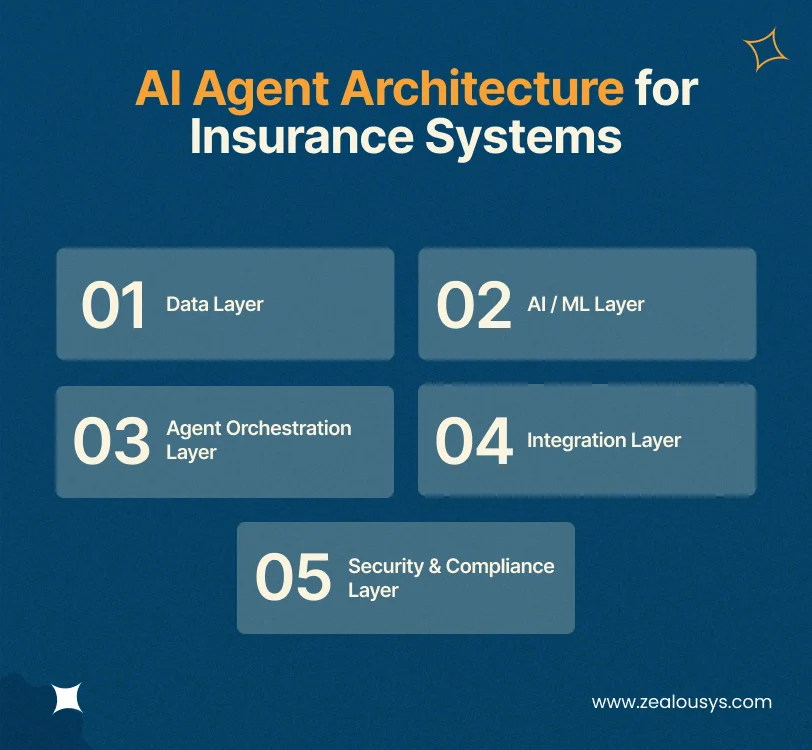
When CTOs and innovation leaders evaluate AI agent development for insurance, they focus on architecture first. A strong architecture ensures scalability, security, compliance, and seamless enterprise AI integration. If you want to implement insurance automation using AI, you must design every layer carefully.
Below is a practical breakdown of how modern AI agents in insurance work at the system level.
The data layer forms the foundation of every insurance AI agent.
Your AI agent collects and processes structured and unstructured insurance data. It analyzes policy data, claims data, and external risk data in real time. It cleans and organizes this information before sending it to the AI models.
Policy Data
The system stores coverage details, premium history, endorsements, exclusions, and renewal records. The AI agent uses this data to automate policy servicing and underwriting decisions.
Claims Data
The platform processes historical claims, settlement timelines, adjuster notes, and payout records. The AI claims processing automation engine identifies patterns and predicts risk exposure.
External Risk Data
The architecture integrates weather feeds, geolocation data, credit scoring systems, and fraud databases. The AI insurance software development strategy becomes stronger when you include external intelligence.
If your data layer is weak, your autonomous AI systems will fail. Clean and well-structured insurance data analytics drive accurate results.
The AI/ML layer powers intelligent automation.
This layer processes data and converts it into actionable decisions. It uses machine learning in insurance to reduce manual intervention and improve underwriting efficiency.
NLP Models
The system uses Natural Language Processing to read policy documents, claim forms, emails, and customer conversations. The insurance AI agent extracts key information automatically. This approach improves AI decision making systems across claims and support workflows.
Risk Scoring Models
The platform trains predictive models to assess claim probability, fraud likelihood, and customer lifetime value. AI underwriting automation becomes faster and more consistent.
Computer Vision Models
The system analyzes property images and damage photos using computer vision. The AI claims processing agent development process includes automated damage assessment. The model estimates repair costs within seconds.
Some enterprises also implement RAG-based AI agents with vector database integration. This setup allows the system to retrieve policy clauses instantly and provide explainable answers.
The orchestration layer makes the insurance AI agent autonomous.
This layer coordinates tasks, triggers workflows, and manages decisions without human supervision. Enterprise AI automation depends heavily on this layer.
Task Planning
The AI agent breaks complex insurance operations into structured tasks. It assigns priorities based on urgency, risk, and compliance rules.
Workflow Automation
The system automatically routes claims to the correct department. It updates CRM records and notifies customers. Insurance automation using AI reduces manual processing delays.
Decision Engine
The decision engine evaluates business rules and model outputs. It approves low-risk claims instantly. It flags high-risk cases for human review. This approach balances automation with governance.
If you want scalable AI agent architecture for insurance systems, you must design orchestration carefully.
Insurance companies operate on legacy systems. Your AI agent must integrate smoothly with existing infrastructure.
Core Insurance Platforms
The AI agent connects with policy administration systems and claims management platforms. It retrieves and updates records in real time.
CRM Systems
The integration layer syncs with CRM tools to track customer interactions. It enables personalized communication.
ERP Systems
The system links financial data and payment workflows. It ensures accurate premium reconciliation and claim payouts.
Third-Party APIs
The architecture integrates with fraud detection databases, credit bureaus, and external risk providers. This enterprise AI integration improves decision accuracy.
Security drives every AI agent development for insurance project.
Insurance companies manage sensitive customer data. They must comply with strict regulations.
GDPR Compliance
The system enforces data minimization and consent management. It tracks how the AI agent uses customer information.
Data Encryption
The platform encrypts data at rest and in transit. It protects policyholder information from breaches.
Access Control
The architecture implements role-based access control. It ensures that only authorized users can access sensitive data.
Enterprises must also implement model explainability and audit logs. Regulators require transparency in AI underwriting automation decisions.
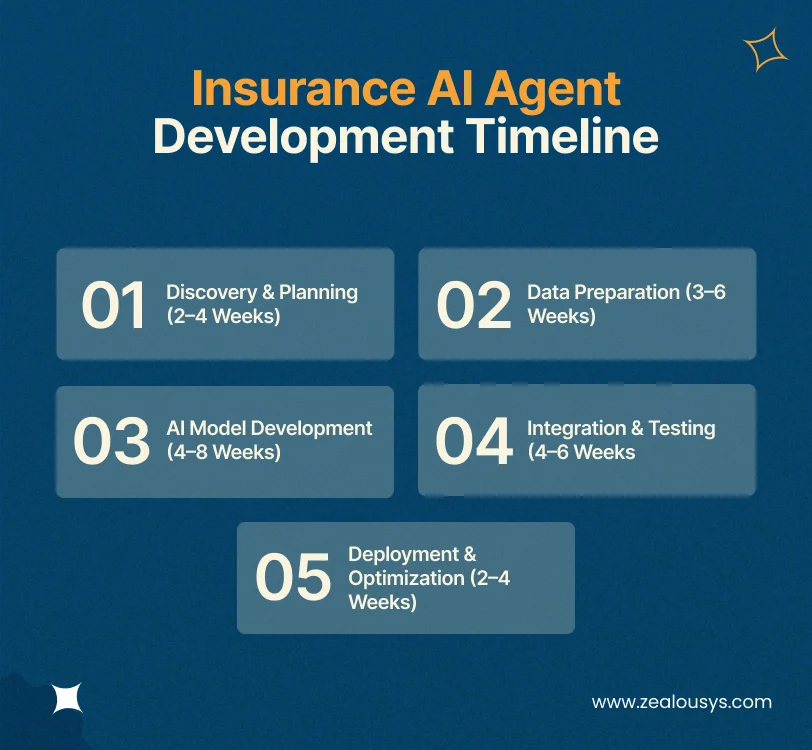
When CTOs and innovation leaders evaluate AI agent development for insurance, they always ask one key question: How long will it take to implement?
An insurance AI agent is not a simple chatbot. It is an intelligent automation system that connects with claims platforms, underwriting engines, CRMs, and legacy policy systems. The timeline depends on complexity, data quality, and integration requirements.
Below is a practical and enterprise-ready roadmap for AI agents in insurance.
Your team defines the business objective clearly.
You identify whether the AI agent will focus on AI claims processing automation, underwriting, fraud detection, or full enterprise AI automation.
This phase creates a clear implementation blueprint for your insurance AI agent.
Your team collects and organizes policy data, claims records, underwriting files, and external risk datasets.
If you plan to use RAG-based AI agents, engineers prepare document repositories and configure vector database integration.
Strong data preparation improves AI decision making systems and ensures reliable machine learning in insurance workflows.
AI engineers build and train models based on your specific use case.
If you require custom AI agent development, engineers configure task orchestration and workflow automation logic.
This stage transforms business logic into intelligent automation.
Developers integrate the insurance AI agent with your core systems.
Teams validate compliance requirements and ensure explainability for underwriting decisions.
This stage ensures your AI agent works smoothly inside your insurance ecosystem.
Teams deploy the solution in a secure cloud or hybrid environment.
Ongoing optimization improves operational efficiency and reduces long-term insurance AI implementation cost.
Insurance leaders evaluating AI agent development for insurance often start with one core question: What will it cost us, and what will we gain?
The cost depends on the complexity of your use case, your existing systems, your data quality, and your compliance requirements. Below is a clear breakdown to help CTOs, CIOs, and InsurTech founders plan their investment with confidence.
The scope of your insurance AI agent directly affects the budget.
If you build a basic AI claims processing automation tool that extracts data and classifies claims, you spend less. If you develop an advanced AI agent that performs underwriting automation, fraud detection, and decision-making using autonomous AI systems, you invest more.
AI agents depend on clean and structured data.
Insurance companies often store data across multiple legacy platforms. You must clean policy data, claims records, underwriting rules, and customer information before training any model.
Data preparation includes:
If your data quality is high, development moves faster. If your data is scattered or inconsistent, your cost increases.
The intelligence layer defines how powerful your AI agent becomes.
You may use:
Custom model training increases cost but delivers stronger accuracy and business value. Pre-trained models reduce cost but may limit customization.
Enterprise AI architecture usually requires testing, fine-tuning, and validation to meet underwriting and claims accuracy standards.
Most insurance companies operate on legacy core systems.
You must integrate your AI agent with:
Enterprise AI integration often becomes the most technically demanding part of the project. Complex integration increases development time and cost.
If you build a standalone MVP, integration remains limited. If you deploy full insurance automation using AI, integration becomes extensive.
Insurance data contains sensitive customer information.
You must implement:
If you operate in regulated markets, you must also support explainability and model transparency. Security-first architecture increases upfront cost but reduces long-term risk.
For enterprise buyers, compliance is not optional. It directly impacts insurance AI implementation cost.
AI agents require continuous improvement.
You must:
Insurance AI software development does not end after deployment. Long-term maintenance ensures stability, performance, and ROI.
The actual cost of AI agent development for insurance depends on scope, system architecture, integration depth, and automation level. Enterprise leaders should evaluate investment based on business impact, scalability, and long-term ROI rather than just initial pricing. Below is a practical cost breakdown for different implementation levels.
An MVP insurance AI agent typically costs between $20,000 and $30,000. At this stage, you build a focused solution for a single use case such as claims document extraction or basic chatbot automation.
You should keep system integration minimal and avoid complex enterprise architecture. You use this phase to test feasibility, validate ROI, and measure efficiency before scaling. InsurTech startups and innovation teams often choose this approach to launch with controlled risk and lower investment.
A mid-level enterprise AI agent solution typically costs between $30,000 and $50,000, depending on integration complexity and intelligence depth. At this level, you combine AI claims processing automation with AI underwriting automation and integrate the system with existing insurance platforms such as CRM and policy management tools.
You deploy intelligent automation across multiple departments. Growing insurance companies choose this approach when they modernize legacy systems and scale enterprise AI integration.
An MVP insurance AI agent typically costs between $50,000 and $150,000. At this level, you build a focused solution for a single use case such as AI claims document extraction, chatbot automation, or basic workflow routing. You keep integration with core insurance systems limited and avoid complex enterprise AI architecture. You test feasibility, validate ROI, and measure efficiency before scaling. InsurTech startups and innovation teams often choose this approach to reduce risk and prove value quickly.
Insurance leaders evaluating AI agent development for insurance must understand the real-world challenges before deployment. Enterprise AI automation delivers strong ROI, but success depends on strategy, architecture, and execution. Below are the most common implementation challenges CTOs, CIOs, and innovation heads face.
Most insurance companies still run on legacy core systems. These systems store policy data, claims records, and underwriting workflows in outdated architectures.
When teams implement an insurance AI agent, they must connect it with existing CRMs, ERPs, and core insurance platforms. Poor integration slows automation and limits performance.
Enterprise architects must design a strong AI insurance architecture that supports API-based connectivity and secure data exchange. Development teams should build a scalable integration layer to ensure seamless enterprise AI integration.
Without proper planning, legacy complexity can increase the overall AI insurance implementation cost.
AI agents in insurance depend heavily on structured and clean data. Claims data, underwriting records, and customer documents often contain inconsistencies.
If teams feed poor-quality data into an insurance AI agent, the system produces inaccurate risk scores and flawed decisions. That issue directly affects underwriting automation and fraud detection accuracy.
Organizations must invest in data cleansing, normalization, and validation before launching AI claims processing automation.
Strong insurance data analytics and governance frameworks improve model performance and reduce long-term risk.
Insurance companies operate under strict regulatory frameworks. Regulators expect transparency, data protection, and auditability in every decision-making system.
When companies deploy AI agents in insurance, they must ensure compliance with regional data privacy laws and industry standards.
Development teams must build secure access control, encryption, and logging mechanisms into the AI agent architecture for insurance systems.
Compliance planning must begin early in the AI agent development timeline to avoid costly redesigns later.
Insurance decisions affect customer trust and financial outcomes. Underwriters and regulators require clear reasoning behind every approval or rejection.
Many autonomous AI systems operate as black boxes. That approach creates risk in underwriting and claims automation.
Organizations must implement explainable AI frameworks within their AI decision making systems.
Developers should design models that provide risk factors, confidence scores, and audit trails. Explainability strengthens trust and supports long-term insurance automation using AI.
Technology alone does not guarantee success. Claims teams, underwriters, and operations heads must trust and use the system.
If employees resist automation, companies fail to achieve ROI from custom AI agent development.
Leadership must train teams and clearly communicate how AI underwriting automation and intelligent automation improve efficiency rather than replace expertise.
Insurance companies should roll out AI agents in phases. They should start with assistive workflows before moving to full automation. This approach improves adoption and reduces operational friction.
AI is no longer optional in the insurance industry. Companies that invest in AI agent development for insurance gain faster claims processing, smarter underwriting, and stronger fraud detection. By partnering with an experienced AI agent development company offering end-to-end AI development services, insurers can design intelligent systems tailored to their operational needs. An insurance AI agent goes beyond basic automation. It enables intelligent automation across operations and integrates with legacy systems to improve efficiency without disrupting core workflows. This approach helps insurers reduce operational costs, improve accuracy, and deliver better customer experiences.
The right AI insurance architecture, secure technology stack, and clear implementation roadmap determine long-term success. A reliable AI agent development company ensures seamless integration, compliance, and scalability through structured AI development services. Development cost and timeline depend on use case complexity and system integration needs, but early adopters gain a strong competitive advantage. Insurance leaders who act now position their organizations for scalable enterprise AI automation and measurable ROI in a rapidly evolving market.
Our team is always eager to know what you are looking for. Drop them a Hi!

Pranjal Mehta is the Managing Director of Zealous System, a leading software solutions provider. Having 10+ years of experience and clientele across the globe, he is always curious to stay ahead in the market by inculcating latest technologies and trends in Zealous.




Comments