You lead a startup, manage operations in retail, or direct IT for a manufacturing operation. One persistent challenge stands out: anticipating customer needs with precision. AI demand forecasting software addresses this directly. It harnesses artificial intelligence to sift through data patterns, guiding choices on stock levels, output schedules, and revenue streams.
Today’s markets shift without warning. A sudden surge or disruption can leave you exposed to excess inventory or unmet orders. As per an IHL study, Inventory mismatches alone cost retailers $1.77 trillion worldwide each year. What is AI demand forecasting? It replaces reliance on intuition with evidence-based strategic planning. Demand forecasting software like this provides steady, data-rich guidance, safeguarding your processes and financial health.
AI demand forecasting software is built to predict customer needs through artificial intelligence. At its heart, what is AI demand forecasting? It’s the application of advanced algorithms to process complex data sets, moving beyond basic historical reviews to deliver forward-looking estimates. This software examines everything from purchase histories to emerging trends, helping leaders anticipate shifts before they hit.
Demand forecasting software like this stands out for its ability to handle real-time inputs. Consider integrating sales figures alongside external signals, such as economic reports or consumer sentiment. AI in demand forecasting makes sense of these layers, generating outputs that guide resource allocation with clarity.
For teams in retail or manufacturing, AI-driven demand prediction integrates smoothly into daily workflows. It supports decisions on everything from restocking to production runs, fostering a proactive stance. In essence, this technology equips your business to meet demand head-on, without the pitfalls of outdated approaches.
AI demand forecasting software operates through a structured yet flexible process that turns raw information into practical predictions. It begins with data collection. The system gathers sales records, customer interactions, and external factors such as market reports. This foundation ensures the forecasts reflect a complete view of influences at play.
From there, AI in demand forecasting employs machine learning for demand forecasting to uncover insights. Algorithms scan the data for patterns, such as recurring seasonal upticks or correlations between promotions and sales volume. These models adjust automatically as new information flows in, refining their accuracy over time without constant manual tweaks.
The final step delivers clear, usable results. Demand forecasting software generates reports, charts, and alerts that highlight potential demand shifts. For instance, it might flag a surge in orders for a specific item weeks ahead. This cycle of gathering, analyzing, and output repeats seamlessly, making AI-driven demand prediction a reliable engine for your operations.
AI demand forecasting software delivers measurable gains that strengthen both your bottom line and day-to-day efficiency. One standout advantage lies in heightened accuracy; models process vast data streams to spot trends that manual methods overlook. This precision helps avoid the common pitfalls of overproduction or shortages, smoothing out your operations from day one.
Beyond accuracy, the benefits of AI demand forecasting extend to substantial cost controls. By fine-tuning inventory to match real needs, businesses cut down on excess stock and related expenses. Predictive analytics in business plays a key role here, turning raw numbers into strategies that save resources and free up capital for growth.
How AI improves business forecasting shows up in faster responses to market changes, too. Whether it’s a sudden trend or supply snag, the software equips you with timely insights. Operations managers find themselves ahead of the curve, building resilience that pays off over time.
Demand forecasting software adapts to key sectors, delivering targeted results through AI demand forecasting software. Below, we break down its applications in retail, manufacturing, eCommerce, and supply chains, with real-world examples for clarity.
In retail, AI demand forecasting software helps chains like Walmart predict store-level demands. It combines point-of-sale data, weather forecasts, and social trends to guide restocking. Walmart’s system, for example, improved forecast accuracy by up to 15 percent, reducing waste on perishables while ensuring availability during high-traffic periods. This keeps operations lean and customer satisfaction high.
Manufacturers turn to AI-driven demand prediction for reliable component planning, as Lenovo demonstrates. Their multi-tiered forecasting uses deep learning models like Deep AR, integrated with centralized data hubs, to navigate supply fluctuations. This cuts error rates and assembly delays, supporting just-in-time manufacturing without excess stockpiles. The focus stays on efficiency, even in uncertain markets.
For eCommerce, AI forecasting tools for eCommerce excel at real-time analysis, much like Amazon’s setup. These systems review browsing habits, ad responses, and promotions to anticipate item surges. Amazon saw a 25 percent reduction in stockouts, enabling seamless fulfillment for trends that emerge overnight. It converts data overload into a competitive strength.
AI in supply chain forecasting unifies the process, as shown in C3 AI’s collaboration with a consumer goods company. The platform processes varied inputs to create daily plans, enhancing accuracy and disruption handling. This leads to fewer bottlenecks from procurement to shipping, with teams gaining a clear, actionable overview. These AI demand forecasting examples prove its versatility across operations.
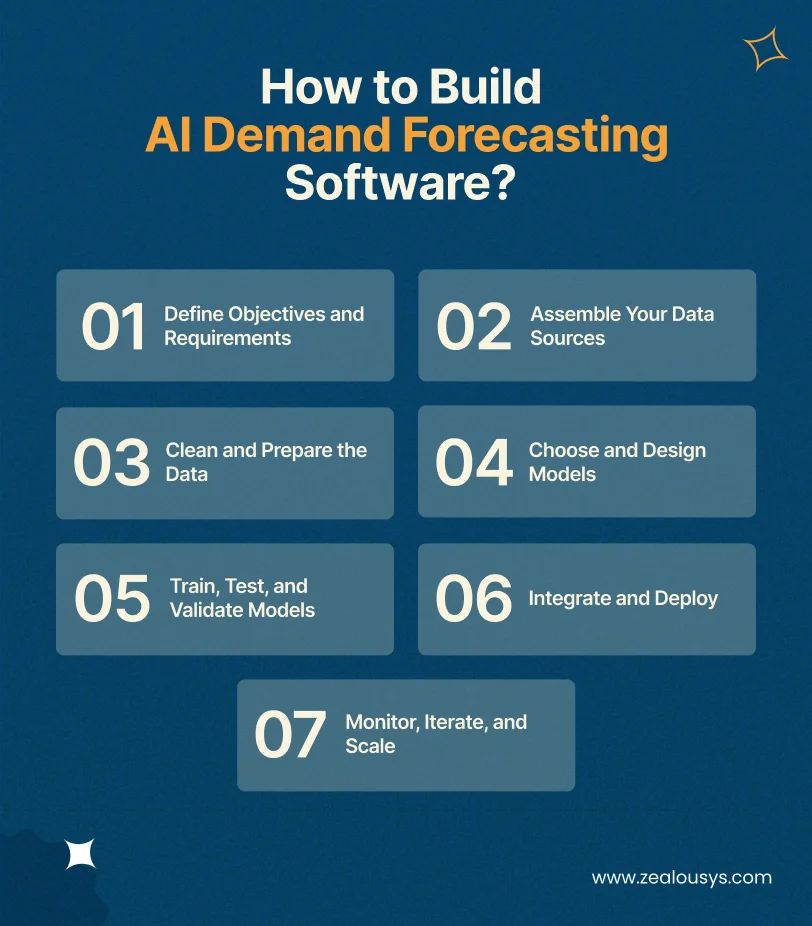
Building AI demand forecasting software calls for a step-by-step plan that matches your business goals with proven tech practices. Whether you’re a startup founder eyeing custom tools or an IT director in manufacturing, this process turns complex ideas into practical systems. Demand forecasting software built this way becomes a core driver for decisions, from stock planning to sales targets.
Follow these seven key steps to create a system powered by AI in demand forecasting. Each builds toward a deployable solution, with tips to keep things efficient. Here’s how to move from concept to a working solution.
Outline what success looks like for your project. Pinpoint needs, such as handling seasonal retail spikes or eCommerce trends. Gather input from teams to set measurable goals, like achieving 90% forecast accuracy. This clarity shapes the entire build, ensuring AI-driven demand prediction aligns with real operations.
Identify and collect relevant data streams, including sales logs, customer profiles, and external feeds like market indices. Prioritize secure, accessible sources to avoid bottlenecks later. For demand forecasting tools for businesses, blending internal ERP data with public APIs creates a rich foundation. Aim for volume and variety to fuel accurate models.
Analyze your dataset for errors, duplicates, or gaps using scripts in tools like Python’s Scikit-learn. Normalize formats and handle missing values through imputation techniques. Quality here directly impacts what is AI demand forecasting; poor prep leads to unreliable outputs. Test subsets early to confirm readiness. Once your data is reliable, you can turn your focus to model design.
Select algorithms based on your data type: time-series like Prophet for trends or neural networks for intricate patterns. Sketch the architecture, factoring in scalability for growth. Machine learning for demand forecasting thrives on this match: start simple, then layer in complexity as tests reveal needs. Document choices for team review.
Feed prepared data into your models, splitting into training and validation sets. Run iterations, measuring against metrics like MAPE for error rates. Adjust hyperparameters to boost performance. This phase validates the AI demand forecasting software’s core engine, catching issues before full rollout.
Connect models to your ecosystem via APIs or microservices. Use platforms like Docker for portability. Launch in a staged environment, pilot with one department first. Ensure seamless ties to tools like inventory systems. For offshore AI development for enterprises, this step emphasizes version control for smooth handoffs.
Set up dashboards to track live performance, alerting on drifts from actual demand. Retrain models quarterly with fresh data to maintain an edge. Gather user feedback for refinements. Ongoing tweaks keep your demand forecasting software responsive, adapting to new business realities over time.
AI demand forecasting software unlocks powerful predictions, yet it comes with hurdles that can trip up even seasoned teams. From data pitfalls to adoption barriers, these issues demand thoughtful strategies to overcome. Addressing challenges in AI demand forecasting head-on ensures your investment yields reliable, scalable results, keeping operations agile in volatile markets.
Incomplete or noisy data often undermines AI models, leading to skewed forecasts that misguide inventory or production. In data-light settings, companies struggle to train effective systems without historical depth.
To counter this, prioritize data governance: Implement automated cleaning routines and augment datasets with external sources like market indices. Regular audits, paired with techniques from McKinsey’s playbook for sparse environments, build a solid base for data-driven demand forecasting.
Once data quality is addressed, integration becomes the next challenge.
Linking AI demand forecasting software to legacy ERP or CRM platforms can create silos, delaying insights and increasing errors. Mismatched formats or outdated infrastructure amplify the friction. Start with modular APIs for phased rollouts, testing compatibility in sandboxes first.
Collaborate with IT early to map workflows, ensuring seamless data flow without overhauls, much like how Forbes highlights hybrid approaches in supply chain AI.
Even the most advanced systems face another issue: unpredictability. Standard models falter against black swan events, such as supply disruptions or sudden demand drops, as they rely on past patterns that don’t repeat. This leaves businesses reactive rather than prepared. Incorporate scenario modeling and ensemble methods that simulate outliers, drawing from diverse training data.
Human-AI hybrids, as outlined in MIT Sloan research, refine these by blending algorithmic outputs with expert judgment for resilient predictions.
As data volumes grow, AI systems strain under computational demands, hiking costs and slowing performance for larger enterprises. Budget limits further complicate access to advanced tools. Opt for cloud-based architectures with auto-scaling features to handle spikes efficiently.
For cost control, begin with open-source frameworks and monitor ROI through pilot metrics, strategies that ease financial pressures noted in industry analyses from PMC studies.
Teams may lack expertise in interpreting AI outputs or maintaining models, fostering resistance and underutilization. This gap slows value realization across operations. Bridge it with targeted training programs and cross-functional workshops that demystify the tech.
Partnering with consultants for initial setups accelerates uptake, turning skeptics into advocates while building internal capabilities over time.
Zealous System emerges as a strong partner for crafting AI demand forecasting software, backed by more than 15 years of delivering bespoke tech solutions. Their expertise in offshore AI development for enterprises shines through in projects that embed machine learning for demand forecasting right into your core systems. From retail chains optimizing stock to manufacturers syncing production, clients gain tools that sharpen predictions and scale effortlessly.
This collaboration goes beyond code; it ensures the solution aligns precisely with your operations. Zealous System manages the full lifecycle, ensuring AI-driven demand prediction meshes with your ERP or CRM without hitches. Their global teams work in sync with yours, cutting costs while upholding top-tier quality.
Consider these key reasons to team up:
For leaders eyeing reliable growth, Zealous System turns AI ambitions into operational wins.
AI demand forecasting software emerges as an essential ally for businesses tackling tomorrow’s uncertainties with today’s data. From retail shelves stocked just right to manufacturing lines humming without waste, its role in sharpening predictions and streamlining supply chains proves indispensable.
What is AI demand forecasting if not a bridge to smarter, more responsive operations? As you’ve seen, the benefits of AI demand forecasting extend across accuracy, cost savings, and agility, empowering startups and enterprises alike.
When it’s time to bring this vision to life, partnering with a trusted AI software development company can accelerate your path forward. Hiring AI developers who specialize in machine learning for demand forecasting ensures a custom fit that evolves with your needs.
Consider how offshore expertise turns complex builds into seamless realities, unlocking efficiencies that drive lasting growth. Your operations deserve this edge. Take the step toward data-driven decisions that shape success.
Our team is always eager to know what you are looking for. Drop them a Hi!

Pranjal Mehta is the Managing Director of Zealous System, a leading software solutions provider. Having 10+ years of experience and clientele across the globe, he is always curious to stay ahead in the market by inculcating latest technologies and trends in Zealous.




Comments