Electronic health records and electronic medical records store essential patient information every single day. Hospitals, clinics, and larger health networks often still depend on platforms built some time ago. Most platforms handle scheduling, lab results, and patient records reliably, but they seldom move beyond documentation. They do little to help clinicians spot patterns quickly or weigh complex decisions under pressure.
You understand the daily pressures involved. Healthcare leaders need higher levels of precision, quicker turnaround times, and full regulatory adherence, all without letting expenses spiral. Bringing artificial intelligence into your present EHR or EMR environment addresses those requirements head-on. It strengthens decision support and streamlines daily workflows without requiring a full system replacement.
This guide explains, step by step, how to integrate AI with existing EHR systems. It reviews the main reasons to proceed, presents actual use cases, walks through the necessary steps, discusses expected costs, and points out reliable methods to handle potential hurdles.
Healthcare organizations rely on digital platforms to keep patient information secure and accessible. Electronic medical records, or EMRs, function as the digital version of a patient chart. They stay limited to one practice or clinic. These records capture visit notes, prescriptions, and lab results produced within that single location.
Electronic health records, or EHRs, work on a larger scale. They pull together data from multiple providers and care sites. The wider reach creates a more complete view of a patient’s health journey. Care teams gain better coordination when patients move between primary doctors, specialists, and hospitals.
That difference determines who can access data, how quickly it moves, and where it tends to stall. EMRs focus on internal documentation and daily tasks. EHRs add support for secure sharing and broader reporting needs.
Both types cover the same core details: patient history, medications, allergies, and treatment plans. They support the daily demands of clinical data management without unnecessary complexity.
A clear understanding of these systems removes guesswork later. It becomes especially helpful when you begin to integrate AI with existing EHR systems or explore AI integration with EMR platforms. That clarity helps you make decisions that fit your current workflows and future plans.
Patient data keeps expanding in both volume and complexity. Current EHR and EMR platforms handle basic storage and retrieval without issue. Still, they often fall short when care teams need quick, actionable insights from that information. Clinicians spend additional time connecting details that could otherwise inform faster decisions.
In practice, the gap becomes obvious during busy clinics and complex cases. Important patterns in test results or treatment responses can remain hidden during rushed shifts. AI reviews large volumes of records at once and surfaces connections at the moment decisions are being made.
According to Research and Markets, the AI-enhanced EHR market grew from $7.33 billion in 2024 to $9.6 billion in 2025, at a 31% CAGR, driven by demand for clinical decision support and workflow automation. This rapid expansion reflects the clear shift happening across healthcare organizations right now.
AI in EHR and EMR systems scans thousands of data points in seconds. It surfaces potential risks, such as overlooked allergies or emerging complications, before they escalate. Providers gain practical support that fits seamlessly into their existing review process.
Daily tasks like pulling records or checking interactions become quicker and less error-prone. Staff shift focus from repetitive searches to direct patient care. The change eases workload pressure across clinics and hospital departments alike.
When records span multiple providers, AI highlights gaps or updates that might otherwise go unnoticed. Care teams close follow-up loops more reliably. Patients experience more consistent attention and fewer avoidable setbacks.
These practical improvements explain why many healthcare leaders are exploring AI integration with EMR platforms and EHR environments. The move builds directly on systems already in place rather than requiring full replacement. Over time, integrating AI into existing EHR systems supports safer care, quicker decisions, and steadier operations.
Also Read: How to Build a HIPAA-Compliant EMR App for Your Healthcare Practice
Practical applications of AI show immediate returns when connected to existing records platforms. In fact, 86% of healthcare organizations, including physicians, nurses, and IT leaders, already use AI, primarily for administrative tasks in EHRs, with expectations for expanded clinical roles like record review. These uses address daily challenges that clinicians and administrators face without requiring a full system replacement. Each use case builds on data your system already collects.
AI reviews charts as they are updated and highlights what a clinician might otherwise miss. It highlights potential drug interactions, missed diagnoses, or guideline deviations during chart review. Providers receive concise alerts that fit directly into their workflow rather than adding extra steps.
Models examine historical patterns across records to forecast risks such as hospital readmissions or disease progression. Care teams adjust plans earlier based on these signals. The process relies on the structured data already stored in EHR and EMR platforms.
Free-text entries in progress notes contain valuable details that structured fields often miss. NLP extracts key information such as symptoms, follow-up instructions, or subtle changes in condition. This turns scattered documentation into searchable, actionable insights without manual re-entry.
Routine tasks like coding diagnoses or checking insurance eligibility consume significant staff time. AI reviews records and suggests accurate codes or flags incomplete entries before submission. That reduces claim rejections and shortens reimbursement timelines.
Aggregated data from multiple patients reveals trends across groups sharing similar conditions or demographics. Teams identify high-risk cohorts and target preventive programs more effectively. This capability becomes available once AI connects to the broader data layer in your EHR environment.
Together, these use cases show where AI earns its place inside clinical systems. They form the foundation for any plan to integrate AI with existing EHR systems while preserving current investments and workflows.
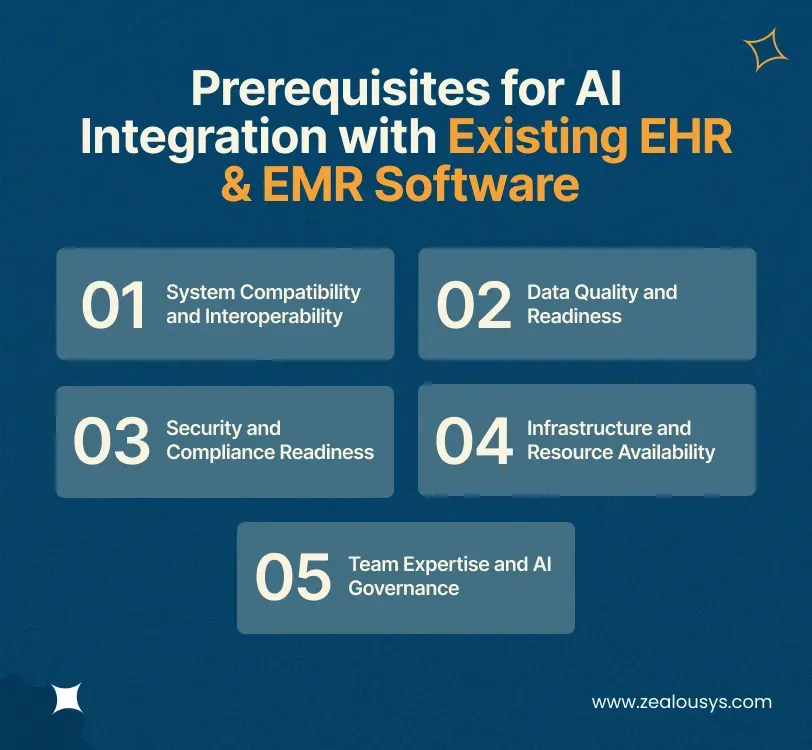
Successful AI projects in healthcare rest on solid preparation. Jumping straight into code or models without the right foundations often leads to delays, rework, or compliance issues. Several core elements must be in place first. These prerequisites protect patient information while ensuring the integration actually delivers value.
Review the technical capabilities of your current platform. Look for available APIs, support for FHIR standards, and HL7 integration options. Legacy systems may need middleware or updates to allow secure, real-time data exchange with AI components. Without this groundwork, AI tools cannot read or write data reliably.
AI performs best with consistent, accurate information. Examine your records for completeness, duplicate entries, and standardized formats across departments. Clean and normalize the data sets that matter most for your intended use cases. Poor data quality at this stage creates unreliable outputs later.
Patient data privacy remains non-negotiable. Confirm that your environment already meets HIPAA requirements and other relevant regulations. Plan for encrypted data flows, audit trails, and access controls specific to AI interactions. Addressing this early avoids painful fixes after the system is already handling live patient data.
AI workloads demand reliable computing power and storage. Assess whether your on-premise servers, cloud setup, or hybrid environment can handle the additional load. Factor in scalability needs and any upgrades required for real-time processing. Budget and timeline planning start here.
Integration involves more than technology. Assemble or train staff who understand both clinical workflows and AI principles. Establish clear policies for model oversight, bias monitoring, and decision accountability. Strong governance keeps the entire effort aligned with organizational goals and ethical standards.
Meeting these prerequisites for AI integration with existing EHR & EMR software prevents delays that derail many AI initiatives. It creates a stable base for the detailed steps that follow and helps you integrate AI with existing EHR systems in a controlled, effective manner.
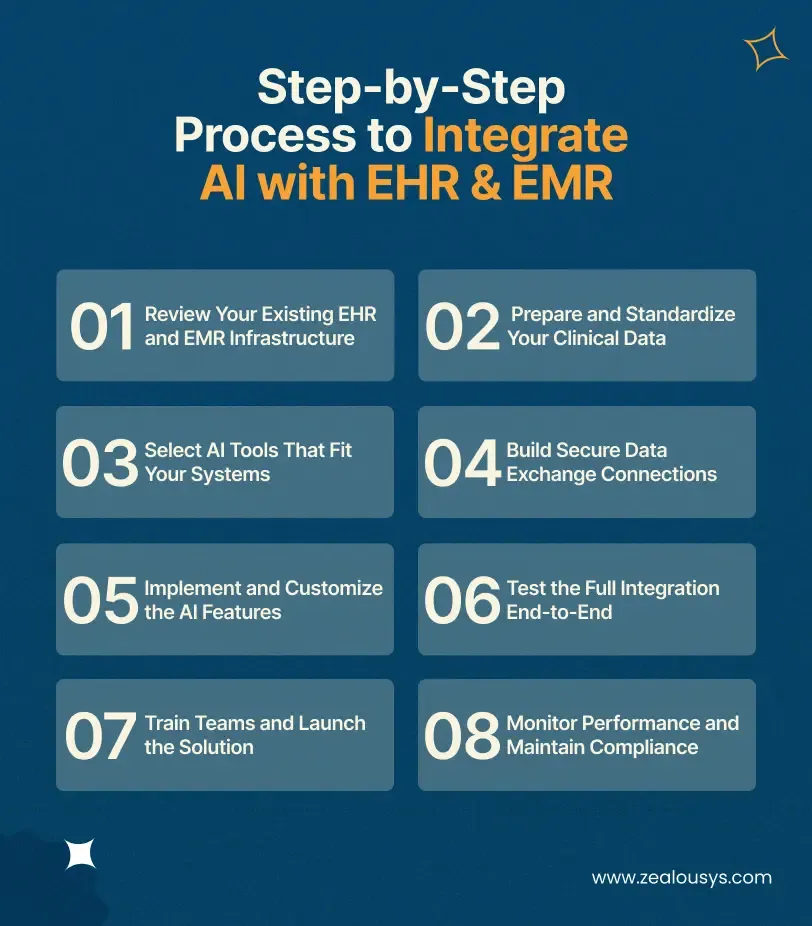
Connecting AI to existing platforms requires a disciplined sequence that protects patient data and limits disruption. This step-by-step process to integrate AI with EHR systems keeps each phase focused and manageable for busy healthcare teams.
The first step is to document exactly what you have today. Map every module, database structure, and available API endpoint in your current setup. Note any legacy components that may limit real-time access. That assessment makes it clear where AI can connect cleanly and where adjustments are needed.
Next comes the most critical preparation phase. Identify the key data sets needed for your chosen AI use cases and bring them into consistent formats. Remove duplicates, fill missing fields, and apply uniform coding across departments. Clean data at this stage prevents flawed outputs once the models go live.
In this step, you evaluate ready-made or custom AI solutions. Compare vendors based on their proven FHIR and HL7 integration experience and compatibility with your specific EHR or EMR version. Request sandbox demonstrations using your own sample data. The right choice aligns technical requirements with your budget and timeline.
Now establish the actual links. Configure APIs or middleware that allow bidirectional, encrypted flow between your records platform and the AI layer. Test these connections under realistic loads while maintaining full audit trails. Strong interfaces ensure AI receives fresh information without compromising healthcare data security.
With connections ready, the next phase focuses on deployment. Configure the selected models for your specific workflows and fine-tune them using your prepared data. Start with one focused use case, such as clinical decision support alerts, before expanding. This controlled rollout lets you verify value quickly.
Before going live, run thorough validation across real scenarios. Simulate daily clinical tasks, edge cases, and peak-hour volumes to confirm accuracy and speed. Involve end users in the testing so any workflow friction surfaces early. Complete this step only when every output meets both technical and clinical standards.
The final implementation step centers on people. Deliver targeted training sessions that show exactly how AI assists rather than replaces daily routines. Roll out in phases, beginning with a pilot group, and gather immediate feedback. A smooth launch depends on staff confidence as much as technical performance.
Integration does not end at launch. Set up ongoing dashboards to track accuracy, response times, and any emerging issues. Schedule regular reviews to update models as new data or regulations appear. Ongoing review is what keeps the connection stable and within regulatory bounds.
Following this structured approach gives you a repeatable path to successful AI integration with existing EHR & EMR. Because each phase builds on the previous one, adjustments remain manageable instead of disruptive. When done carefully, the system improves clinical support without disrupting daily operations.
The cost of integrating AI with EHR & EMR systems varies based on the scale you choose and how closely the solution must align with daily clinical work. Some organizations begin with a limited pilot, while others invest in broader capabilities across departments and sites. The three levels below reflect typical project scopes seen across clinics, hospitals, and health networks in recent implementations.
Basic MVP integration usually falls in the $20,000–$30,000 range for the first year. It delivers one focused capability, such as automated note summarization or simple risk alerts, using pre-built models with standard API connections. Key considerations include minimal data cleaning, quick deployment on existing cloud setups, and limited staff training. This route suits single-location clinics testing the waters without major workflow changes.
Mid-scale AI integration typically runs between $30,000 and $50,000 initially. It connects several features at once, including predictive readmission tools and basic administrative automation across departments or sites. Core elements involve deeper data standardization, secure middleware development, and targeted training for multiple user groups. This level balances meaningful impact with controlled spending for mid-sized hospitals or clinic groups.
Enterprise-grade platform integration generally starts at $50,000 and can reach $1,20,000 or more for full rollout. It supports organization-wide use cases with bidirectional data flow, advanced governance, and high-availability performance across all locations. Key considerations cover extensive legacy system bridging, comprehensive compliance auditing, and ongoing model monitoring at scale. Large health systems choose this path when AI must become a core part of every clinical and operational process.
Several practical elements influence the final investment. Here are the main ones:
These details on the cost of AI integration in EHR systems help you set a realistic budget and plan ahead for ongoing expenses. With cost expectations defined, execution becomes the next priority.
The difference between an integration that delivers lasting value and one that creates ongoing headaches lies in how carefully you apply proven practices along the way. These practices protect patient safety, preserve your existing systems, and encourage real adoption among clinical teams.
The best starting point is to test AI on one focused use case inside a single department. Pick something with a clear daily impact, such as automated note extraction or basic risk alerts. Run the pilot for a defined period, collect real feedback, and adjust before moving further. Testing in phases reveals weak points before they spread and helps staff trust what they are using.
Next, include physicians, nurses, and administrative users from the very first discussions. Their daily experience shapes how AI outputs appear in workflows and prevents features that feel added on rather than helpful. Schedule regular review sessions throughout the project. When frontline teams help design the solution, adoption happens faster and with far less resistance.
In this area, treat healthcare data security as a core requirement rather than a final checklist item. Build encryption, role-based access, and full audit trails directly into the AI connections. Conduct independent reviews at each major milestone to confirm ongoing HIPAA alignment. This consistent focus avoids costly retrofits later.
Define exactly who owns model decisions, how bias gets reviewed, and what escalation paths exist when clinicians disagree with AI suggestions. Document these rules in simple, accessible policies that everyone can reference. Assign dedicated roles for oversight so accountability stays clear. Strong governance keeps the entire effort aligned with both clinical standards and organizational values.
Make sure every connection follows FHIR standards and supports smooth HL7 exchange with your current platforms. Test data flows not just in ideal conditions but during peak hours and across all linked systems. This preparation removes future barriers when you want to add new tools or expand to additional sites. True interoperability turns your EHR into a flexible foundation instead of a limitation.
Plan more than one introductory session. Create short, practical modules tailored to doctors, nurses, and billing staff so each group sees exactly how AI fits their tasks. Provide on-site champions and quick-reference materials during the first months of live use. Ongoing support reduces frustration and helps teams discover new ways the AI can assist them.
The final practice is to treat the integration as an ongoing process rather than a one-time project. Track accuracy, response times, and user satisfaction through simple dashboards. Schedule quarterly reviews to retrain models with fresh data and address any drift. This habit keeps the AI relevant as care practices and regulations change.
Following these best practices for successful AI-EHR integration gives you the greatest chance of smooth results when you integrate AI with existing EHR systems. They turn potential challenges into manageable steps and help your teams gain real value from the technology without unnecessary disruption.
Integrating AI with existing EHR systems gives healthcare organizations a practical way to gain faster insights and smoother daily operations from the platforms they already rely on. The full process, from assessing prerequisites through careful implementation and ongoing monitoring, keeps patient data secure while delivering clear improvements in decision support and coordination. Organizations that approach the process methodically reduce risk and make better use of the systems they already own.
The real advantage comes when AI works quietly alongside familiar EHR and EMR software rather than forcing a complete replacement. Clinical teams notice fewer manual tasks, administrators gain better visibility, and patients benefit from more consistent care. When the groundwork is solid, AI fits into daily operations without disrupting what already runs well.
We at Zealous System specialize in custom healthcare software development services that make AI integration with existing EHR systems reliable and effective. Our focus stays on building secure, compliant connections tailored to your specific EHR and EMR software environment, so the transition supports your goals without unnecessary disruption.
You now have a clear framework for moving forward. Apply it with clarity and steady execution.
1. How long does it typically take to integrate AI with existing EHR systems?
Basic integrations typically require 3 to 6 months from assessment to production deployment. Mid-scale integrations usually need 6 to 12 months. Larger enterprise efforts can run 12 to 18 months when multiple locations and older platforms are involved. The exact timeline depends on data readiness and team availability.
2. Can I integrate AI with my legacy EMR without replacing the whole system?
Yes, in nearly every case. The process uses APIs or lightweight middleware to connect AI tools to your current EMR without a full overhaul. This keeps your existing workflows intact while adding new capabilities. Early infrastructure review confirms exactly what adjustments, if any, are needed.
3. Does AI integration with EHR and EMR systems stay HIPAA compliant?
It must, and it can when done correctly. Security measures such as encryption, access controls, and audit trails are built in from the first step. Independent reviews at each phase keep everything aligned with current regulations. Strong governance prevents compliance gaps as the project grows.
4. What are the biggest challenges when adding AI to existing EHR platforms?
Data quality problems and staff adoption lead the list. Older systems often need extra work to enable smooth, real-time connections. Clear communication and early involvement of clinical teams reduce resistance and keep the project on track.
5. Do small clinics need special infrastructure to start AI integration with EMR?
No. Many start successfully with standard cloud or hybrid setups already in place. Focus first on one simple use case and scale only as results appear. The prerequisites checklist shows exactly what your current environment must support.
6. How do I make sure clinical teams actually use the new AI features?
Involve doctors and nurses from the planning stage so the tools fit real daily routines. Deliver short, role-specific training and provide quick-reference support during the first weeks. Visible wins, such as faster note review or fewer missed alerts, build confidence fast.
7. What is the smartest way for a hospital to begin AI integration with existing EHR systems?
Start with a single high-impact use case inside one department. Run a short pilot, measure results, and gather direct feedback before expanding. This controlled approach limits risk and proves value quickly to leadership and frontline staff.
Our team is always eager to know what you are looking for. Drop them a Hi!

Pranjal Mehta is the Managing Director of Zealous System, a leading software solutions provider. Having 10+ years of experience and clientele across the globe, he is always curious to stay ahead in the market by inculcating latest technologies and trends in Zealous.




Comments