Logistics leaders deal with tight margins and high expectations every day. Shipments get delayed, routes waste fuel, and customers want constant updates. AI-powered logistics software tackles these problems by turning live operational data into timely, practical decisions your team can act on immediately.
In the sections ahead, you will see exactly how to plan, design, and launch an AI-powered logistics platform that fits your operations. You will learn about the key features that matter most, the architecture that supports growth, and the factors that influence AI logistics software development cost.
Whether you manage day-to-day logistics or lead digital initiatives, these details provide a solid foundation. Use them to assess your current setup or plan a new custom AI logistics platform development project.
AI-powered logistics software is a specialized platform that brings artificial intelligence directly into the daily operations of supply chains. It gathers information from vehicles, warehouses, shipments, and external sources, then applies intelligent algorithms to automate decisions and spot patterns humans might miss.
At its heart, this software moves far beyond basic tracking or scheduling tools. Traditional systems follow set rules and historical data alone. AI-powered logistics software, however, learns continuously from real-time inputs such as traffic updates, weather changes, and order volumes. It then adjusts plans on the fly to avoid disruptions before they occur.
The platform typically handles end-to-end processes in one connected environment. From demand forecasting and route planning to inventory placement and predictive maintenance, every element works together to support smoother operations. For freight forwarders, fleet managers, and warehouse teams, it creates a single source of reliable intelligence rather than scattered reports.
In practice, AI logistics software with these capabilities helps leaders respond faster to daily challenges while maintaining control over complex networks.
According to research from The Business Research Company, the global AI in logistics market reached approximately $26.33 billion in 2025. It is projected to grow to $38.68 billion in 2026, reflecting unusually rapid adoption across transportation, warehousing, and supply chain planning.
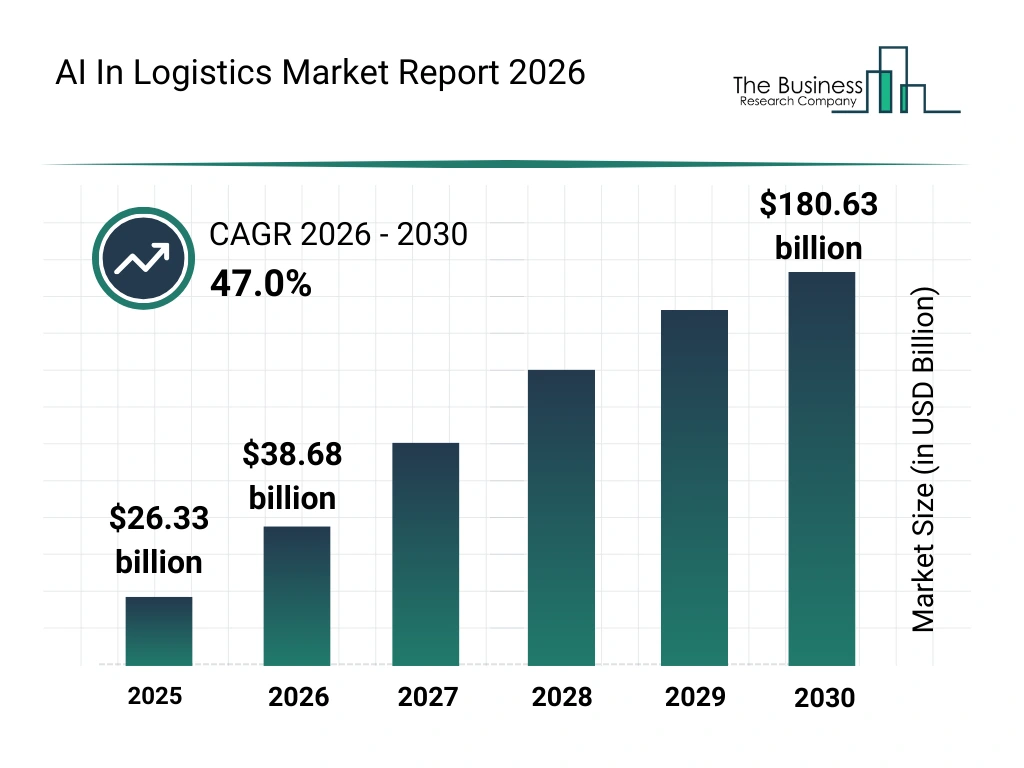
Looking ahead, the market is estimated to reach $180.63 billion by 2030, with a compound annual growth rate of roughly 47 percent throughout the forecast period.
This pace of growth is not driven by experimentation alone. Logistics companies are moving from pilot programs to production systems. AI is now being applied to route planning, demand forecasting, warehouse robotics, freight visibility, and exception management. The need to accelerate delivery times, cope with increasing fuel prices, and deal with uncertain demand has made intelligent automation less of a choice than it was a few years ago.
For CEOs and CTOs considering custom development, these numbers signal something practical. AI in logistics is not an early-stage innovation. It is becoming core infrastructure. Companies that develop scalable, AI-enabled technologies are now preparing themselves for a rapidly rising industry with steady capital investment.
AI-powered logistics software stands out because it turns raw data into decisions that keep operations running smoothly. The right features directly address the daily pain points that logistics leaders face, such as unpredictable delays, rising costs, and visibility gaps.
When you evaluate or plan to build AI logistics software, these capabilities form the core of what actually delivers results across freight, fleet, warehouse, and last-mile operations. Here are the key features that matter most:
The system pulls live data from GPS devices, sensors, and traffic sources to show exactly where every shipment sits. It flags potential delays hours or even days in advance so teams can reroute or notify customers without last-minute stress. This single view replaces multiple spreadsheets and phone calls.
Algorithms review current road conditions, vehicle availability, and order priorities to build and adjust routes throughout the day. Dispatch teams receive clear recommendations that reduce empty miles and keep drivers on schedule even when unexpected events occur.
The software studies historical patterns alongside current market signals to predict order volumes weeks in advance. Warehouse managers then position stock in the right locations, cutting down on rush transfers and stockouts that hurt service levels.
Sensors on trucks and warehouse machinery feed data into models that spot wear before breakdowns happen. Maintenance schedules shift from fixed calendars to condition-based plans, so fleets stay on the road longer with fewer surprise repairs.
AI guides picking paths, packing sequences, and storage assignments based on order profiles and space availability. Teams process more orders with fewer errors, and the system adapts instantly when inbound volumes spike.
The platform compares carrier rates, capacity, and compliance rules in real time to suggest the best carrier for each load. It also supports dynamic pricing adjustments that reflect actual market conditions without manual calculations.
Delivery windows, driver locations, and customer preferences come together in one engine that sequences stops for maximum efficiency. Customers receive accurate time slots and live updates that improve satisfaction scores.
The software continuously scans for unusual patterns in transit times, temperature readings, or inventory levels. Early warnings allow teams to contain issues before they affect multiple shipments or compliance standards.
Individually, each feature solves a problem. Together, they create operational clarity across the network.
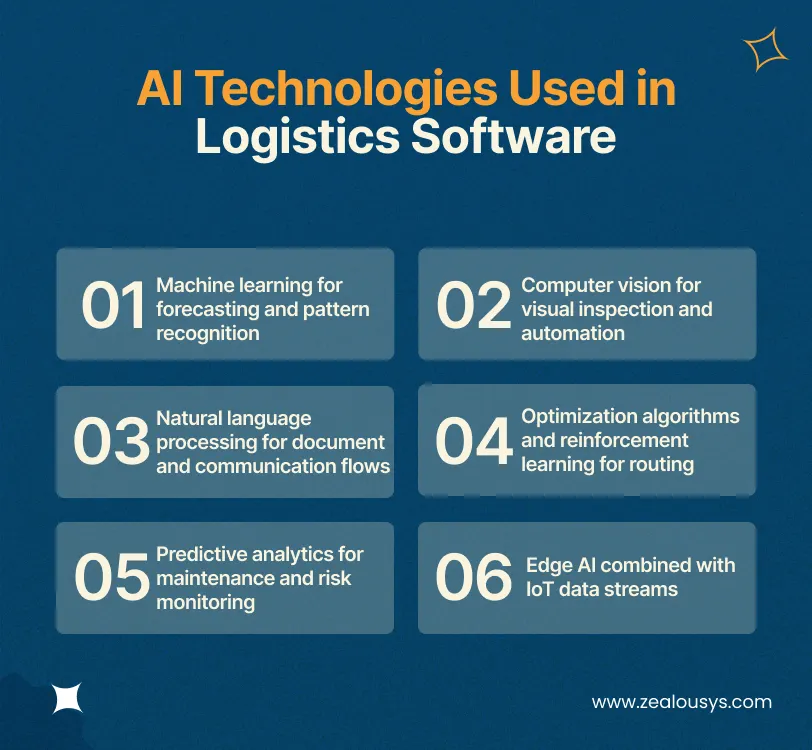
AI-powered logistics software depends on specific technologies that process live data and deliver decisions you can trust. These tools handle the volume, speed, and variety of information that moves through warehouses, trucks, and distribution networks every hour.
When chosen carefully, these technologies shift your system from rule-based automation to data-driven decision making. It learns patterns, adjusts plans, and flags issues before they become problems.
Here are the core technologies that power effective AI logistics software today:
Algorithms review past shipment volumes, weather records, and market signals to anticipate demand shifts. You gain clear projections that guide inventory placement and capacity planning weeks in advance.
Cameras paired with image models read labels, detect damage, and direct robotic arms in sorting areas. This removes guesswork from receiving and packing processes that once relied on manual checks.
The system scans freight documents, emails, and customer notes to pull out key details automatically. It reduces entry errors and shortens the time your teams spend on paperwork.
These engines evaluate thousands of route options against fuel costs, delivery windows, and traffic conditions. They recommend the best sequence and update it in real time when conditions change.
Models examine sensor readings from vehicles and equipment to forecast failures before they happen. Your maintenance schedules shift from calendar-based to condition-based, keeping fleets available longer.
Small models running directly on devices process location, temperature, and vibration data instantly. Decisions happen on the spot without round-trips to the cloud, which matters for time-sensitive last-mile operations.
These technologies work together inside one platform. They give you the foundation needed for reliable AI-powered logistics software that actually scales with your business.
A strong foundation matters when you decide to build AI-powered logistics software. The architecture must handle continuous data from thousands of trucks, warehouses, and shipments while delivering fast, accurate AI decisions under pressure.
Good design separates each responsibility into clear layers. This keeps the system stable, easier to update, and ready to grow as your network expands. It also supports the real-time needs of route changes, inventory shifts, and predictive alerts that logistics teams rely on daily.
Here is how a practical AI logistics software architecture typically breaks down:
Sensors, GPS trackers, warehouse scanners, and external feeds send information straight into the system. This layer cleans and routes the incoming streams so nothing gets lost in high-volume periods.
Structured records sit in databases while raw sensor data and documents go into scalable storage. You can query recent activity instantly and pull historical patterns for training new models.
Dedicated engines run forecasting, optimization, and anomaly detection models here. They pull fresh data, generate recommendations, and push results back to the rest of the platform without slowing operations.
Rules for dispatch, pricing, compliance, and workflow sit in this middle layer. It coordinates everything so a route change automatically updates inventory views and customer notifications.
Connections to ERP systems, carrier portals, customer platforms, and mobile apps happen through secure APIs. This lets your existing tools talk to the new AI system without custom coding on every side.
Dashboards, maps, and mobile views present clear information to planners, drivers, and managers. Each screen shows only what that person needs at that moment.
Encryption, access controls, and real-time health checks run across all layers. Cloud-based or hybrid setups let you add capacity during peak seasons without downtime.
A layered design keeps the system adaptable, so you can expand capabilities without rebuilding the entire platform. You can start with core modules and expand later while keeping the entire system reliable and secure.
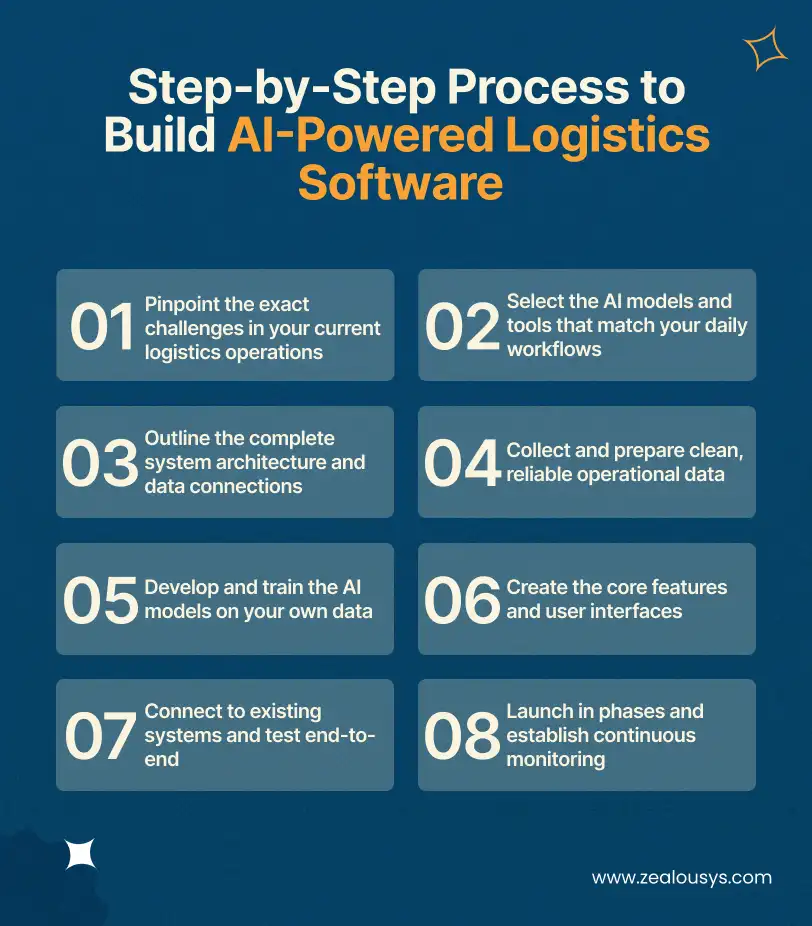
Building a reliable system takes more than just adding AI to existing tools. You need a structured approach that keeps your specific operations in mind from day one. This process guides you through the decisions that matter most when you set out to build AI-powered logistics software.
The steps below follow the sequence that successful projects actually use. Each one builds on the last, so you avoid costly rework later. Follow them in order, and you will end up with a platform that fits your fleet, warehouse, and customer needs exactly.
The first step is to sit down with your operations team and list the real bottlenecks you face every week. Map out where delays happen, which reports take too long to create, and what customer complaints keep coming back. This clear picture becomes the foundation for every feature you develop next.
Next comes choosing the right technologies based on the challenges you just identified. Look at forecasting needs for demand, optimization engines for routing, and sensor models for maintenance. Pick only what solves your actual problems instead of chasing every new trend.
In this step, you sketch how all the pieces will fit together. Decide where data will live, how models will run in real time, and which existing systems must connect without friction. A clean blueprint here prevents integration headaches months down the line.
Now you gather historical records from your TMS, WMS, GPS logs, and carrier portals. Clean the duplicates, fill missing entries, and label key events so the AI can learn accurately. Good data at this stage decides whether your predictions will be trustworthy or not.
Here, you build the forecasting, routing, and anomaly models using the prepared dataset. Train them in stages, test against real past scenarios, and fine-tune until the accuracy meets your operational standards. This is where the intelligence of your future platform takes shape.
Once the models perform well, move on to building the actual screens and workflows your teams will use daily. Design simple dashboards for planners, mobile views for drivers, and alert systems that feel natural. Focus on making every interaction fast and obvious.
In this phase, you link the new platform to your ERP, carrier APIs, and customer portals. Run full simulations with live-like data, then test every scenario from peak season volume to sudden route closures. Fix issues here before anyone in the field sees the system.
The last step is a controlled rollout, starting with one depot or one fleet segment. Set up dashboards that track model performance and system health every day. Plan regular reviews so the platform keeps learning and stays valuable as your business grows.
Following this order keeps your project disciplined and reduces costly surprises later. You stay focused on results that matter to your operations instead of getting lost in technical details.
AI-powered logistics software projects come in different sizes to match where your operations stand today and where you plan to grow. The three categories below show exactly what you get at each level, so the numbers never come as a surprise.
This version focuses on essential AI capabilities for smaller fleets or warehouse teams testing the waters. The general AI logistics MVP development cost range runs from $15,000 to $30,000. Core features include real-time shipment tracking, basic demand forecasting, and simple route suggestions. Key considerations focus on essential integrations only and a 3–6-month timeline, perfect for smaller fleets or pilot testing.
Here, the platform expands to handle multiple locations or moderate shipment volumes. Expect a general range of $30,000 to $50,000. It adds full dynamic routing, predictive maintenance, and solid ERP or carrier connections. Key considerations include handling moderate complexity and a development window of 6–10 months.
Large networks with hundreds of vehicles, global routes, or complex compliance requirements fall into this category. The typical range sits between $50,000 and $140,000+. Core capabilities cover advanced custom models, end-to-end automation, and enterprise security across complex supply chains. Key considerations center on high scalability, strict compliance, and timelines from 10 to 18 months.
Here is a clear comparison of typical costs in 2026 for quality custom development:
| Category | Main Capabilities | Typical Cost Range (USD) | Approximate Timeline |
|---|---|---|---|
| Basic MVP | Real-time tracking, basic forecasting, simple routing | $15,000 – $30,000 | 3–6 months |
| Mid-Scale AI Logistics Software | Full route optimization, predictive maintenance, multi-system integration | $30,000 – $50,000 | 6–10 months |
| Enterprise-Grade AI Logistics Software | Advanced custom models, global scalability, compliance & full automation | $50,000 – $140,000+ | 10–18 months |
Several practical elements shape the final AI logistics software development cost. Here are the six that matter most:
These ranges align with current 2026 development benchmarks, which is why offshore teams often deliver similar scope at a lower overall investment.
Deciding on the right development partner for your AI-powered logistics software makes a real difference in how quickly you see results. You need a team that knows the daily realities of freight forwarding, fleet management, and warehouse management inside out, while also mastering the AI side.
At Zealous System, we combine years of hands-on work building custom logistics platforms with real AI expertise, so the systems we deliver actually fit the daily realities of freight forwarding, fleet operations, and warehouse teams. We know how to turn live data from vehicles and shipments into clear predictions and automatic adjustments that reduce delays and cut unnecessary costs.
We work in structured phases, share progress openly, and keep costs predictable from planning through deployment. As an offshore AI logistics software development company, we handle everything from initial scoping through to deployment and ongoing support, ensuring seamless integration with your existing systems.
When built correctly, an AI-powered logistics platform changes how your teams respond to daily disruptions and long-term demand shifts. The features, technologies, and architecture we discussed create a connected system that reduces delays, optimizes routes, and improves visibility across every part of your operation.
Following the step-by-step process outlined here helps you move from initial planning to a fully functional platform without unnecessary detours. Understanding the real costs involved lets you budget confidently and choose the right scope for your business needs, whether you start small or aim for enterprise scale.
At Zealous System, we serve as a trusted custom logistics software development company with proven expertise in AI software development. Many leaders choose to hire developers from our teams because they bring both deep logistics knowledge and practical AI skills to every project, delivering platforms that perform reliably from day one and continue to evolve with your business.
Our team is always eager to know what you are looking for. Drop them a Hi!

Pranjal Mehta is the Managing Director of Zealous System, a leading software solutions provider. Having 10+ years of experience and clientele across the globe, he is always curious to stay ahead in the market by inculcating latest technologies and trends in Zealous.




Comments