
Real estate web portal development plays a key role in helping modern property businesses grow and compete in 2026. Real estate startup founders, property portal owners, brokers, and developers use custom platforms to manage listings, attract buyers, and generate qualified leads. A reliable real estate portal development company builds solutions that support property search, agent management, and seamless user experiences across buy, sell, and rent platforms. Businesses choose custom real estate web portal solutions to gain flexibility, improve performance, and scale operations efficiently.
Modern property portal development focuses on user-friendly design, advanced search filters, and smart data management. Core features of real estate web portal platforms include property listings, location-based search, dashboards for agents, and a centralized admin panel. Companies that invest in scalable real estate portal development can handle growing traffic, new property types, and future integrations without performance issues. Teams often ask how to develop a real estate web portal that balances usability, security, and long-term growth.
Understanding real estate web portal development cost helps founders, CTOs, and investors plan better budgets. Cost depends on platform complexity, custom features, third-party integrations, and scalability requirements. A trusted custom real estate portal development company follows a clear real estate portal development process to deliver reliable results on time. Businesses that choose professional real estate portal development services gain a future-ready platform built for performance, growth, and evolving market needs.
Real estate web portal development is the process of building a centralized digital platform that allows users to list, search, buy, sell, or rent properties online. Businesses use property portal development to manage property listings, connect buyers with sellers, and streamline real estate operations through a single web-based system.
A custom real estate web portal goes beyond a basic website and supports advanced features such as property search filters, user dashboards, agent management, and lead tracking. Real estate startup founders, brokers, and property portal owners rely on real estate portal development services to create platforms that match their business model and scale as user demand grows.
Real estate web portal development also focuses on performance, security, and long-term scalability. A reliable real estate portal development company designs solutions that support high traffic, large property databases, and seamless integrations. Businesses that invest in scalable real estate portal development gain better control over operations, user experience, and future expansion.
Real estate web portal development supports multiple portal types based on business goals and target users. Each portal type serves a specific purpose and requires a custom development approach.
Listing portals allow users to browse, search, and compare properties for sale. These platforms support advanced filters, location-based search, and detailed property pages. Real estate startup founders and property portal owners often choose custom real estate web portal development to manage large property listings efficiently.
Rental portals focus on long-term and short-term rental properties. These platforms support tenant inquiries, availability management, and rental pricing details. Real estate brokers and agencies use scalable real estate portal development to handle high traffic and frequent listing updates.
Commercial property portals showcase offices, retail spaces, warehouses, and industrial properties. Builders and real estate developers use these portals to promote premium listings and capture high-value leads. Many businesses partner with a real estate portal development company to build secure and performance-driven commercial platforms.
Aggregator portals combine listings from multiple agents, brokers, and property sources into one platform. Property aggregators rely on strong admin panels, automation, and predictive analytics to manage data at scale. CTOs and product managers often evaluate real estate portal development services based on flexibility, integration capabilities, and long-term scalability.
This structured approach helps businesses choose the right real estate portal development process based on features, budget, and future growth plans.
Modern real estate web portal development focuses on creating platforms that are easy to use, scalable, and designed to generate leads. Real estate startup founders, brokers, developers, and property portal owners rely on these features to build powerful and competitive digital platforms in 2026.
Property search and advanced filters help users quickly find relevant listings based on location, budget, property type, and amenities. This feature improves user experience and reduces search time.
Interactive property listings display images, videos, pricing, and property details in an engaging format. This helps buyers and renters evaluate properties more effectively and increases user engagement.
Map and location-based search allows users to explore properties using real-time location data. This feature helps users understand neighborhood details and nearby amenities before making decisions.
User registration and personalized dashboards allow buyers, sellers, and agents to manage profiles, save searches, and track inquiries. This feature improves user retention and platform usability.
Agent and broker management tools help real estate agencies manage profiles, property assignments, and performance from a single dashboard. This simplifies operations and improves coordination.
Lead management and CRM integration capture property inquiries and organize leads automatically. This helps real estate businesses respond faster and improve conversion rates.
An admin panel with analytics provides full control over users, listings, and platform performance. This feature supports data-driven decisions and enables scalable real estate portal development.
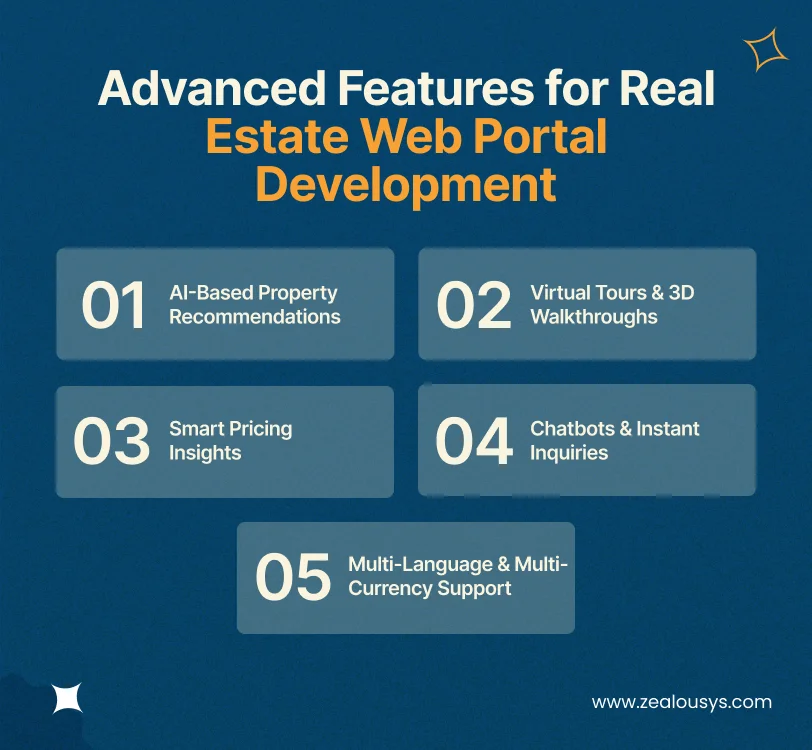
Advanced features are essential in real estate web portal development to meet the expectations of modern buyers, sellers, and investors. A well-planned custom real estate web portal helps property businesses improve user engagement, streamline operations, and stay competitive in 2026. These features add long-term value to scalable real estate portal development projects.
AI-based property recommendations help users find relevant listings based on preferences, location, and browsing behavior. This feature increases user engagement and improves lead conversion for property portals and real estate agencies.
Realted: Top 15 Use Cases and Real World Examples of AI in Real Estate
Virtual tours and 3D walkthroughs allow users to explore properties remotely and make informed decisions faster. This feature reduces physical site visits and improves the overall user experience on real estate portals.
Smart pricing insights analyze market trends, demand, and property data to suggest competitive pricing. Builders, developers, and investors use this feature to make data-driven decisions and improve sales performance.
Chatbots and instant inquiry systems allow real-time communication with potential buyers and renters. This feature ensures quick responses, improves lead handling, and supports a smoother real estate portal development process.
Multi-language and multi-currency support helps property portals reach international buyers and investors. This feature makes the platform accessible to a global audience and supports business expansion across regions.
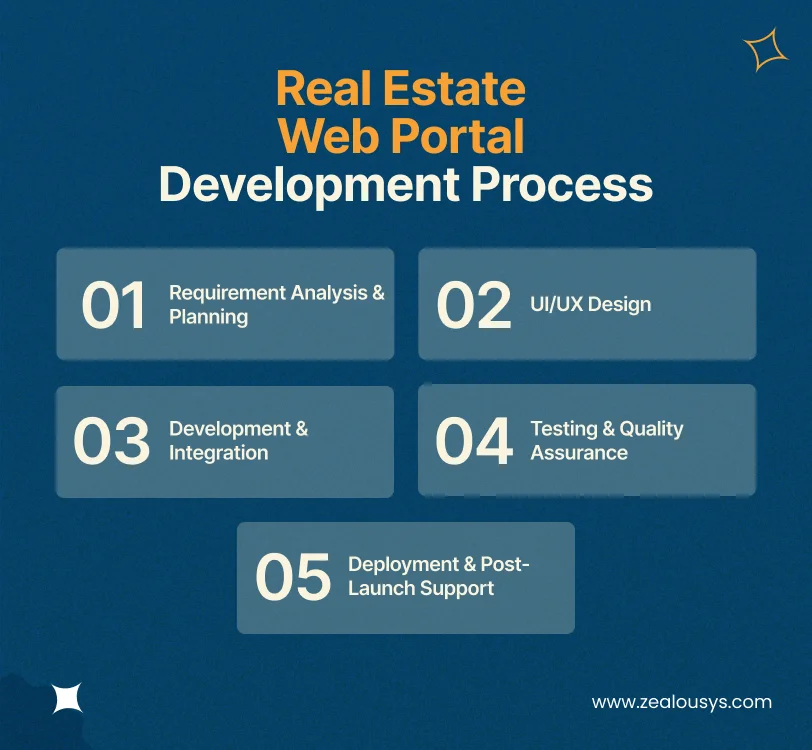
A clear and structured real estate web portal development process helps startups, brokers, developers, and property platform owners build reliable and scalable solutions. We follow a step-by-step approach that aligns technology with business goals and long-term growth.
We begin by understanding your business model, target users, and growth plans. Our team defines features, workflows, and integrations to create a clear roadmap for custom real estate web portal development. This stage helps control real estate web portal development cost and avoids future rework.
We design clean and intuitive user interfaces that improve property discovery and user engagement. Our designers focus on usability, navigation, and responsiveness while planning core features of a real estate web portal for buyers, sellers, agents, and admins.
Our developers build secure and high-performing platforms using modern technologies. We handle backend logic, frontend development, and third-party integrations to deliver scalable real estate portal development tailored to your business needs.
We test every real estate portal for performance, security, and functionality. Our quality checks ensure smooth user journeys, accurate data handling, and reliable system performance across devices.
It is important to deploy the portal in a stable and scalable environment for real-world use. Our real estate portal development services include ongoing support, updates, and optimization to ensure long-term success and growth.
The cost of real estate web portal development depends on the scope of features, level of customization, and scalability requirements. Real estate startup founders often begin with a basic portal, while property aggregators, brokers, and builders invest in advanced functionality to support high traffic, lead management, and long-term growth.
A basic real estate web portal development usually costs between $8,000 and $15,000 and suits real estate startup founders and small agencies. This cost covers essential features such as property listings, basic search filters, user registration, and a simple admin panel to manage content and inquiries.
A mid-level custom real estate web portal development typically costs $15,000 to $30,000 and fits growing brokers, agencies, and property portal owners. This budget supports advanced search filters, user dashboards, agent management, CRM integration, and a scalable architecture for increasing traffic.
An enterprise-grade real estate web portal development generally costs $30,000 to $60,000 or more and serves large builders, developers, and property aggregators. This investment includes advanced analytics, role-based access, third-party integrations, cloud infrastructure, high performance, and long-term scalability.
The real estate web portal development cost increases with the number of features, custom UI/UX design, and system integrations. Projects that focus on scalable real estate portal development also require investment in secure architecture, cloud hosting, and long-term maintenance. CTOs and product managers often plan budgets based on future expansion, data security, and system performance.
A reliable real estate portal development company follows a transparent development process and provides clear cost estimates. Working with a custom real estate portal development company helps businesses control expenses while building a secure, scalable, and future-ready platform.
Zealous System assists real estate businesses in building custom, scalable, and high-performance web portals that support long-term growth. We work with startups, brokers, builders, and property aggregators to understand business requirements and create solutions that improve property management, lead generation, and user experience.
Our team delivers end-to-end real estate web portal development, covering planning, UI/UX design, development, testing, and deployment. We build feature-rich portals with advanced search, listing management, CRM integration, and analytics to support daily operations and future expansion. Zealous System operates as a trusted real estate software development company, delivering solutions that align with business goals and market demands.
We follow a transparent development process and use modern technologies to ensure security, scalability, and performance. Our offshore delivery model helps businesses control development costs while maintaining quality and clear communication. Zealous System focuses on delivering real estate web portals that drive efficiency, engagement, and measurable results.
Real estate web portal development involves building a digital platform that allows users to list, search, buy, sell, or rent properties online. The portal includes features like property listings, filters, user dashboards, and an admin panel.
Real estate web portal development cost depends on features, design complexity, and scalability. A basic portal costs less, while custom and enterprise-grade portals require a higher investment due to advanced functionality.
The development timeline varies based on requirements and features. A basic portal usually takes a few weeks, while a scalable and feature-rich portal may take several months.
A real estate web portal should include property listings, advanced search filters, user and agent dashboards, lead management, CRM integration, and an admin panel.
Yes. Businesses can build a custom real estate web portal tailored to their target audience, business model, and growth plans.
Yes. A well-designed real estate web portal supports scalability through cloud infrastructure, modular architecture, and performance optimization.
The development process includes requirement analysis, UI/UX design, development, testing, deployment, and ongoing support.
Yes. Post-launch support includes performance monitoring, updates, bug fixes, and feature enhancements to ensure long-term stability.
You can get started by consulting with a development team to define requirements, estimate costs, and create a clear development roadmap.
Our team is always eager to know what you are looking for. Drop them a Hi!

Raj Kewlani is a Project Manager and Mobile & Open Source Development Lead at Zealous System, specializing in agile-driven digital solutions. He focuses on delivering high-quality mobile apps and open-source projects that align with business goals.




Comments