
Enterprise leaders often navigate tough decisions amid floods of data and shifting priorities. Interactive advisory software supports these decisions by turning live data into context-aware recommendations that leaders can act on immediately. For those overseeing digital shifts or IT strategies, enterprise advisory software turns complex information into clear paths forward.
Consider the hurdles in big organizations where teams sift through disparate data sources, risking delays or errors. Decision support software for enterprises reduces this risk by reacting to user inputs and adjusting guidance as conditions change.
This article walks you through the key aspects of creating such systems. From core features to development steps, costs, and timelines, you’ll gain practical knowledge to pursue AI advisory software development that aligns with your goals.
Interactive advisory software refers to digital platforms that provide real-time, user-driven guidance to help businesses make better decisions. Instead of fixed reports, these systems let users test variables, ask targeted questions, and see outcomes change in real time. At its core, enterprise advisory software combines data analysis with interactive interfaces to support complex problem-solving in large organizations.
Unlike traditional tools that deliver one-way information, an interactive decision support system engages users through dialogues, simulations, and scenario modeling. For instance, a financial team might use it to explore market risks by adjusting parameters and viewing instant outcomes. This makes decision support software for enterprises a bridge between raw data and strategic actions.
Built on advanced technologies, these platforms often integrate AI to process vast datasets and offer predictive insights. AI advisory software development focuses on creating systems that learn from interactions, improving accuracy over time. Practically speaking, they fill the gap between raw analytics and day-to-day decision support without relying on constant human input.
Such software finds applications across sectors, from supply chain management to customer strategy. It empowers teams to test ideas without real-world consequences, fostering innovation. By centralizing knowledge and analytics, interactive advisory software becomes a key asset for enterprises aiming to stay agile.
Interactive advisory software delivers clear advantages for large organizations, from faster insights to stronger team alignment. These systems, often built through AI advisory software development, help leaders tackle daily challenges with precision.
Enterprise advisory software processes data in real time, letting users input queries and get immediate responses. This shortens analysis cycles and allows teams to react while conditions still matter.
Decision support software helps enterprises make better choices by combining user data with smart analytics. It gives teams clear, reliable guidance so they can make confident decisions.
Interactive advisory software spots inefficiencies, like wasted resources or duplicate efforts. Over time, this changes how budgets and resources are assigned across teams.
An interactive decision support system provides shared access to insights, encouraging input from various groups. It helps break barriers between teams for more cohesive problem-solving.
AI-powered platforms expand as businesses evolve, managing larger data sets without slowdowns. Enterprises can apply the software to new areas effortlessly.
The system includes built-in safeguards to protect sensitive data, ensuring safe, compliant, and reliable enterprise use.
An intuitive design makes the software easy to use, so employees can start using it right away. Most teams don’t need formal training, which leads to faster adoption.
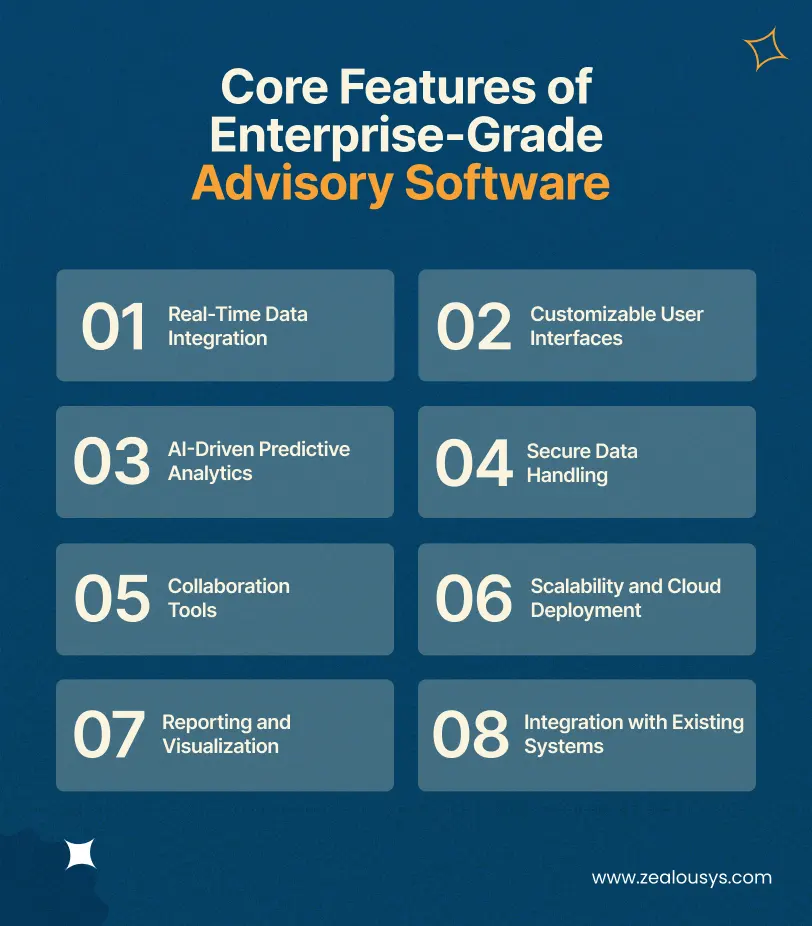
Enterprise advisory software stands out with capabilities that drive effective decision-making in complex settings. Through AI advisory software development, these platforms implement elements that ensure reliability, flexibility, and user focus.
Interactive advisory software pulls in live data from multiple sources, such as databases or APIs. Insights stay current without relying on manual refreshes or delayed reporting.
Decision support software for enterprises offers dashboards that users can personalize based on roles or preferences. This makes navigation straightforward and relevant to specific tasks.
An interactive decision support system uses machine learning to forecast outcomes from user inputs. It provides scenarios and probabilities to aid in planning.
Enterprise advisory software includes encryption and access controls to protect sensitive information. Compliance with standards like GDPR keeps operations trustworthy.
These platforms allow real-time sharing of insights and annotations among teams. This supports joint reviews and refinements of recommendations.
AI advisory software development prioritizes architectures that handle growing data loads. Cloud options allow seamless expansion without hardware overhauls.
Interactive advisory software turns user questions into easy-to-understand charts and reports, helping decision-makers quickly grasp insights without needing technical help.
Decision support software for enterprises connects easily with CRM, ERP, or other tools. This creates a unified environment for comprehensive analysis.
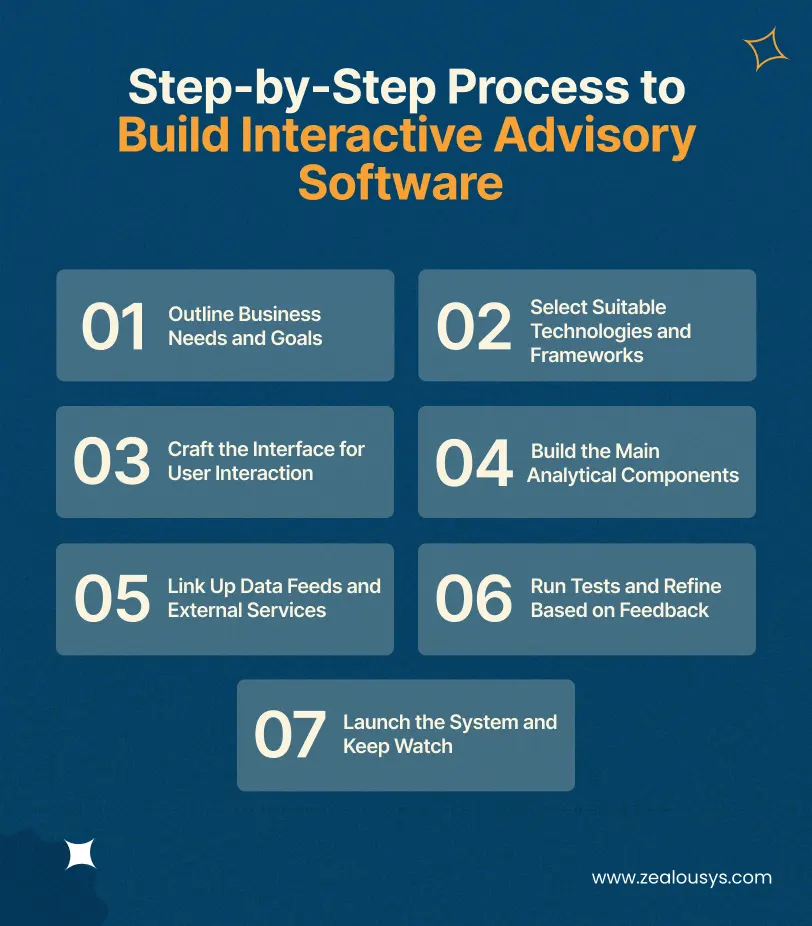
Creating interactive advisory software calls for a methodical path that ties technology closely to your business aims. This framework, key to AI advisory software development, helps deliver a robust tool tailored for enterprise needs.
The first step involves talking to key players in your organization to pinpoint exactly what the enterprise advisory software should do. Pin down issues like fragmented data or delayed insights, and establish targets such as sharper predictions. Workshops or targeted questions can help rank the must-have features that fit seamlessly into daily operations.
Next, pick out the platforms and tools that promise growth and easy blending with current setups. For decision support software for enterprises, options like AWS or Azure for cloud support pair well with AI tools such as TensorFlow for handling analytics. Prioritize those that work smoothly with your existing infrastructure to keep things running without hitches.
In this phase, sketch out layouts that prioritize ease and engagement. An interactive decision support system thrives on features like simple adjustments and immediate visual responses, perhaps through draggable elements. Run early tests with end-users to tweak the design, making sure it works well on various screens.
Now, focus on constructing the backend where data crunching and AI happen. AI advisory software development here means coding algorithms that analyze inputs and spit out smart suggestions in real time. Weave in security right from the start to keep all information flows protected.
At this stage, connect the system to internal databases, APIs, and external data sources. This setup lets interactive advisory software draw from a wide pool of information for thorough advice. Double-check these links with tests to guarantee fast, accurate data handling.
Here, put the software through its paces with detailed checks, from individual parts to full user trials. Collect thoughts from testers to spot and solve problems, polishing the features along the way. Repeated testing improves how the system behaves under real operational conditions.
The last step is to introduce the tool gradually, maybe starting with a small team. Install tracking to observe how it’s used and how well it performs. Regular updates ensure the decision support software for enterprises stays relevant as your requirements shift.
Budgets and timelines vary widely based on how deeply the software integrates into enterprise operations. AI advisory software development costs can vary widely, but breaking it down into categories helps set realistic expectations for enterprise advisory software.
You could begin with a straightforward version that focuses on essential data pulls and basic user interactions. This setup often includes simple queries and core integrations, making it ideal for initial testing in smaller teams. General ranges sit around $15,000 to $30,000, with development wrapping up in 3 to 6 months, depending on refinements.
Stepping up, this level brings in AI elements for better analytics and tools for team sharing. It suits departments handling moderate data volumes, with considerations around user training and partial customizations. Expect budgets from $30,000 to $50,000, and timelines stretching 6 to 12 months to allow for thorough testing.
For full-scale systems, incorporate deep AI models, broad integrations, and high scalability to meet organization-wide demands. Key points include compliance checks and ongoing support structures. Costs generally run from $50,000 to $1,50,000 or more, with builds taking 12 to 18 months or beyond to ensure robustness.
Several elements play a role in shaping the budget and schedule for creating interactive advisory software. Understanding these can help you plan AI advisory software development more effectively for your enterprise needs.
A larger team with specialized skills in AI and software engineering raises costs due to higher salaries and coordination needs. Smaller, experienced groups might speed up timelines, but could limit parallel work on complex features.
Selecting advanced AI frameworks or proprietary tools increases expenses through licensing fees and training. Simpler open-source options cut costs but may extend development time for custom adaptations in decision support software for enterprises.
High customization for unique enterprise workflows demands more design and coding efforts, pushing up both costs and timelines. Standard templates lower these, but might not fully meet specific needs in an interactive decision support system.
Connecting to existing databases or apps requires extra testing and adjustments, adding to the budget. Smooth integrations save time, while incompatible systems lead to rework in enterprise advisory software projects.
Hiring developers in high-cost regions inflates expenses compared to offshore teams. Outsourcing can shorten timelines with round-the-clock work, but it introduces communication challenges that affect overall efficiency.
Interactive advisory software changes how enterprise decisions are made by bringing analysis closer to the moment of action. By following the steps outlined, from defining needs to deployment, you can create a system that integrates seamlessly with your operations. Enterprise advisory software, when built thoughtfully, not only addresses current challenges but also positions your team for future growth.
Remember, the best interactive advisory software emerges from a balance of advanced features and user-centric design. Whether opting for an MVP development services or a full-scale platform, focus on scalability and integration to maximize impact. AI advisory software development demands attention to detail, but the rewards in efficiency and insight make it worthwhile.
At Zealous System, as a custom software development company, we specialize in crafting such custom software solutions. If you’re ready to explore decision support software for enterprises, consider partnering with experts who understand your unique requirements.
Here are answers to common questions that arise when considering or planning interactive advisory software for enterprise use.
Interactive advisory software engages users directly through real-time queries, scenario adjustments, and personalized recommendations. Standard BI tools focus mainly on static dashboards and historical reporting, while this type offers dynamic, conversational guidance that adapts to inputs.
Timelines vary by scope. A basic MVP might wrap up in 3 to 6 months, mid-scale versions often take 6 to 12 months, and advanced systems with deep AI and integrations can span 12 to 18 months or more.
Key drivers include team expertise and size, the choice of AI technologies, the level of customization needed, the complexity of integrations with existing systems, and developer location. These factors can significantly shift the budget across categories.
Custom builds shine when your enterprise has unique workflows, strict compliance needs, or specific data sources that generic tools can’t handle well. Off-the-shelf options work for standard use cases but often require heavy adaptations that reduce their advantages.
Focus on scalable cloud platforms (like AWS or Azure), robust AI frameworks (such as TensorFlow or PyTorch), secure data integration tools, and user-friendly frontend libraries. These ensure performance, reliability, and future-proofing.
Plan for ongoing monitoring, user feedback loops, and regular updates to models and features. This keeps the interactive decision support system aligned with evolving business needs and data patterns.
A cross-functional team works best, including IT architects, data experts, business stakeholders, and possibly a product owner. This mix keeps technical decisions grounded in real enterprise priorities.
Our team is always eager to know what you are looking for. Drop them a Hi!

Ruchir Shah is the Microsoft Department Head at Zealous System, specializing in .NET and Azure. With extensive experience in enterprise software development, he is passionate about digital transformation and mentoring aspiring developers.




Comments