
Artificial intelligence is no longer just a trend for tech teams. Businesses of all sizes now use AI solutions to grow faster, reduce costs, and make smarter decisions. In 2026, AI plays a direct role in daily operations, customer experience, and long-term strategy. Startup founders, CEOs, and digital transformation leaders actively look for practical AI tools that deliver real business value.
Modern AI solutions help businesses automate routine work, analyze data better, and respond to customers faster. Companies now use AI tools for business growth across marketing, sales, operations, HR, and finance. From AI automation solutions to advanced decision-making systems, businesses adopt AI to stay competitive in fast-changing markets. Industries like SaaS, healthcare, FinTech, retail, manufacturing, and real estate already see measurable benefits from AI adoption.
This blog highlights the 10 top AI solutions every business should know in 2026. It focuses on AI use cases for modern businesses instead of theory or hype. Each solution explains how companies use AI to improve efficiency, support growth, and gain a competitive edge. If you want to understand how businesses use AI in 2026, this guide gives you a clear and practical starting point.
Businesses face constant noise around AI trends in 2026, which makes decision-making more difficult. A clear evaluation approach helps businesses separate real value from short-term hype. Top AI solutions for businesses focus on measurable outcomes instead of impressive promises. These solutions support business growth, improve efficiency, and deliver practical results across teams and functions.
Top AI solutions deliver measurable business results that leaders can track and evaluate. Effective AI tools improve efficiency, reduce operational costs, or increase revenue. High-impact AI solutions solve real challenges across operations, analytics, and decision making. Hype-driven AI tools fail to support long-term business goals and often limit real adoption.
Strong AI solutions scale smoothly as businesses grow. Scalable AI systems handle increasing users, larger data volumes, and complex workflows without performance issues. Flexible AI architectures support startups, SMEs, and large enterprises equally. Growth-ready AI tools reduce the need for constant redevelopment and technical restructuring.
Top AI solutions generate clear and measurable returns on investment. AI automation solutions reduce manual work and lower operational overhead. Data-driven AI tools improve speed, accuracy, and productivity across departments. High-ROI AI solutions help businesses justify adoption within realistic timelines and budgets.
Successful AI solutions integrate easily with existing business systems. AI-powered business tools connect smoothly with CRMs, ERPs, cloud platforms, and analytics tools. Simple software integration shortens deployment cycles and reduces technical risk. Well-integrated AI solutions encourage faster adoption across teams.
The best AI solutions apply across multiple industries and business models. AI business solutions adapt well to SaaS, healthcare, FinTech, retail, manufacturing, and real estate environments. Industry-ready AI use cases support operations, marketing, finance, HR, and customer experience. Versatile AI solutions deliver consistent value across different business needs.
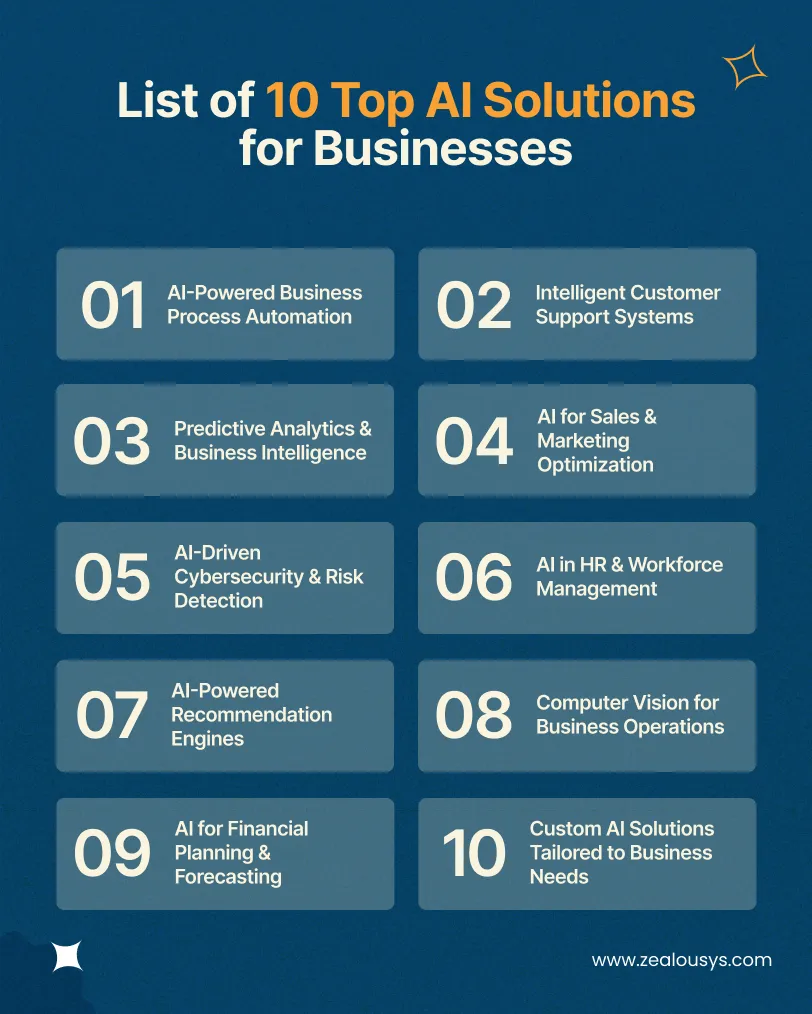
Businesses in 2026 use a wide range of AI solutions to automate operations, improve decision making, and accelerate growth. These ten AI solutions help companies stay competitive, scalable, and future-ready across industries.
AI-powered business process automation uses artificial intelligence to automate repetitive, rule-based, and time-consuming tasks. Businesses use AI automation solutions to improve speed, accuracy, and operational efficiency across departments.
How It Helps Businesses
Common Use Cases
Intelligent customer support systems use AI chatbots and virtual assistants to handle customer interactions. These AI-powered business tools deliver instant and accurate responses across multiple channels.
How It Helps Businesses
Common Use Cases
Predictive analytics and business intelligence use AI to analyze historical data and predict future outcomes. Businesses gain actionable insights for smarter planning and decision making.
How It Helps Businesses
Common Use Cases
AI for sales and marketing optimization improves customer targeting, engagement, and conversions. Businesses use AI solutions to personalize interactions and optimize revenue growth.
How It Helps Businesses
Common Use Cases
AI-driven cybersecurity uses machine learning to detect threats, fraud, and anomalies in real time. Businesses protect sensitive data and systems with intelligent security monitoring.
How It Helps Businesses
Common Use Cases
AI in HR and workforce management improves hiring, employee engagement, and workforce planning. Businesses use AI to make faster and smarter decisions.
How It Helps Businesses
Common Use Cases
AI-powered recommendation engines analyze user behavior to deliver personalized product and content suggestions. Businesses improve engagement and conversions through intelligent personalization.
How It Helps Businesses
Common Use Cases
Computer vision allows AI systems to analyze images and videos for automation and monitoring. Businesses improve accuracy and efficiency through visual intelligence.
How It Helps Businesses
Common Use Cases
Related: 10 Use Cases of Computer Vision in The Defence Sector
AI for financial planning and forecasting uses data models to predict financial outcomes. Businesses improve budgeting, cash flow management, and financial decision making.
How It Helps Businesses
Common Use Cases
Custom AI solutions align with specific business goals and workflows. Businesses build AI systems that adapt to their data, processes, and growth plans.
How It Helps Businesses
Common Use Cases
Adopting AI in 2026 requires a clear plan and a business-first mindset.Businesses should focus on solving real problems instead of chasing AI trends. A structured approach helps companies gain faster results and measurable ROI.
Businesses should start AI adoption by identifying areas with clear operational pain points. Teams should focus on tasks that consume time, increase costs, or slow down decision-making. Customer support, sales forecasting, operations, and data analysis provide strong and practical AI use cases.
Leaders should align AI solutions with business goals such as growth, efficiency, and cost reduction. Startups and SMEs should choose AI tools that support business growth instead of complex enterprise systems. Decision-makers should prioritize AI solutions that improve efficiency and scale as the business grows.
Clear and well-defined use cases help businesses avoid wasted investments. They also improve AI adoption success and deliver measurable business results.
Businesses should begin AI adoption with small and focused pilot projects. Teams should test AI automation solutions on a single process or within one department. Pilot projects reduce risk and help teams understand real-world AI performance.
Companies should measure success using clear KPIs such as time saved, cost reduction, or revenue impact. Early wins build internal confidence and encourage wider AI adoption across teams. Scalable AI pilot projects allow businesses to expand solutions smoothly as needs grow.
This practical approach works well for startups, SMEs, and enterprises that plan to explore AI solutions for businesses in 2026.
Businesses should select AI partners with proven industry experience and strong technical expertise. A reliable AI partner understands real business workflows, not just algorithms and models. The right partner delivers customized AI business solutions instead of generic tools.
Companies should evaluate AI partners based on transparency, clear communication, and long-term support. A capable partner integrates AI-powered business tools smoothly with existing systems. Experienced partners help businesses convert AI use cases into real operational value.
You can choose the right AI partner to ensure sustainable growth and support smarter business decision-making.
AI no longer sits on the sidelines of business strategy in 2026. Businesses now use AI solutions to improve efficiency, reduce costs, and make faster decisions. Startup founders adopt AI tools to scale operations without increasing overhead, while enterprise leaders partner with an AI development company to gain clearer insights and stay competitive. Across industries like SaaS, healthcare, fintech, retail, manufacturing, and real estate, AI continues to move from experimentation to everyday execution.
The top AI solutions help businesses automate workflows, analyze large volumes of data, and deliver personalized customer experiences. AI-powered business tools support smarter decision making across operations, sales, marketing, finance, and HR. SMEs use AI solutions to compete with larger enterprises through speed, agility, and innovation, while digital transformation leaders rely on AI software development services to modernize systems and improve performance.
Every business should start AI adoption with clear goals and practical use cases. Teams should focus on AI solutions that directly improve business efficiency and support sustainable growth. Companies that invest in scalable, secure, and well-integrated AI solutions today position themselves to lead their markets in 2026 and beyond.
Our team is always eager to know what you are looking for. Drop them a Hi!

Ruchir Shah is the Microsoft Department Head at Zealous System, specializing in .NET and Azure. With extensive experience in enterprise software development, he is passionate about digital transformation and mentoring aspiring developers.




Comments