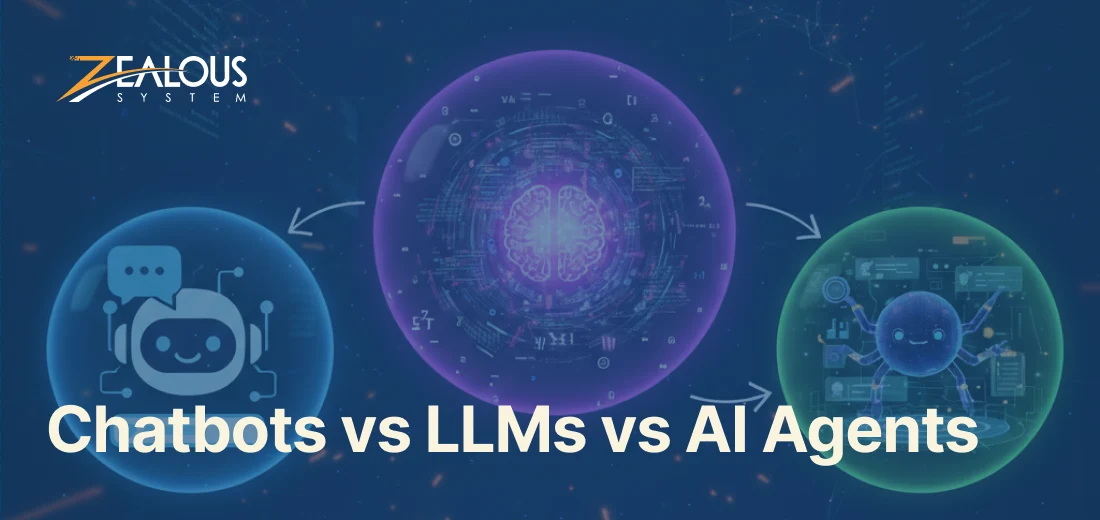
When evaluating AI solutions for businesses, it’s easy to get lost in the options available. As a decision-maker, you need tools that align with your specific goals, whether that means handling customer interactions more efficiently or automating complex processes. Comparing chatbots vs LLMs vs AI agents helps clarify which one suits your needs, from basic support to advanced decision-making.
Chatbots offer straightforward conversational interfaces for routine tasks. LLMs bring depth to text-based applications, like generating insights or content. AI agents, however, go further by reasoning and acting on their own, making them ideal for enterprise-level automation.
This breakdown focuses on how each option performs in real business scenarios, not just how they differ in theory. This should help you choose an AI solution that fits how your operations actually work.
In the discussion of chatbots vs LLMs vs AI agents, chatbots stand out as accessible entry points into AI solutions for businesses. Think of a chatbot as a virtual assistant designed to engage users in conversation through text or voice. It simulates human interaction to address queries or guide actions, often integrated into websites, apps, or messaging platforms.
These tools handle repetitive tasks reliably, which reduces pressure on support teams. They reduce the need for live agents, allowing teams to prioritize more complex issues. For many companies, chatbots represent a cost-effective way to scale support without heavy investment.
Chatbots function using predefined logic or artificial intelligence, depending on their type.
Rule-based chatbots follow fixed scripts and decision trees. They match user inputs with predefined keywords, buttons, or menu options. Once a match occurs, the chatbot delivers a preset response.
This approach keeps conversations predictable and controlled. However, it limits the chatbot to only those scenarios developers have explicitly defined. If a user asks something outside the script, the chatbot fails to respond meaningfully.
Read Also: How Chatbots are Transforming the Healthcare Industry?
AI-powered chatbots use natural language processing to understand user intent and context. They analyze how users phrase questions rather than relying only on keywords. This enables them to generate more natural and relevant responses.
Some AI chatbots improve over time by learning from interactions. They adapt to different sentence structures and varied user behavior, making conversations feel more human.
Both chatbot types respond instantly. Rule-based chatbots perform best in controlled environments, while AI-powered chatbots handle real-world conversations more effectively.
Read Also: Chatbots in Education
Chatbots handle high-volume customer queries without delays. They answer common questions such as password resets, order status, account details, and billing information. They stay available 24/7 and respond instantly, even during peak hours.
Chatbots for customer service reduce wait times and improve customer satisfaction. They also lower the workload on support teams. This allows human agents to focus on complex, sensitive, or high-value customer issues.
Chatbots provide instant access to frequently asked questions. They help users find information without searching through long help pages or documentation.
E-commerce businesses use chatbots to answer questions about product sizing, availability, shipping timelines, and return policies. Healthcare platforms use them for appointment booking, clinic hours, and basic health guidance. Self-service chatbots improve user experience and reduce support tickets.
Chatbots engage website visitors the moment they arrive. They ask targeted questions to understand user needs and intent. Based on responses, chatbots qualify leads and route them to the right sales team.
They collect contact details, suggest relevant products or services, and schedule demos or consultations. SaaS companies often use chatbots to explain features, share pricing information, and capture early-stage leads without manual follow-ups.
Chatbots automate appointment scheduling across industries. They check availability, confirm time slots, and send reminders. This removes manual coordination and reduces missed appointments.
Healthcare clinics, salons, service providers, and consultants rely on chatbots to streamline bookings and improve operational efficiency.
Read Also: 10 Profitable Chatbot Business Ideas
Chatbots assist customers throughout the order lifecycle. They provide real-time order tracking, delivery updates, and shipment notifications. They also handle cancellations, returns, and refund requests.
This improves transparency and builds trust. It also reduces inbound queries related to order status.
Read Also: Guide to Medical AI Chatbot Development
Chatbots support internal teams by answering HR and IT-related questions. They help employees with leave policies, onboarding steps, system access, and internal documentation.
This speeds up internal processes and reduces dependency on support teams for routine tasks.
Read Also: AI Chatbots in Schools
Chatbots collect user feedback at key touchpoints. They run quick surveys after purchases, support interactions, or demos. Users find chat-based feedback easier and faster than traditional forms.
Read Also: How AI Chatbots Improve Customer Support in Auction Platforms?
Chatbots work best for high-volume, repetitive interactions where speed and consistency matter. Businesses in retail, banking, and service industries benefit most from this approach.
They are also ideal for startups and MVPs with limited resources. Chatbots are easy to integrate, quick to deploy, and simpler to maintain than advanced AI systems.
When your goal is consistency rather than creative conversation, chatbots deliver reliable results. In comparisons between chatbots, LLMs, and AI agents, chatbots remain the right choice for basic automation and predictable workflows.
A Large Language Model (LLM) is an AI system designed to understand and generate human language at scale. Businesses use LLMs when text analysis, interpretation, or content creation plays a central role in daily operations.
An LLM trains on massive volumes of text data. It learns patterns in language, such as grammar, tone, and structure. When a user provides a prompt, the model generates responses based on those learned patterns. Many enterprise AI tools rely on LLMs to convert raw inputs into polished, usable text.
LLMs do not think or reason like humans. They do not possess awareness or intent. They generate outputs by predicting what text should come next. This makes them effective for processing and producing large amounts of language quickly.
LLMs break down incoming text into smaller units called tokens. They analyze relationships between these tokens across multiple computational layers. This allows them to detect meaning, context, and intent in different writing styles.
They recognize patterns such as sentence structure, terminology, and phrasing. This enables them to handle casual questions, professional emails, or technical documentation with equal ease.
When generating text, LLMs predict each word based on previous context. They build responses step by step using probability models. This process produces coherent paragraphs, summaries, or explanations. Prompt phrasing strongly influences tone, depth, and structure of the output.
Read Also: How to Pick the Right LLM for Market Research and Sentiment Analysis?
LLMs generate marketing copy, blog drafts, product descriptions, and email responses. They help teams produce content faster while maintaining consistency. Many businesses use them to scale content production without increasing headcount.
LLMs analyze long documents and produce concise summaries. They extract key points from reports, contracts, policies, and research papers. This saves time and improves decision-making across teams.
LLMs analyze customer reviews, surveys, and support tickets. They identify trends, recurring issues, and sentiment patterns. Businesses use these insights to improve products, messaging, and support strategies.
LLMs act as copilots for developers and analysts. They assist with code suggestions, documentation, and debugging guidance. Teams also use them to brainstorm ideas, outline strategies, and explore solutions faster.
LLMs help interpret unstructured data. They convert raw text into structured insights and summaries. Businesses use them to identify trends, extract key information, and support analytics workflows.
LLMs can generate information that sounds correct but is factually wrong. This issue, often called hallucination, creates risk in compliance, finance, or legal use cases. Outputs require validation before use.
LLMs simulate understanding but lack true reasoning. They struggle with tasks that require step-by-step logic, long-term planning, or multi-system decision-making. This limits their reliability in complex automation.
LLMs may produce different answers to the same prompt. This inconsistency makes them difficult to use alone in systems that demand predictable behavior or strict rules.
Training data can introduce bias into outputs. Businesses must apply governance and review processes to reduce risk. LLMs also require significant computational resources, which increases cost and limits standalone deployment.
An AI agent is an autonomous system designed to act on goals, not just respond to inputs. Businesses use AI agents when they need systems that can make decisions, execute tasks, and adapt to changing conditions without constant human input.
AI agents combine multiple capabilities. They often use Large Language Models for understanding and reasoning. They connect with tools, APIs, databases, and workflows to take real actions. Unlike chatbots or standalone LLMs, AI agents operate across systems to complete tasks end to end.
These agents interact with digital or physical environments to achieve defined outcomes. Enterprises adopt them to manage complex workflows where simple conversation or text generation is not enough.
Read Also: How to Build an AI Agent from Scratch?
AI agents differ from chatbots and LLMs in autonomy, decision-making, and execution.
Chatbots focus on scripted or conversational responses. LLMs focus on understanding and generating text. AI agents go further by breaking objectives into steps and completing them independently.
Agents assess situations, plan actions, and adjust based on new information. They actively use tools such as APIs, enterprise software, and databases to act in real time. This allows them to move from answering questions to solving problems.
In business terms, AI agents manage full workflows instead of isolated tasks. They reduce manual handoffs and enable task automation using AI at scale.
Read Also: Top 5 Use Cases for AI Agents Built with LangChain
AI agents automate complex, multi-step business processes. Toyota uses AI agents in predictive maintenance to analyze equipment data and schedule repairs before failures occur. This reduces downtime and improves operational efficiency.
In retail, Walmart applies AI agents to inventory management. Agents forecast demand, optimize stock levels, and prevent shortages or overstocking.
Read Also: Why AI Agents Are a Game-Changer for Legal Document Workflow?
AI agents support faster and more accurate decision-making. Barclays Bank integrates AI agents into loan processing workflows. Agents review applications, assess risk, and speed up approvals compared to manual reviews.
In healthcare, Cleveland Clinic uses AI agents to optimize patient scheduling. Agents predict no-shows, allocate resources, and improve appointment efficiency.
Read Also: What Agentic AI Means for Healthcare and How to Use It
AI agents automate internal support functions across large organizations. Moveworks deploys agents to resolve IT issues without human intervention. At Power Design, agents handle IT requests autonomously. At Ciena, they manage employee service requests across global teams.
These agents adapt to different environments and policies, making them effective in dynamic enterprise settings.
Read Also: Top 20 Best AI Agent Business Ideas
Enterprises adopt AI agents to reduce manual effort and speed up decision-driven workflows. Surveys indicate that companies adopting them report gains in efficiency and faster decision-making, allowing teams to focus on strategic work. This shift stems from the need to handle complex workflows without expanding staff.
Scalability drives interest as well. Agents automate repetitive processes across functions like finance and customer service, providing a competitive edge. With advancements making integration easier, more organizations experiment with and scale these systems.
Innovation plays a part too. Agents enable new ways of collaborating with humans, delivering insights and actions that traditional tools can’t match. As businesses face pressure to adapt, AI agents emerge as essential for long-term growth.
Read Also: Why Every Restaurant Needs an AI Voice Agent
The differences between chatbots, LLMs, and AI agents become clearer when you compare how each one operates in real business settings. These distinctions affect both day-to-day execution and longer-term system design decisions. Drawing from expert views, let’s explore the main areas where they diverge.
Chatbots: These tools focus on managing basic dialogues through set responses or simple pattern recognition. They handle routine exchanges effectively but lack depth for anything beyond predefined scenarios. In practice, this means answering FAQs or guiding users through menus without creating new content.
LLMs: Large language models shine in understanding and producing text, enabling tasks like summarization or creative writing. They process inputs to generate coherent outputs based on learned patterns. However, their strength remains in language alone, without extending to external actions.
AI Agents: Agents combine reasoning with execution, allowing them to tackle multi-step problems. They not only converse but also interact with systems to complete goals, such as automating reports or resolving issues end-to-end. This broadens their role in enterprise AI tools far beyond what chatbots or LLMs offer.
Chatbots: Chatbots react to user inputs within fixed boundaries, requiring human-defined rules to operate. They wait for prompts and deliver scripted replies, showing little initiative. This makes them dependable for consistent, low-variation tasks but not for dynamic situations.
LLMs: These models respond based on the given context but don’t act without ongoing direction. They generate ideas or answers on demand, yet lack the drive to pursue objectives independently. Their independence stops at text output, needing integration for more.
AI Agents: Agents operate proactively, breaking down goals into actions without constant oversight. They adjust plans in real time using tools and feedback, achieving true self-sufficiency. For businesses, this means less manual intervention in processes like workflow automation.
Chatbots: Best suited for straightforward queries, chatbots manage simple interactions like basic support. They falter on nuanced or evolving requests, sticking to what they’ve been programmed for. This limits them to environments with predictable patterns.
LLMs: LLMs tackle language complexities, such as interpreting intent or generating detailed explanations. They handle varied text inputs well but struggle with tasks requiring logic beyond words. In analytics, they extract insights, yet can’t execute follow-ups.
AI Agents: Designed for intricate, multi-faceted challenges, agents plan and adapt to solve them. They manage sequences involving data, decisions, and actions, ideal for enterprise workflow automation. This capability sets them apart in high-stakes settings.
Chatbots: Easy to embed in platforms like websites or apps, chatbots scale for volume but not depth. They connect to basic APIs for data pulls, keeping setups simple. Growth comes from handling more users, not expanding functions.
LLMs: LLMs integrate via APIs for custom applications, scaling through fine-tuning. They adapt to larger datasets but require engineering for broader systems. In business, this means evolving from prototypes to production.
AI Agents: Agents excel at deep integrations, linking multiple tools and databases for comprehensive tasks. They scale across operations, supporting growth in complex enterprises. This makes them flexible for expanding needs.
Chatbots: Personalization relies on user data within rules, offering tailored responses from history. Learning is minimal, often needing updates from developers. They maintain consistency but don’t evolve much on their own.
LLMs: These models personalize through context in sessions, adjusting outputs to styles or preferences. They draw from vast training but don’t retain user-specific learnings long-term. Fine-tuning enhances relevance over time.
AI Agents: Agents learn from interactions and outcomes, refining approaches for better personalization. They build memory to anticipate needs, adapting dynamically. In customer service, this leads to proactive, customized solutions.
| Aspect | Chatbots | LLMs | AI Agents |
|---|---|---|---|
| Capabilities | Basic dialogues and responses | Text understanding and generation | Reasoning, planning, and execution |
| Autonomy | Reactive, script-based | Prompt-driven, no initiative | Proactive, independent actions |
| Complexity Handling | Simple, predictable tasks | Language nuances and insights | Multi-step, dynamic processes |
| Integration and Scalability | Easy embeds, volume-focused | API-based, tunable | Deep links, operational growth |
| Personalization and Learning | Rule-driven tailoring | Context-aware adjustments | Adaptive, memory-based evolution |
Figuring out which AI solution fits your business comes down to matching tools with your daily challenges. In the chatbots vs LLMs vs AI agents debate, the choice hinges on factors like task complexity and desired outcomes. Start by reviewing your operations to see where automation can make the biggest impact.
Begin with a clear view of your goals. What problems do you aim to solve, such as handling inquiries or improving decision workflows? Consider the scale of your team and budget, as simpler tools like chatbots require less setup.
Ask key questions to guide your decision. Do interactions stay basic, or do they involve multiple steps and data sources? Think about integration with existing systems and how much independence you need from the AI.
Go for chatbots if your focus is on quick, repetitive tasks in customer-facing roles. They work well for FAQs or initial support in startups, where low cost and easy deployment matter most. This keeps things efficient without overcomplicating your setup.
In scenarios with high query volume but low variety, chatbots deliver consistent results. For instance, e-commerce sites use them for order status checks, freeing staff for other duties. If your needs align with basic conversational AI solutions, this is a solid starting point.
Select large language models when text analysis or generation drives your processes. They suit content-heavy work, like drafting materials or pulling insights from data, ideal for product managers in SaaS environments. LLMs add value in brainstorming or personalization without needing full autonomy.
For businesses emphasizing creativity over action, LLMs provide flexibility. They handle varied inputs but stop at outputs, making them fit for copilots in development or marketing. Weigh this if your team needs support in language tasks rather than end-to-end execution.
Turn to AI agents for processes requiring reasoning, planning, and independent actions. Enterprises with complex workflows, like supply chain management, benefit from their ability to handle multi-step tasks autonomously. Agents excel where outcomes matter more than just responses.
If your operations involve decisions across tools or channels, agents drive real efficiency. They adapt to changes, making them suitable for growing teams in digital transformation. Choose this for AI agents for business process automation when scalability and proactive problem-solving are priorities.
Test options through small pilots to see what works in your context. Start simple and scale up, perhaps combining tools like a chatbot fronted by an LLM for better interactions. Monitor performance metrics like resolution time or user satisfaction to refine your approach.
Factor in future growth. If expansion looms, lean toward agents for their adaptability. Always align the solution with your core objectives to ensure it supports long-term success.
Businesses in 2026 use different types of AI solutions based on the level of intelligence, autonomy, and complexity they need. Chatbots, Large Language Models (LLMs), and AI agents each serve distinct business use cases. Understanding where each solution fits helps organizations choose the right AI approach for efficiency, scalability, and growth.
Best suited for: High-volume, rule-based interactions
Best suited for: Language understanding, content, and insights
Best suited for: Autonomous workflows and complex operations
In summarizing the distinctions among chatbots vs LLMs vs AI agents, the right choice depends on how much autonomy and complexity your workflows require. Chatbots address fundamental interactions efficiently, LLMs provide advanced capabilities for text processing, and AI agents development services offer independent functionality for multifaceted procedures. Each option serves a different stage of adoption, from early experimentation in startups to full-scale deployment in large organizations.
If implementation becomes complex, collaborating with an AI development company can help bridge gaps in architecture, data, or execution. At Zealous System, we help teams hire AI developers who can build systems aligned with specific business goals. This helps reduce implementation risk and improves alignment with long-term business goals.
When exploring chatbots vs LLMs vs AI agents, several common queries arise among decision-makers seeking the best AI solutions for businesses. Below, we address key concerns with direct insights.
LLMs often generate inaccurate or fabricated details due to reliance on patterns rather than verified facts. They also exhibit biases from their training data and fail at tasks requiring ongoing memory or real-world actions.
Startups benefit from chatbots in MVPs focused on simple interactions, like basic customer queries. They deploy quickly at lower costs, allowing testing before committing to the advanced autonomy of agents.
AI agents automate sequences of tasks, such as data analysis followed by report generation. This reduces human involvement in repetitive processes, leading to faster execution and fewer errors in areas like supply chain management.
LLMs cannot fully replace creators, as they lack original insight and require human review for accuracy. They serve best as aids for initial drafts or idea expansion in content workflows.
Consider task complexity: chatbots for routine dialogues, LLMs for text handling, and agents for independent actions. Budget, integration ease, and scalability also guide the decision to match business goals.
While ideal for enterprises with complex needs, small businesses can use agents for targeted automation, like lead nurturing. Start with scalable platforms to avoid high initial costs.
Our team is always eager to know what you are looking for. Drop them a Hi!

Ruchir Shah is the Microsoft Department Head at Zealous System, specializing in .NET and Azure. With extensive experience in enterprise software development, he is passionate about digital transformation and mentoring aspiring developers.




Comments