Running a security business today means managing more than guards and cameras. Many private security companies now use drones for perimeter security, patrol monitoring, and faster incident response. However, without a drone patrol management system, teams often struggle to track patrol routes, manage live feeds, and record incidents efficiently. This is where a drone security management system becomes essential. It helps security owners and operations managers control drone patrols, monitor activities, and store reports in one centralized platform.
If you use drones for patrols, you may ask how to manage drone security patrols without relying on manual logs or scattered tools. A drone patrol software for security companies simplifies daily operations by showing patrol activity in real time, logging flight history, and capturing incidents with images or video. Facility managers, gated community administrators, and industrial site security heads use these systems to improve visibility, reduce response time, and maintain consistent security coverage across large properties.
Getting started with a drone patrol system for private security does not require technical expertise. You begin by understanding your patrol needs and choosing the right drone integration software that connects your drone with a web dashboard and mobile app. A well-designed drone patrol app for security companies helps teams manage patrols, generate client-ready reports, and scale operations confidently. With the right system in place, security companies gain better control, higher efficiency, and stronger trust from clients.
A drone patrol management system is a central software platform that helps security companies manage drone-based patrol operations in one place. It allows teams to monitor drone patrols, view live or recorded footage, log incidents, and generate reports without switching between multiple tools.
The system works through a mobile app and a web dashboard, so security managers can track patrol activity from a phone, tablet, or computer. Field operators can report incidents instantly, while supervisors can review patrol history, alerts, and footage in real time.
This type of drone security management system focuses specifically on professional security operations, not recreational or hobby drone use. It supports perimeter security, private security patrols, and industrial site monitoring by improving visibility, control, and response time.
By using drone patrol software for security companies, businesses can manage drone security patrols more efficiently, reduce manual work, and maintain clear records for audits, clients, and compliance needs.
Security companies increasingly rely on drones to monitor perimeter security, large properties, and high-risk areas. However, without a drone patrol management system, daily operations quickly become difficult to control and scale.
Teams often record drone patrol details on paper, spreadsheets, or separate tools. This approach increases human error and makes it hard to verify patrol completion or review past activities. A centralized drone patrol management system automatically tracks flights, routes, and patrol history in one place.
Drone footage, images, and incident reports usually sit across multiple devices or cloud folders. Security managers waste time searching for information during critical moments. A drone security management system stores all videos, logs, and reports in a single, secure dashboard that teams can access instantly.
When teams lack real-time visibility, they respond late to intrusions or suspicious activity. A drone patrol monitoring system delivers live updates, alerts, and location data so operators and supervisors can act immediately.
Property managers and real-estate developers often ask for proof of patrols and incident handling. Without proper reporting, security companies struggle to provide transparency. A drone patrol system for private security generates clear, shareable reports that show patrol coverage, incidents, and response actions.
Operational inefficiency limits business growth
Managing multiple sites, drones, and teams without proper software drains time and resources. A drone patrol app for security companies simplifies scheduling, reporting, and team coordination, allowing companies to scale operations without increasing overhead.
A well-designed drone-based security management system brings control, visibility, and efficiency to drone operations. It helps security companies protect assets better, respond faster, and deliver measurable value to clients.
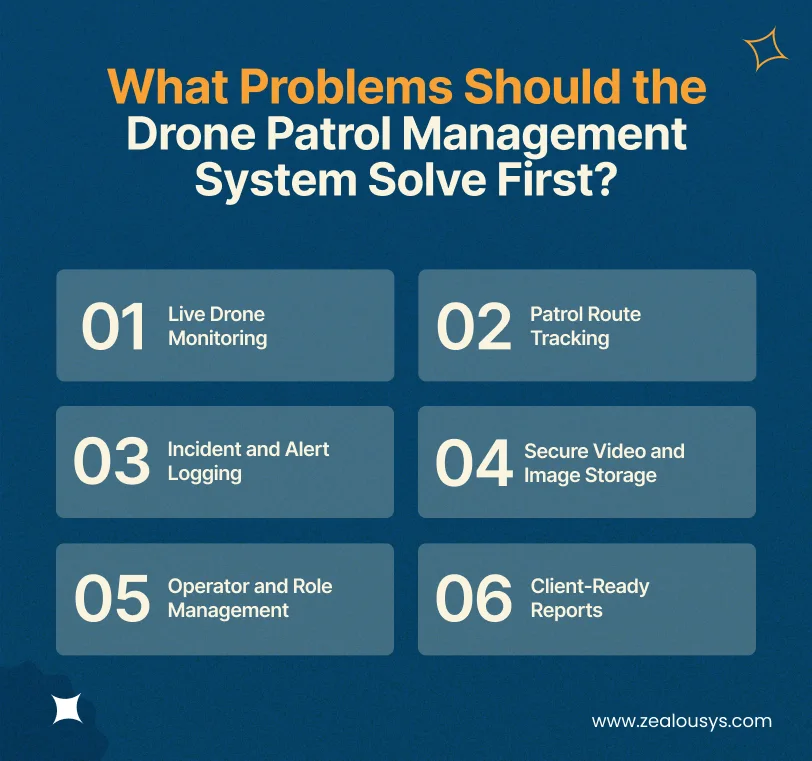
When security teams start using drones, daily operations quickly become hard to manage without the right software. A drone patrol management system should first solve the most common and practical problems faced by private security companies.
Security managers need to see what the drone sees in real time. Live monitoring helps teams respond faster to incidents and avoid blind spots during perimeter patrols. A centralized drone security management system keeps live feeds accessible from a dashboard or mobile app.
Security operations require proof that patrols happened as planned. Patrol route tracking records where the drone flies and when it completes each patrol. This feature helps security companies maintain accountability and improve perimeter coverage.
Security teams must record every unusual activity clearly. The system should allow operators to log incidents instantly, attach images or videos, and generate alerts when something requires attention. Proper logging improves response time and supports future investigations.
Drone patrols generate large amounts of footage. The system should store videos and images securely with easy search and access control. Secure storage protects sensitive data and helps meet client and compliance expectations.
Security companies work with multiple operators and supervisors. The system should assign roles and permissions based on responsibility. Clear access control prevents misuse and keeps operations organized.
Clients expect clear and professional updates. A drone patrol management system should generate simple reports that show patrol history, incidents, and evidence. These reports build trust and help security companies demonstrate value.
Yes, a drone patrol management system can integrate with your drone and remote controller, but it depends on the drone brand and its SDK or API support. Most professional and enterprise drones provide official SDKs or APIs that allow software teams to connect safely with the drone’s controller software.
A well-planned drone security management system can connect with supported drones to:
These integrations make it easier for private security companies to manage drone patrols without switching between multiple tools.
Depending on the drone’s capabilities, the system can access:
This data helps security teams create clear incident reports and improve response times.
Early technical validation helps avoid delays and extra costs. A software team checks the drone model, SDK limits, and controller access before development starts. This step confirms what the drone patrol management system can and cannot control. It also ensures the system stays scalable, secure, and reliable for long-term security operations.
Starting with validation allows security businesses to build a practical and future-ready drone patrol solution that fits real operational needs.
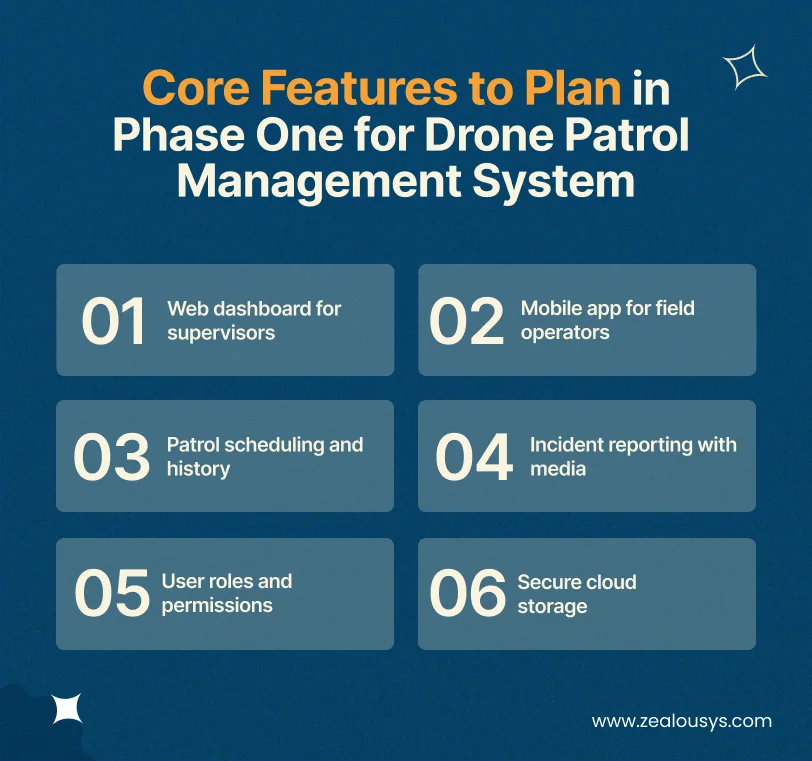
When building a drone patrol management system, it is best to start with features that solve daily operational problems for security teams. These core features create a strong foundation and allow the system to scale later.
The web dashboard gives supervisors a clear view of all drone patrol activities in one place. It shows patrol status, drone usage, incidents, and reports so managers can make quick decisions and maintain control.
The mobile app helps field operators manage patrols directly from their phones or tablets. Operators can start patrols, receive alerts, and report incidents without relying on manual communication.
The system allows teams to schedule regular drone patrols and track completed routes. Patrol history helps security managers review coverage, verify patrol completion, and improve future planning.
The incident reporting feature lets operators record issues using photos, videos, and notes from the drone feed. This creates clear evidence and improves response time during security events.
Role-based access keeps the system secure and organized. Supervisors, operators, and administrators each see only what they need, which reduces errors and protects sensitive data.
Secure cloud storage saves drone footage, patrol logs, and incident reports safely. This makes data easy to access anytime while meeting security and compliance requirements.
These phase-one features help private security companies manage drone patrols efficiently while keeping operations simple, secure, and scalable.
Before you speak with a software company about a drone patrol management system, preparing a few key details will save time and help you get accurate guidance. This checklist applies to private security companies, facility managers, industrial sites, and smart communities planning to manage drone-based security operations.
Share the exact drone brand and model you use for perimeter security. This information helps the software team confirm whether the drone supports integration through APIs or SDKs. It also determines what data the system can access, such as live video, flight logs, or alerts.
Explain how you currently use drones for security patrols. Describe patrol frequency, manual or automated routes, and typical incident scenarios. Clear use cases help design drone patrol software that matches real operational needs.
Mention where the drone patrol system will operate, such as condominiums, gated communities, commercial properties, or industrial sites. Each site type affects patrol workflows, alert rules, and reporting structure in a drone security management system.
List any security, privacy, or local regulatory requirements you must follow. Compliance planning ensures the drone patrol management system handles data storage, access control, and audit logs correctly from day one.
Define what reports you want from the system. Many security companies need patrol history, incident reports, images, and client-ready summaries. Clear reporting expectations help build software that supports operational transparency and client trust.
Share a realistic budget range and expected timeline for development. This helps the software partner suggest the right approach, whether a phased rollout or a minimum viable system that can scale later.
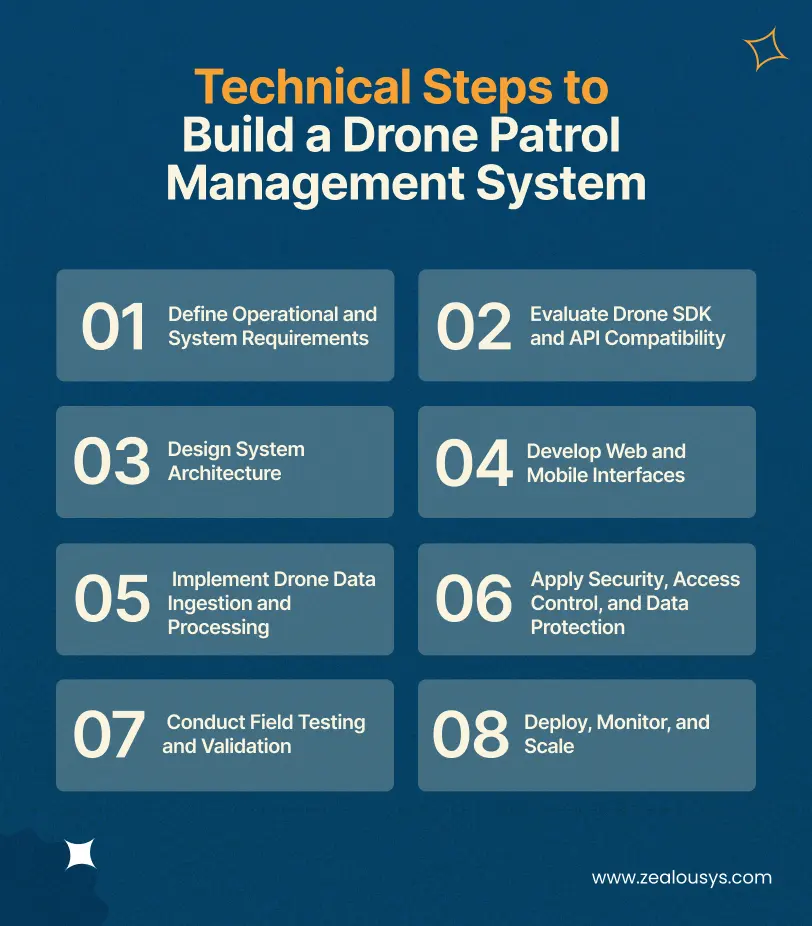
A drone patrol management system requires a structured technical approach to ensure reliability, scalability, and secure drone integration. The steps below outline how security companies can design and implement a production-ready system.
Document patrol workflows, perimeter coverage logic, incident response rules, and reporting needs. Translate these into functional and non-functional requirements such as latency, uptime, scalability, and compliance.
Assess the drone manufacturer’s SDKs, APIs, telemetry access, and video streaming protocols. Confirm access to flight data, GPS coordinates, camera feeds, and remote controller integration capabilities.
Create a modular architecture with microservices or service-oriented components. Separate modules for drone communication, patrol management, incident handling, user management, and reporting improve maintainability.
Build a web-based command drone dashboard for supervisors and a mobile application for field operators. Implement real-time updates using WebSockets or MQTT for live patrol monitoring.
Integrate live video streams, telemetry data, and flight logs into the backend. Use event-driven processing to trigger alerts for boundary breaches, abnormal flight behavior, or incident detection.
Enforce role-based access control, authentication, and authorization. Encrypt data in transit and at rest, and implement secure cloud storage for media and patrol records.
Perform integration testing with live drones in real patrol environments. Validate system stability, data accuracy, failover handling, and operator usability under operational conditions.
Deploy the system using cloud infrastructure with monitoring and logging enabled. Scale services horizontally as patrol volume increases and continuously optimize performance.
The development timeline depends on how complex your security operations are and how deeply the system needs to integrate with your drones. Most private security companies start with a practical, phased approach instead of building everything at once.
A basic drone patrol management system usually takes around 2 to 3 months. This version focuses on essential needs such as patrol tracking, incident reporting, user roles, and a central dashboard. Security teams use this stage to validate workflows and ensure the system fits real operations.
A more advanced drone security management system takes 3 to 6 months. This stage adds features like live drone monitoring, patrol history, secure media storage, detailed reports, and mobile app access. Many security operations managers choose this phase to improve response time and operational visibility.
Drone integration software development depends on the drone model and its API or SDK support. Some drones allow quick integration, while others need custom handling. This step may add extra time, especially when building a perimeter security drone system that requires stable data flow and safety checks.
Large security companies, industrial sites, and smart city planners often need a scalable drone-based security management system. These systems support multiple sites, advanced permissions, and long-term data storage. Enterprise builds usually take six months or more.
Partnering with Zealous gives security companies a clear advantage when building a reliable and scalable drone patrol management system. As a drone software development company, Zealous focuses on turning real security operations into practical digital solutions. The team understands how drone patrols work on the ground and designs systems that support live monitoring, patrol tracking, incident reporting, and centralized control without adding unnecessary complexity.
Zealous also brings strong software integration services, which are critical for drone-based security platforms. The development team works closely with drone SDKs, remote controllers, and existing security tools to ensure smooth data flow and real-time communication. This approach helps security companies connect drones, dashboards, and mobile apps into one unified system that improves response time and operational visibility.
With a focus on secure architecture and long-term scalability, Zealous builds systems that grow alongside your business. From early feasibility and MVP development to full deployment and ongoing support, the team delivers end-to-end solutions that reduce risk and accelerate time to value for modern security operations.
Our team is always eager to know what you are looking for. Drop them a Hi!

Pranjal Mehta is the Managing Director of Zealous System, a leading software solutions provider. Having 10+ years of experience and clientele across the globe, he is always curious to stay ahead in the market by inculcating latest technologies and trends in Zealous.




Comments