Urgent care app development is growing fast as patients expect quick access to medical help without long wait times. Clinics, healthcare startups and urgent care centers now build modern urgent care apps to offer smoother appointments, faster triage and better patient experiences. This shift helps healthcare providers improve service quality and run operations with more efficiency. Digital urgent care platforms also help founders and decision makers understand how on demand medical apps can transform urgent care delivery.
A modern urgent care app gives patients real time updates, easy appointment scheduling and secure communication with doctors. Healthcare entrepreneurs, CTOs and product managers use these apps to automate processes and reduce manual work. Many clinics now invest in HIPAA compliant mobile app development to meet patient expectations and to improve care coordination. Strong features, clean design and smart technology help clinics offer reliable and convenient digital care.
This guide explains how to build an urgent care app that works for both patients and healthcare providers. You will learn about essential features, the right tech stack, security requirements and the development process. You will also see how healthcare app development experts help clinics and startups launch modern urgent care apps that support digital transformation in the healthcare industry.
A modern urgent care app is a digital platform that helps patients connect with urgent care centers, clinics and healthcare providers in a fast and convenient way. It allows users to check real time wait times, book appointments, access virtual consultations and view medical records from their phones. Clinics and hospitals use it to streamline patient flow, improve communication and deliver care without delays.
A modern urgent care app makes healthcare easy to access for everyone. It helps patients get quick support for non-emergency health problems. It allows healthcare teams to manage appointments and track patient records in one place. It also reduces manual tasks and saves time for staff. The app uses healthcare app development, on-demand medical services, and secure digital communication to deliver a smooth care experience.
Patients use urgent care apps to save time, avoid long queues and reach qualified doctors quickly. Healthcare startups, urgent care centers and hospitals use these apps to manage high patient volumes and offer modern digital services. CTOs, product managers and investors in the healthcare industry also rely on urgent care mobile app development to create scalable and convenient solutions for their users.
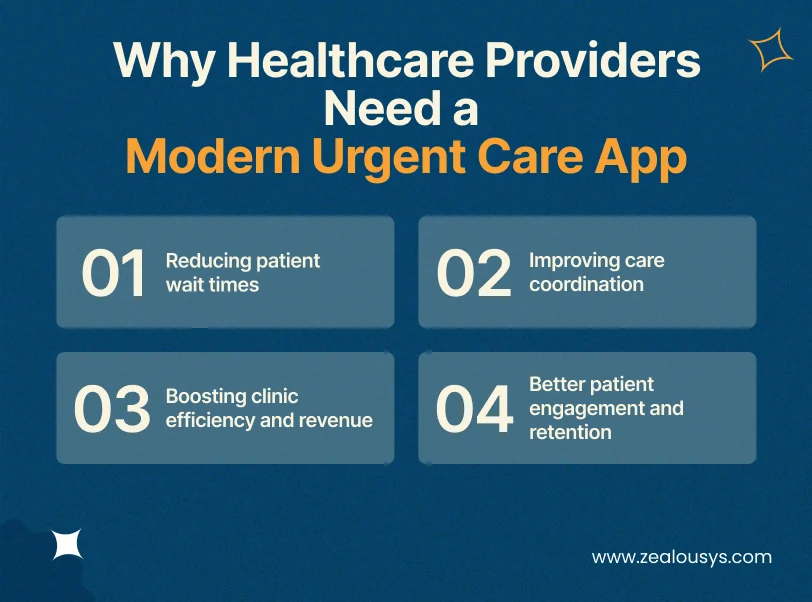
A modern urgent care app helps healthcare providers deliver faster, smarter, and more convenient care. Healthcare startups, urgent care centers, and clinics use these apps to streamline daily operations and improve patient experiences. With on-demand access, digital workflows, and secure communication, urgent care mobile app development has become essential for providers who want to stay competitive in 2025.
A modern urgent care app reduces patient wait times by allowing users to book appointments online and check real-time queue updates. Patients avoid long waiting room delays, and providers manage the flow of visits more efficiently. When healthcare app development includes virtual check-ins and digital registration, clinics process patients faster and offer a more organized care experience.
Healthcare providers improve care coordination when they use urgent care software solutions that connect doctors, nurses, and administrative teams in one place. The app shares patient records, past visits, prescriptions, and lab results securely. This level of coordination creates a smooth workflow and reduces errors. A modern urgent care app helps providers deliver consistent and accurate care to every patient.
Urgent care mobile app development boosts clinic efficiency and revenue by automating time-consuming tasks. Clinics handle scheduling, billing, and patient data digitally without manual paperwork. When operations run smoothly, clinics serve more patients in less time. Better efficiency leads to higher patient satisfaction and increased revenue for healthcare providers.
A modern urgent care app strengthens patient engagement and retention through easy communication and helpful digital features. Patients receive appointment reminders, follow-up alerts, and personalized health updates. They stay connected with their healthcare provider and trust the service more. These engagement features play a key role in keeping patients loyal and improving long-term relationships.
A modern urgent care app gives patients fast access to medical support and helps healthcare providers work more efficiently. To build an urgent care app that meets today’s expectations, you must include features that improve convenience, transparency, and clinical accuracy. Here are the essential features every urgent care app development project should include.
Patients create their profiles quickly with basic details like name, medical history, and preferred clinic. This feature helps healthcare providers access accurate information and deliver better care. It also speeds up onboarding and reduces paperwork for urgent care centers.
Users book their appointments instantly without waiting on phone calls. The app shows available time slots and allows patients to choose the best option. Clinics improve workflow, and patients enjoy a smooth booking experience.
Patients connect with doctors through secure video or audio calls. This feature supports remote treatment and reduces unnecessary clinic visits. It also helps healthcare providers deliver fast medical advice during peak hours.
Patients view live wait times for each clinic location before they visit. This feature reduces frustration and improves transparency. Clinics manage patient flow better and maintain higher satisfaction levels.
The app connects with existing Electronic Health Record systems. Doctors view patient history, lab reports, allergies, and past treatments in one place. This integration improves medical accuracy and makes the urgent care app more valuable for providers.
Patients access their prescriptions and lab results directly from the app. This feature removes the need for physical visits to collect documents. It also helps patients track their treatment progress easily.
Users find the nearest urgent care center using location-based services. The app displays directions, estimated travel time, and working hours. This feature improves convenience and supports faster decision-making in emergencies.
Patients receive instant appointment reminders, prescription updates, and follow-up messages. Clinics stay connected with patients and reduce no-shows. This feature increases engagement and improves overall patient experience.
The app verifies insurance details in real time and simplifies the billing process. Patients understand their coverage before treatment. Clinics reduce manual work and avoid claim errors.
The app protects patient data with secure authentication, encrypted communication, and role-based access. These features keep your urgent care app compliant with healthcare regulations and build patient trust.
A modern urgent care app becomes more powerful when it includes advanced features that support faster diagnosis, smarter care delivery and better clinic management. These features also help healthcare startups, clinics and urgent care centers deliver a smooth digital experience that patients expect today. Below are the most valuable additions for a future-ready urgent care mobile app.
An AI symptom checker helps patients understand their health concerns before they speak with a provider. The tool asks simple questions and uses medical algorithms to offer possible conditions. This feature reduces unnecessary visits, speeds up patient triage and improves decision making for urgent care teams. Healthcare app development companies use AI models to make this feature accurate and safe for real users.
A chatbot for instant triage helps patients get quick answers without waiting in line. The chatbot handles basic questions, collects symptoms and guides users to the right care option. Clinics use this feature to reduce call center pressure and offer round the clock support. Startups also use it to improve patient engagement and increase app usage.
Wearable integration allows the urgent care app to collect real time health data from devices like smartwatches and fitness trackers. The app displays key metrics such as heart rate, blood oxygen and activity levels. Providers use this data to monitor patients more effectively and make faster decisions. This feature strengthens the value of urgent care software solutions and helps clinics build modern digital experiences.
Remote patient monitoring helps doctors track patients with ongoing health conditions from anywhere. The urgent care app collects data, sends alerts and supports timely intervention. Clinics and hospitals use this feature to lower readmission rates and improve patient outcomes. This capability also supports the growing demand for telemedicine and on demand medical care.
A multi clinic management dashboard helps healthcare leaders manage several urgent care locations from a single place. The dashboard shows patient flow, appointment status, staff allocation and performance insights. Administrators use this feature to improve operations and make data driven decisions. This tool also helps startups scale their urgent care mobile app faster across multiple regions.
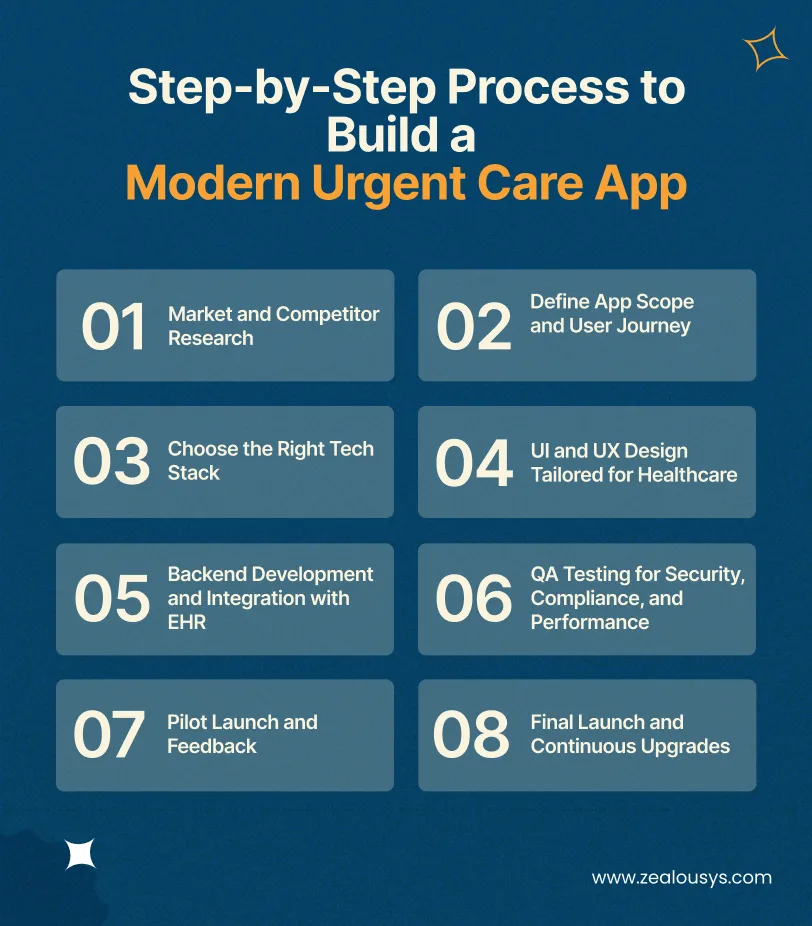
Building a modern urgent care app becomes easier when you follow a clear and structured process. This approach helps healthcare startups, clinics, and tech decision makers move from idea to launch with confidence while staying aligned with urgent care app development standards.
Start by understanding what patients and healthcare providers expect from a modern urgent care app. Analyze the leading urgent care app platforms in your region and study their features, user experience, strengths, and gaps. This research helps you identify opportunities, refine your value proposition, and build a solution that stands out in the competitive healthcare app development market.
Define a clear scope for your urgent care mobile app from the start. Focus on the core features that patients and providers will use every day. Design a simple and smooth user journey for both users. Plan how users sign up, book appointments, check wait times, join virtual consultations, and view medical records. This clear planning helps your development team build the app more efficiently.
Choose a tech stack that delivers fast performance, easy scaling, and strong healthcare security. Many startups use React Native or Flutter for cross-platform app development because these frameworks lower costs and speed up delivery. Pick backend technologies like Node.js, .NET, or Java to support reliable operations. Use secure cloud platforms such as AWS or Azure to protect patient data. Select tools that connect smoothly with EHR systems and meet healthcare compliance standards.
Design a clean, intuitive interface that makes urgent care services easy to access. Focus on accessibility, readability, and simple navigation because patients often need help quickly. Create a design that supports telemedicine, appointment booking, and patient onboarding without confusion. Ensure your design aligns with healthcare usability guidelines and supports a seamless patient experience.
Build a strong backend that manages appointments, patient data, and real-time updates without delays. Connect your urgent care app with EHR systems using HL7 or FHIR so doctors can view accurate patient records instantly. Follow HIPAA-compliant practices and use encrypted communication to keep all medical data safe and secure.
Test the app carefully before launch. Run security tests to protect patient data. Make sure the app follows HIPAA, GDPR, and healthcare data privacy rules. Test the app under high traffic to confirm it handles many users smoothly. Fix all issues quickly and ensure every feature works properly before going live.
Release a pilot version of your modern urgent care app to a small group of users. Collect feedback from patients, doctors, and administrators. Identify what works well and what needs improvement. You can use this feedback to refine the experience and strengthen your urgent care app before the full release.
Launch the app for all users once you finalize the improvements. Monitor usage patterns, app performance, and user behavior regularly. Continue to upgrade the app with new features like AI symptom checkers, telemedicine enhancements, and improved dashboards. Maintain your app actively so your urgent care software stays modern and competitive.
The cost to build a modern urgent care app depends on the features you choose, the platforms you target, and the level of customization your healthcare organization needs. Healthcare startups and urgent care clinics usually start with essential features, and the total cost increases as they add advanced capabilities like telemedicine, AI tools, and EHR integrations.
A basic urgent care app with features such as patient profiles, appointment booking, wait time tracking, and notifications typically costs approx USD 10,000 to USD 25,000. This version works well for clinics that want to launch quickly with a simple digital experience.
A mid level urgent care app with telemedicine video calls, secure chat, digital prescriptions, and payment integrations usually costs approx USD 25,000 to USD 50,000. Most healthcare organizations choose this range because it offers strong patient engagement and operational efficiency.
A fully custom urgent care app with advanced features like AI symptom checking, multi clinic management, real time analytics, EHR EMR integration, and HIPAA grade security can cost approx USD 50,000 to USD 120,000 or more. The cost increases when the app requires deep integrations, complex workflows, or high scalability.
The final cost also depends on your development model. Offshore development teams can significantly reduce overall expenses while maintaining high quality. This helps startups and healthcare providers build a modern urgent care app that aligns with patient expectations and industry compliance standards.
A strong tech stack helps you build a secure, fast and scalable modern urgent care app. It also supports key features like telemedicine, patient management and real time updates.
React Native and Flutter help you build cross platform apps quickly. Swift and Kotlin support high performance native apps for iOS and Android. These technologies ensure a smooth and reliable user experience.
Node.js helps you create fast and scalable backends. .NET supports enterprise healthcare systems. Java delivers strong performance and Python supports AI based features such as symptom checking.
MongoDB handles flexible medical data. PostgreSQL manages structured records and billing details. Both options support secure and accurate data storage.
AWS, Azure and GCP help you host urgent care apps securely. These platforms support HIPAA compliance and allow your app to scale as your user base grows.
FHIR and HL7 allow your app to connect with EHR systems. EHR API integrations give providers real time access to patient records and reports. These integrations improve care quality and clinic efficiency.
Building a modern urgent care app requires strict compliance with healthcare regulations. These standards protect patient data and help you build trust with users. Your app must follow key rules like HIPAA, GDPR, HL7, FHIR and strong data security practices. Below is a simple explanation of what each requirement means and why it matters for your urgent care app development project.
Your urgent care app must follow HIPAA guidelines if you plan to serve patients in the United States. HIPAA protects sensitive patient information and controls how healthcare providers collect and store medical data. You must secure all patient records, use encrypted communication and allow access only to authorized users. This compliance ensures that your urgent care app meets legal standards and keeps patient data safe at every step.
If your app serves users in Europe then GDPR becomes essential. GDPR gives users full control over how their personal data is collected and used. Your app must clearly state why it collects information and how it stores it. You must request consent from every user and allow them to update or delete their data anytime. GDPR compliance helps you build trust with European patients and ensures full transparency in data handling.
HL7 and FHIR standards help your urgent care app communicate smoothly with hospital systems and electronic health records. These standards create a common language for healthcare data. Your app can share lab results, prescriptions and patient history without errors. Following HL7 and FHIR improves accuracy and ensures your urgent care app fits smoothly into the existing healthcare ecosystem.
Security must be a top priority when you build a modern urgent care app. You must encrypt all patient information during storage and transfer. Encryption protects sensitive data from unauthorized access. You must also use secure authentication methods like OTP or biometric login. These steps reduce security risks and keep your urgent care app safe from data breaches.
Building a modern urgent care app looks exciting, but healthcare startups, clinics, and CTOs often face a few real challenges during development. Understanding these challenges helps you plan better and launch a reliable, patient-friendly solution.
Urgent care apps must show live wait times, doctor availability, and appointment status. The development team must ensure data updates instantly so patients always see accurate information.
Your urgent care app must protect patient data. The team must use secure login, encryption, and controlled access to meet HIPAA rules and keep sensitive health information safe.
Many clinics use older EMR or EHR systems. The development team must connect the new urgent care app with these legacy platforms to ensure smooth data sharing for doctors and staff.
A modern urgent care app must work smoothly as users grow. The app development team must build an app that loads fast, handles high traffic, and maintains strong performance on all devices.
Zealous System is a trusted healthcare app development company that helps startups, clinics and urgent care centers build modern and user friendly urgent care apps. Our team understands how digital healthcare works and creates solutions that support smooth patient journeys, secure data flow and efficient clinic operations.
Our offshore mobile app development team in India builds HIPAA compliant, scalable and feature rich urgent care apps that include online scheduling, real time wait time updates, telemedicine, EHR integration and patient management tools. We reduce your development cost while maintaining high quality and transparent communication throughout the project.
When you hire offshore mobile app developers from Zealous System, you get dedicated experts who understand the needs of healthcare founders and providers. We design every urgent care app to improve patient satisfaction, boost clinic performance and help your healthcare business grow with confidence.
Modern urgent care apps are shaping the future of healthcare delivery by making care faster, smarter, and more accessible. Clinics, hospitals, and startups can use these apps to improve patient experience, manage appointments efficiently, and offer convenient services like telemedicine and real time updates. Patients also receive quicker access to care, which builds trust and strengthens long term relationships.
Clinics and startups can unlock massive growth when they invest in urgent care app development with the right features, technology, and compliance. A well built urgent care app improves clinic performance, attracts more patients, and supports long term digital transformation. This is the ideal moment for healthcare providers to embrace digital urgent care and move confidently into the next era of healthcare.
Our team is always eager to know what you are looking for. Drop them a Hi!

Hardik Gupta is the Team Lead for Mobile App Development at Zealous System. He specializes in creating innovative mobile applications for iOS and Android, focusing on delivering high-performance solutions and staying ahead of industry trends.




Comments