
The FinTech industry in the UAE is growing fast and digital payments, online lending and open banking platforms are becoming the new normal. As more users adopt online financial services the risk of fraud also increases. Many FinTech companies now rely on AI fraud detection systems and automated risk scoring models to stay compliant and secure. These advanced systems help detect suspicious activity in real time and protect both the business and its customers.
AI powered fraud detection uses machine learning to analyze user behavior, past transaction patterns and identity data. It helps FinTech companies identify unusual activity instantly and reduce chargebacks and financial losses. AI risk scoring improves approval accuracy and speeds up digital onboarding. This helps platforms balance security with a smooth customer experience. AI also plays an important role in meeting UAE compliance requirements related to AML, KYC and digital identity checks.
UAE FinTech leaders, CTOs, risk managers and compliance teams now explore AI solutions to build secure and scalable financial platforms. With the rise of digital banking and the UAE National AI Strategy 2031, investing in AI based fraud prevention is no longer optional. It has become a key step for future ready FinTech products. Investing in the right development approach can help reduce fraud, improve compliance reporting and build trust with users and regulators.
FinTech adoption in the UAE continues to accelerate as consumers move from physical banking to digital-first experiences. Users now rely on mobile banking apps, online wallets, instant payments, and virtual financial services. With this growth, transaction volumes increase every day.
As a result, FinTech platforms must detect suspicious activities faster and protect users at every touchpoint. AI helps companies process millions of transactions in real time and identify abnormal patterns without slowing down the payment experience.
Rising and Evolving Fraud Threats
Digital finance introduces convenience, but it also opens doors for cybercriminals and advanced fraud networks. FinTech companies now deal with multiple forms of fraud including:
These threats continue to evolve, and traditional rule-based systems cannot respond fast enough. AI learns from behavior, detects unknown patterns, and prevents fraud before it causes damage.
The UAE continues to strengthen its digital finance ecosystem. The National AI Strategy 2031 encourages responsible adoption of AI across financial services. Regulatory bodies such as the UAE Central Bank and financial free zones now expect FinTech companies to implement modern fraud prevention systems. AI supports compliance teams by improving accuracy in monitoring transactions, generating transparent reports, and reducing manual review effort.
AI-powered fraud detection has become a core requirement for UAE FinTech companies. It protects customers, reduces financial loss, strengthens trust, and supports compliance with evolving regulations. FinTech companies that invest in AI today position themselves as secure, competitive, and future-ready in the growing digital financial ecosystem.
An AI-driven fraud detection system helps UAE FinTech companies protect digital payments with speed and accuracy. It supports FinTech founders, CTOs, CIOs, compliance teams, and risk managers who want stronger fraud prevention without affecting user experience. As digital transactions grow across banking, payments, lending, crypto, and BNPL platforms, AI fraud detection helps reduce losses, support AML compliance, and build customer trust in Dubai, Abu Dhabi, and across the UAE.
AI fraud detection systems monitor every activity in real time, and this allows UAE FinTech companies to identify anomalies instantly instead of relying on delayed batch reviews. The system checks user behavior, device data, and transaction patterns as payments occur. This reduces chargebacks and stops suspicious transfers before they escalate.
Real-time transaction monitoring supports secure mobile banking, wallet payments, cross-border transfers, and digital commerce. It also improves fraud prevention accuracy, which is important for digital-first banks and payment platforms in the UAE.
Machine learning models learn from transaction history and fraud attempts. The system detects new and unknown fraud patterns by analyzing spending habits, login behavior, account usage, and transaction frequency. This capability helps FinTech companies identify fraud that traditional rule-based systems fail to detect.
Machine learning fraud detection is useful for payment gateways, lending apps, digital wallets, cryptocurrency platforms, and any organization using digital payments. As the UAE FinTech ecosystem grows, machine learning ensures systems stay adaptive and secure.
Risk scoring automation allows AI to evaluate every transaction or onboarding request using dynamic scoring instead of static rules. The system assigns a risk score based on user identity, behavior, location, and transaction value. High-risk actions trigger alerts or manual review, while low-risk users move forward smoothly.
Automated risk scoring reduces manual workload for compliance teams and improves customer satisfaction by minimizing false alerts. This capability supports AML compliance automation and makes digital onboarding faster for UAE financial institutions.
AI improves AML and KYC processes through biometrics, document scanning, OCR, and cross-database validation. The system checks identity documents, verifies user photos, and compares records to sanctions lists and fraud databases. This capability helps UAE FinTech companies follow regulatory requirements set by the Central Bank of the UAE and Abu Dhabi Global Market.
Automated digital onboarding with biometrics also reduces identity fraud, supports fast verification, and improves accessibility for remote users. AI-powered identity verification is essential for digital banking, BNPL providers, and online lending platforms.
UAE FinTech companies must justify automated fraud detection decisions during compliance checks and audits. Explainable AI provides detail on how the system identified fraud or assigned a risk score. Compliance officers and risk analysts can review reports that show reasoning, patterns, and supporting data.
This transparency builds credibility with regulators and strengthens AML audit readiness. Explainable AI also helps internal teams improve detection models and refine fraud prevention frameworks over time.
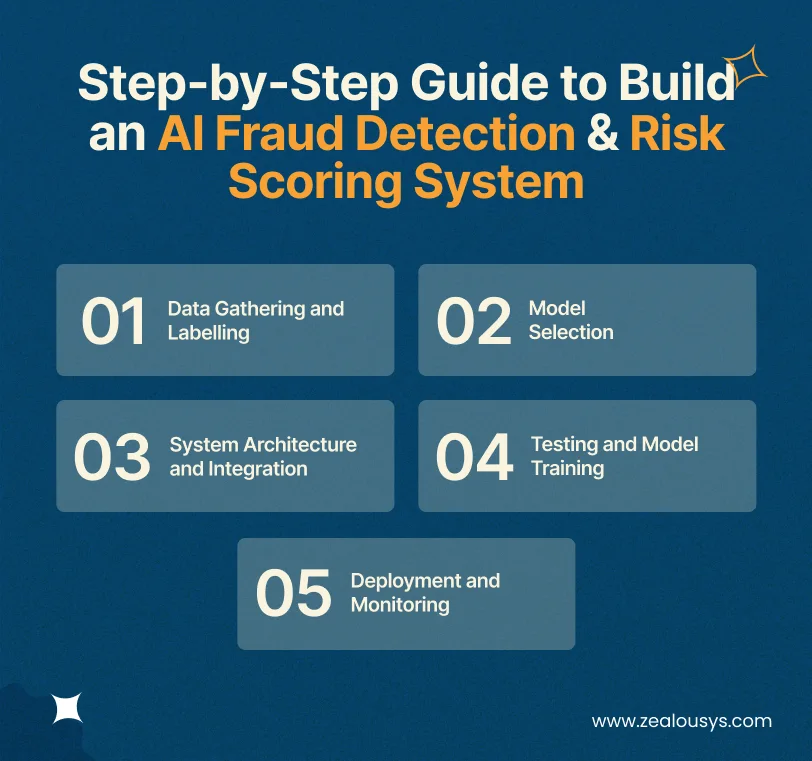
Building AI-driven fraud detection and risk scoring systems requires a clear development process. This roadmap helps UAE FinTech companies, digital banking teams, AML officers, compliance leaders, and technology decision-makers understand how AI fraud detection platforms are planned, developed, and deployed. The goal is to build secure and scalable systems that support AML compliance automation, fraud prevention software, and AI-powered transaction monitoring.
The first step is collecting high-quality data. The accuracy of an AI fraud detection system depends on the data that trains it. UAE FinTech companies gather transaction history, past fraud cases, and user behavior logs. The data includes onboarding details, device tracking, login attempts, payment flows, and digital wallet activity.
After gathering the data, teams label fraud patterns and normal behavior. This helps machine learning models detect identity theft, payment fraud, chargebacks, and suspicious activity. Regulatory teams, compliance officers, and CTOs ensure the process aligns with UAE and FSRA data protection policies.
Once the data is ready, developers select machine learning and AI models. Supervised learning models identify known fraud types. Unsupervised anomaly detection models discover new and hidden risks in financial transactions. NLP models verify documents and detect onboarding fraud, which supports AI risk scoring and digital identity verification.
FinTech CTOs, software architects, and cybersecurity leads choose models based on accuracy, response time, explainability, and regulatory transparency.
After choosing the models, development teams design the solution architecture. The AI fraud detection platform must connect smoothly with banking core systems, payment gateways, KYC platforms, and onboarding flows through APIs.
A well-designed system architecture ensures real-time fraud analysis and risk scoring without slowing down the customer experience. This step is important for digital banking and payment apps where fast approvals help maintain trust.
Once the system architecture is ready, teams begin testing and model training. Real financial activity and historical fraud data help test prediction accuracy, false positive rates, and decision timing.
Continuous improvement plays a critical role. The machine learning model learns from live UAE market behavior and retrains itself to stay ahead of new fraud patterns. Banking security specialists and product owners ensure the system meets regulatory and operational expectations.
After validation, teams deploy the AI system on secure infrastructure. Many UAE FinTech companies choose Azure cloud environments or Nvidia-supported AI platforms for better scalability and compliance. Deployment teams ensure the solution meets AML and CBUAE guidelines.
Monitoring begins immediately after deployment. The system observes live financial activity and keeps adjusting thresholds, risk scoring patterns, and fraud triggers. This supports long-term fraud prevention, operational efficiency, and digital trust.
AI-driven fraud detection gives FinTech companies in the UAE a stronger and smarter way to manage risks. As digital banking, online lending and cashless transactions continue to grow in the UAE, fraud attempts are becoming more sophisticated. AI helps FinTechs stay protected and compliant while improving customer experience.
AI analyzes huge amounts of transaction data in real time and identifies suspicious activity instantly. The system detects unusual behavior patterns with high accuracy. This reduces the chances of missed threats and improves fraud prevention.
AI evaluates risk instantly and approves low-risk customers faster. Users complete onboarding, sign-ups and transactions without delays. This helps FinTech companies offer smooth and secure digital experiences.
AI helps FinTechs meet UAE regulations including AML, KYC and open banking requirements. The system verifies identities, monitors transactions and creates audit-ready compliance reports automatically. This reduces manual work and protects businesses from legal penalties.
AI reduces the time and resources required for manual fraud checks. The system handles data processing, identity verification and transaction monitoring without human intervention. Teams spend less time reviewing alerts and more time solving complex challenges.
AI models continue learning from new threats. The system adapts automatically to emerging fraud methods including identity theft and synthetic identities. FinTech companies stay protected without constant manual updates.
When customers feel secure, they use FinTech services with confidence. AI helps build a trusted environment where users believe their money and identity remain safe.
AI fraud detection and risk scoring systems play an important role in protecting the fast-growing FinTech ecosystem in the UAE. As digital payments and online financial services grow, the risk of fraud also increases. AI helps FinTech companies detect fraud faster, reduce financial losses and stay compliant with regulations.
Below are the most common and high-impact use cases in the UAE market.
Digital wallets, online banking and contactless payments are now normal across UAE cities. AI monitors every transaction in real time and checks spending patterns. The system detects unusual behavior and stops suspicious payments before they complete. FinTech companies improve customer trust and reduce chargeback costs by lowering fraud activity.
Many fraud attempts come from fake accounts created using stolen or mixed personal information. AI models verify documents, match biometric data and compare records during onboarding. The system quickly flags fake identities and blocks high-risk users. This reduces onboarding risk and improves compliance with UAE KYC rules.
Financial institutions in the UAE must follow strict Anti-Money Laundering regulations. AI tools review thousands of transactions at once and identify hidden patterns linked to illegal transfers. The system flags unusual activity and assigns a risk score. Risk teams receive alerts in seconds and respond faster.
Buy Now Pay Later platforms and digital lending apps are growing in the UAE FinTech sector. AI evaluates financial behavior instead of relying only on traditional credit scores. The system checks repayment history, digital footprints and transaction behavior. FinTech companies make safer approval decisions and reduce loan default risks.
Crypto adoption is increasing in Dubai and Abu Dhabi. AI detects abnormal trading activity, wallet behavior and cross-border transfers. The system helps digital asset platforms prevent fraud and meet Virtual Asset Regulatory Authority compliance expectations. AI improves platform security and protects investor funds.
Cybercriminals often try to break into active bank or wallet accounts. AI analyzes login attempts, device type and user habits. If a login pattern changes, the system blocks access and requests additional verification. This protects users from unauthorized account access and prevents financial loss.
Payment gateways in the UAE work with thousands of merchants. AI systems detect suspicious merchant behavior such as unusual refund patterns, fake orders or abnormal sales spikes. This helps platforms remove high-risk merchants before fraud becomes widespread.
AI-driven fraud detection brings powerful benefits, but FinTech companies in the UAE still face several practical challenges during implementation. Understanding these challenges early helps businesses plan better and build a system that works smoothly in real operations.
FinTech companies in the UAE must store and manage sensitive customer data inside the country. ADGM and CBUAE regulations protect financial information and prevent cross-border data misuse. These rules can delay AI adoption if the platform depends on overseas servers.
You can solve this challenge by choosing cloud providers with data centers inside the UAE. A custom AI system can also include strong encryption, role-based access, and secure API connections to keep data compliance in check. This approach builds customer trust and satisfies strict UAE financial security standards.
Many UAE banks and financial institutions still use older software and disconnected databases. These systems handle core operations, so replacing them is risky and expensive. Integration issues can slow down AI development and lead to inconsistent information across platforms.
You can overcome this challenge with API-first development and modular architecture. Custom integration layers connect legacy systems with modern fraud detection tools. This approach keeps business operations running while the AI system improves fraud monitoring in real time.
Traditional fraud tools often block genuine transactions. This issue creates frustration for customers and increases the workload for customer support teams. AI models can also show bias if they train on limited or outdated data.
You can fix this challenge with continuous model training and feedback loops. The system learns from real transaction behavior. It identifies real threats with better accuracy and reduces false alerts. A dynamic risk scoring engine lets genuine users enjoy smooth and secure digital payments.
The UAE follows strict financial compliance standards. Regulators ask companies to explain why the system blocked a transaction or flagged a user as high-risk. Black-box AI models struggle to provide clear reasoning.
You can solve this challenge by using explainable AI models. These models give clear reports and decision insights. Compliance teams can easily track every action and share audit-ready information with regulators. This transparency builds strong credibility with both customers and government authorities.
Zealous System works with UAE FinTech companies strengthen fraud prevention with advanced AI development services customized for digital banking, payments, lending, and compliance-driven environments. As an AI software development company, we create custom machine learning models that monitor transactions in real time and detect suspicious behavior before it becomes a financial loss. Our team focuses on high accuracy, low latency, and seamless user experience so FinTech products stay secure without increasing customer friction.
We also design smart risk-scoring engines that help businesses make faster onboarding and approval decisions with confidence. Our AI development services include planning, development, secure integration, and regulatory alignment with UAE frameworks like CBUAE, ADGM, and DIFC. We ensure the entire system supports AML, KYC, digital identity verification, and transparent audit trails.
After launch, we continue to improve and support the platform through ongoing optimization, retraining, and system updates. With experience in generative AI services and enterprise-grade AI solutions, Zealous System delivers scalable technology that evolves with new fraud patterns and market regulations. FinTech companies rely on us to build AI systems that protect revenue, strengthen compliance, and support business growth in the UAE financial ecosystem.
AI powered fraud detection is now essential for FinTech companies in the UAE as digital payments and online transactions continue to grow. Manual checks and traditional rule based systems can no longer keep up with evolving fraud methods. AI models help detect suspicious behaviour in real time, reduce false alarms and support faster customer onboarding. This improves security, trust and customer experience while meeting regulatory expectations.
Building a custom AI solution also helps FinTech companies align with UAE compliance requirements like AML and KYC. It ensures the system adapts as regulations and fraud patterns evolve. Early adoption gives financial institutions a competitive advantage and protects them from rising risks. If your business is planning to develop or upgrade an AI fraud detection solution, expert guidance can help speed up development and reduce cost. You can request a free consultation to explore the best approach for your organization.
Our team is always eager to know what you are looking for. Drop them a Hi!

Pranjal Mehta is the Managing Director of Zealous System, a leading software solutions provider. Having 10+ years of experience and clientele across the globe, he is always curious to stay ahead in the market by inculcating latest technologies and trends in Zealous.




Comments