
Canada’s tech market is moving fast. By 2026, the country will have become a strong and stable market for digital innovation, with steady growth in areas like AI, cloud services, fintech, and mobile technologies. Businesses across industries are investing more in digital tools to work better, automate processes, and scale with confidence. As this momentum builds, one key question comes up again and again: how much does software development cost in Canada?
Well, software development costs in Canada depend on several factors. These include the size and complexity of the project, the technologies used, design requirements, system integrations, and ongoing support. Costs also vary by location, as developer rates can differ across cities and provinces. Whether a business is building a simple application or a large enterprise system, understanding software development costs in Canada in 2026 helps teams plan better and make smarter decisions.
This guide provides a clear and practical look at software development pricing in Canada. It explains how costs are structured, outlines common pricing models, and shares ways to manage budgets without affecting quality. By the end, you’ll have a realistic understanding of what to expect when investing in software development in Canada.
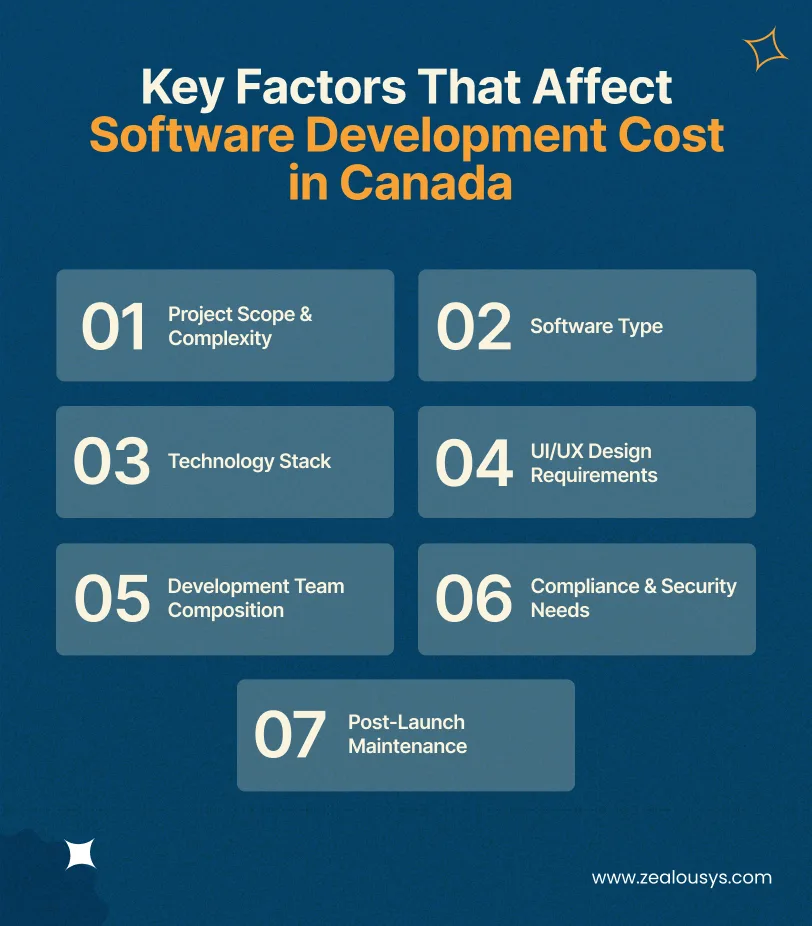
Several technical and business factors influence software development cost in Canada. Startup founders, SMEs, and enterprise teams often face budget issues when they ignore these factors early. Understanding them helps businesses plan realistic budgets and avoid unexpected costs during development.
Project scope plays a major role in custom software development cost in Canada. Simple applications with limited features cost less and take less time to build. MVPs with basic features such as user login, dashboards, and standard workflows require fewer development hours. Complex platforms with AI, real-time analytics, automation, or third-party integrations increase development effort and overall costs.
The type of software directly affects the cost to build software in Canada. Web applications usually cost less than mobile apps or enterprise systems. Mobile apps that require native performance and enterprise software with role-based access and compliance features demand more development time. SaaS platforms also require scalable architecture, which increases development and infrastructure costs. You can hire developer from here city wise like app developers Montreal, app developers Quebec, app developers Ontario, app developer Toronto.
The chosen technology stack influences both performance and software development pricing in Canada. Modern frameworks, cloud-native platforms, and AI-powered components improve scalability and future readiness. However, these technologies increase development effort and require skilled developers. Selecting proven and efficient technologies helps businesses control costs without sacrificing quality.
UI/UX design requirements significantly impact development budgets. Simple and intuitive interfaces reduce design and development costs. Custom user experiences for different roles, accessibility compliance, and industry-specific workflows increase both design time and overall project cost. Businesses planning complex user journeys should account for higher design investment.
The development team structure affects the hourly rate of software developers in Canada. Hiring senior developers, architects, QA engineers, and DevOps specialists improves software quality and reliability. Larger and more experienced teams increase development costs but reduce long-term risks. Team size and skill level directly influence the total project budget.
Compliance and security requirements raise software development cost in Canada 2026, especially for regulated industries. Healthcare, fintech, and enterprise SaaS platforms require data encryption, secure authentication, audit logs, and regulatory compliance. These requirements add development and testing time but protect businesses from legal and security risks.
Post-launch software maintenance adds long-term costs that many businesses overlook. Software requires regular updates, performance optimization, and feature enhancements after launch. Ongoing maintenance ensures stability and scalability but increases the total software development cost in Canada over time. Proactive budgeting for software maintenance services allows businesses to control costs and avoid unexpected expenses.
Understanding the software development cost in Canada in 2026 helps startup founders, SMEs, and enterprise leaders plan realistic budgets before committing to a build. Below is a detailed and transparent breakdown of software development pricing in Canada, based on real-world project sizes, team structures, and delivery models commonly used by Canadian businesses.
The hourly rate of software developers in Canada depends on experience level, technical expertise, and project complexity. Companies building MVPs, custom platforms, or enterprise-grade systems often use a combination of junior, mid-level, and senior developers to balance delivery speed and software development cost in Canada.
Junior developers typically charge between CAD 30–50 per hour and handle basic feature implementation, UI development, bug fixes, and routine maintenance tasks under senior guidance. Startup founders often rely on junior resources during early MVP stages to keep custom software development cost in Canada manageable.
Mid-level developers usually cost around CAD 50–100 per hour and manage full-cycle development, third-party integrations, API development, and performance improvements. Most SMEs prefer mid-level talent because it offers a strong balance between code quality and software development pricing in Canada.
Senior developers command hourly rates of CAD 100–150 or more and take responsibility for system architecture, security planning, scalability design, and complex business logic. Enterprises and SaaS companies depend heavily on senior developers, which has a direct impact on overall software development rates in Canada.
The cost to build software in Canada varies based on feature depth, number of user roles, system integrations, scalability expectations, and compliance requirements. In 2026, Canadian startups, SMEs, and enterprises typically see the following cost ranges depending on the type of software they plan to build.
A basic MVP development services in Canada usually costs between CAD 20,000 and 35,000. This option suits startup founders and non-technical business owners who want to test product-market fit without committing to a full-scale build.
At this cost level, the MVP typically includes essential features such as user authentication, basic dashboards, core workflows, and limited integrations. By starting with an MVP in this price range, businesses can significantly reduce the initial software development cost in Canada while validating ideas quickly and gathering real user feedback.
A mid-scale custom software project in Canada generally falls between CAD 25,000 and 50,000. This range is common among SMEs and growing businesses that require more robust functionality and operational efficiency.
Software built at this level includes advanced business logic, third-party API integrations, admin panels, role-based access, and moderate scalability. Companies investing in this range often focus on balancing performance, usability, and long-term value while managing custom software development cost in Canada effectively.
An enterprise software solution in Canada typically costs CAD 50,000 to 100,000 or more, depending on complexity and compliance needs. Large organizations and enterprises choose this option when they require highly secure systems, complex workflows, data governance, and strict regulatory compliance.
These projects often involve multiple user roles, advanced security layers, audit trails, and integration with legacy systems. Enterprises planning long-term platforms must budget carefully, as this level of development significantly increases overall enterprise software development pricing in Canada.
A scalable SaaS platform in Canada usually requires an investment of CAD 50,000 to 150,000, especially when designed for growth and multi-tenant usage. This cost range covers cloud-native architecture, performance optimization, subscription management, and ongoing feature expansion.
Product managers and CTOs often adopt a phased development approach within this budget to control software development rates in Canada, ensuring the platform remains flexible, scalable, and cost-efficient over time.
Many Canadian companies compare local development with offshore options to optimize budgets. Businesses often notice a 40–60% reduction in software development cost when combining Canadian product strategy with offshore execution.
This hybrid approach allows:
Building software in Canada doesn’t have to mean blowing your budget. With the right planning and execution, companies can reduce the software development cost in Canada by 20–50%, even for custom projects. The key is knowing where to be smart using incentives, choosing the right approach, and optimizing how the work gets done without sacrificing quality or compliance.
Here’s how teams are doing it in 2026.
One of the most effective (and often overlooked) ways to lower the cost to build software in Canada is through tax incentives. The Scientific Research and Experimental Development (SR&ED) program allows eligible Canadian-controlled companies to claim up to 35% of qualified R&D expenses. For innovation-heavy or experimental projects, this can significantly reduce the net custom software development cost in Canada, especially when credits are planned for early rather than treated as an afterthought.
If cost control is a priority, starting with a Minimum Viable Product (MVP) is one of the smartest moves you can make. By focusing only on core features, what users truly need on day one, you can reduce upfront spending by 40–60%. This approach not only lowers the initial software development pricing in Canada, but also lets you gather real user feedback before investing in advanced features that may not even be needed.
Design decisions made early can either save or drain your budget later. A modular architecture, built using open-source frameworks and reusable components, can cut development time by 30–50%. Pairing this with cloud infrastructure, such as AWS Canada Central, helps teams scale efficiently without overbuilding. This approach keeps long-term software development costs in Canada 2026 predictable while supporting future growth.
Traditional waterfall development often leads to surprises—and expensive rework. Agile development, on the other hand, allows teams to build in small iterations, spot issues early, and adapt quickly. This alone can reduce costs by 25–30% compared to rigid models. Add automated testing and CI/CD pipelines, and you can cut manual effort by another 15–25%, making Agile a strong choice for controlling the hourly rate of software developers in Canada over time.
Where and how you build your team has a major impact on cost. Instead of defaulting to high-rate markets like Toronto or Vancouver, many companies are choosing Montreal or hybrid delivery models that combine local oversight with cost-effective offshore talent. Agencies that offer blended teams can also help balance quality and budget. The key is clear contracts, defined scope, and strong communication; without that, even lower software development rates in Canada can turn expensive fast.
At Zealous, we assist Canadian companies in saving 40–70% on software development costs compared to local rates. Whether you’re a startup, small business, or enterprise, we make it possible to build software without stretching your budget.
Big Savings, Smarter Spending: Working with our offshore teams, MVPs that usually cost CAD40,000 can be built for under CAD 20,000, and bigger projects can save 50–60%. We also cut costs on office space, hardware, and local hiring. SR&ED credits can make your investment go even further.
Software development in Canada in 2026 comes with plenty of opportunities, but also a lot of choices. The software development cost in Canada can vary depending on what you’re building, how complex it is, and how your team is structured. The good part is that with clear planning, a phased approach, and smart decisions early on, these costs can be managed without stress.
Many businesses today are also open to flexible build models, including hybrid or offshore teams, to keep budgets under control while still building quality software. At Zealous, we support this approach by combining skilled global developers with an understanding of Canadian standards, security needs, and compliance. It’s a practical option for companies that want to move faster without overspending.
At the end of the day, software success isn’t just about cost, it’s about building something useful, scalable, and reliable. With the right plan and the right support, the cost to build software in Canada can feel manageable, and investing in software in 2026 becomes a smart step toward long-term growth.
Our team is always eager to know what you are looking for. Drop them a Hi!

Ruchir Shah is the Microsoft Department Head at Zealous System, specializing in .NET and Azure. With extensive experience in enterprise software development, he is passionate about digital transformation and mentoring aspiring developers.




Comments