
Quick Answer: App development in the UK costs between £15,000 for a simple MVP and £500,000 or more for a complex enterprise platform in 2026. Most standard business apps built by a UK agency fall between £40,000 and £120,000. The average UK app project budget, according to Clutch data from February 2026, sits at approximately £90,780. Your actual cost depends on app complexity, platform choice, team location, and UK-specific compliance requirements such as UK GDPR, FCA, or NHS Digital standards.
As per reported by statista, Total revenue is expected to show an annual growth rate (CAGR 2022-2027) of 9.05%, resulting in a projected market volume of US$23.81bn by 2027.
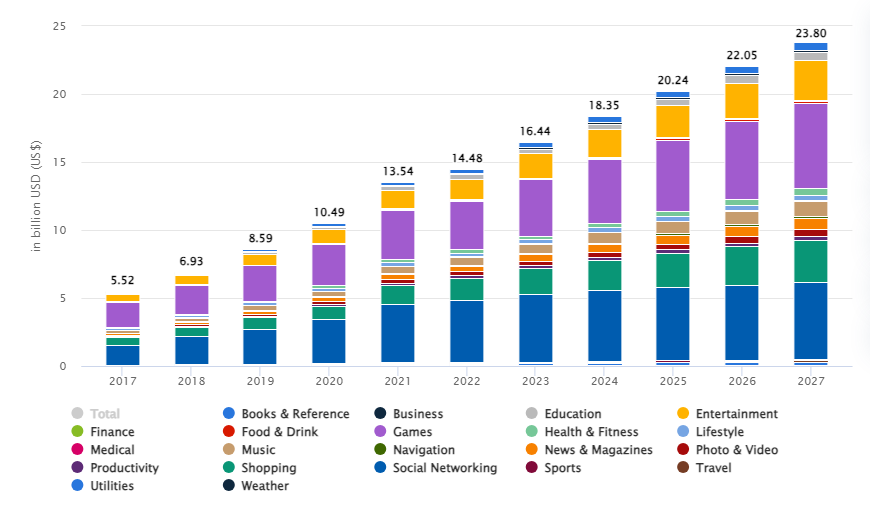
The UK app development industry was worth £28.3 billion in 2024 to 2025, employing around 73,470 people across 14,527 businesses. There are 99.3 million UK mobile connections for a population of under 70 million, and UK users now average over five hours per day on mobile devices (DataReportal Digital 2026).
When businesses ask how much it costs to build an app in the UK, they rarely get a straight answer, and for good reason. An app that displays a restaurant menu costs fundamentally different from a regulated fintech platform processing real-time payments. A cross-platform build using Flutter costs 30 to 40% less than two separate native codebases. An offshore development team in India charges one third of London agency rates. These variables compound, which is why quotes from three different UK agencies on the same brief can vary by 300%.
This guide cuts through the noise with actual 2026 benchmarks from multiple sources, a full breakdown of what drives cost at every stage, honest detail on hidden costs that most guides ignore, and practical strategies for reducing your budget without sacrificing quality or compliance.
The cost ranges below reflect 2026 UK agency pricing synthesised from multiple sources including Clutch directory data, Riseuplabs, Redeagle.tech, and Inoxoft benchmarks. The Clutch average UK app project budget as of February 2026 sits at approximately £90,780, with most SME projects landing between £30,000 and £80,000.
| App Type | Typical Cost (2026) | Timeline | Best For |
|---|---|---|---|
| Simple MVP / Proof of Concept | £15,000 to £30,000 | 8 to 14 weeks | Startups validating an idea before full investment |
| Standard Business App | £30,000 to £50,000 | 14 to 24 weeks | SMEs building customer-facing or operational tools |
| Complex Platform / Marketplace | £50,000 to £75,000 | 6 to 12 months | Two-sided platforms, on-demand, eCommerce at scale |
| Enterprise / Regulated Industry App | £75,000 to £150,000+ | 9 to 18 months | Fintech, NHS, financial services, large enterprise |
These ranges assume a single mobile platform or a cross-platform build. Building separate native apps for both iOS and Android adds roughly 50 to 70% to the cost. Apps requiring AI integration, real-time data processing, regulated industry compliance, or complex third-party integrations should budget at the upper end of their complexity band.
Real-World Example: A fintech MVP for iOS built by a Manchester agency typically costs £38,000 to £55,000. An enterprise healthcare app requiring NHS Digital compliance and ongoing support can reach £200,000 or more. Source: Elite IT Team, 2026.
Developer location is the single biggest lever on your app development budget. The median UK software developer day rate as of April 2026 is £500, with London rates running slightly above the national average. Specialist mobile development contract rates show a lower headline median of £360 per day, reflecting a different role mix. [Source: ITJobsWatch UK contract data, April 2026]
| Developer Type | London Rate | Regional UK Rate | Offshore Rate (India/E. Europe) |
|---|---|---|---|
| Junior Developer (1 to 2 years) | £40 to £60/hr | £30 to £45/hr | £15 to £25/hr |
| Mid-Level Developer (3 to 5 years) | £60 to £90/hr | £45 to £65/hr | £25 to £40/hr |
| Senior Developer (5+ years) | £90 to £130/hr | £65 to £90/hr | £35 to £60/hr |
| AI / ML / AR Specialist | £100 to £150+/hr | £80 to £120/hr | £40 to £70/hr |
| Agency Blended Rate (team) | £95 to £150/hr | £50 to £85/hr | £20 to £50/hr |
London agencies charge 30 to 50% more than regional UK studios for equivalent senior engineering work. A hybrid model combining a UK project manager with Eastern European or Indian developers typically delivers a blended rate around 40 to 45% lower than an all-London team, while keeping GMT-compatible working hours and UK legal coverage.
One of the most impactful cost decisions you make early in an app project is platform choice. The table below compares the main options for UK businesses in 2026.
| Platform | Typical Cost Range | Pros | Watch-outs |
|---|---|---|---|
| Native iOS only | £20,000 to £100,000 | Best performance, full Apple feature access | Excludes Android users; second build needed for Android |
| Native Android only | £15,000 to £75,000 | Full Google ecosystem, wider device range | Excludes iOS users; fragmented device testing overhead |
| Native iOS + Android | £30,000 to £150,000 | Maximum performance on both platforms | Highest cost; two codebases to maintain long term |
| Flutter (cross-platform) | £20,000 to £120,000 | Single codebase, 30 to 40% cost saving, near-native feel | Some advanced device features require platform plugins |
| React Native (cross-platform) | £20,000 to £110,000 | Large ecosystem, code reuse, web transition possible | Performance ceiling on animation-heavy apps |
| Progressive Web App (PWA) | £10,000 to £50,000 | No app store needed, lowest cost entry point | Limited device hardware access, offline gaps |
Cross-platform frameworks like Flutter and React Native have matured significantly. For most business applications, the performance difference compared to native is barely noticeable to end users. Choosing cross-platform over two separate native builds typically saves 30 to 40% on development cost and reduces ongoing maintenance overhead, since you maintain a single codebase rather than two.
Understanding where your budget goes at each phase of development helps you prioritise spend, negotiate more confidently with agencies, and identify where you can save without affecting the core product.
| Development Phase | Typical UK Cost | What It Covers |
|---|---|---|
| Discovery and Planning | £2,000 to £10,000 | Requirements, market research, technical feasibility, scope definition |
| UI/UX Design | £3,000 to £25,000 | Wireframes, user journeys, design system, interactive prototypes |
| Frontend Development | £10,000 to £80,000 | User interface build, animations, responsive layouts, component library |
| Backend Development | £15,000 to £100,000 | Server logic, database architecture, API design, authentication systems |
| Third-Party Integrations | £500 to £5,000 per API | Payment gateways, maps, social login, analytics, CRM and ERP connections |
| Quality Assurance and Testing | £5,000 to £20,000 | Unit tests, integration tests, UAT, device compatibility, load testing |
| App Store Submission | £500 to £2,000 | Apple and Google submission, screenshots, metadata, review management |
| Post-Launch Maintenance | 15 to 20% of build cost per year | Bug fixes, OS updates, security patches, minor feature improvements |
Post-launch maintenance is consistently the most underestimated cost in UK app budgets. The honest total cost of ownership for a £50,000 standard app typically looks closer to £80,000 to £100,000 in Year 1 once hosting, maintenance, compliance updates, and minor feature additions are included.
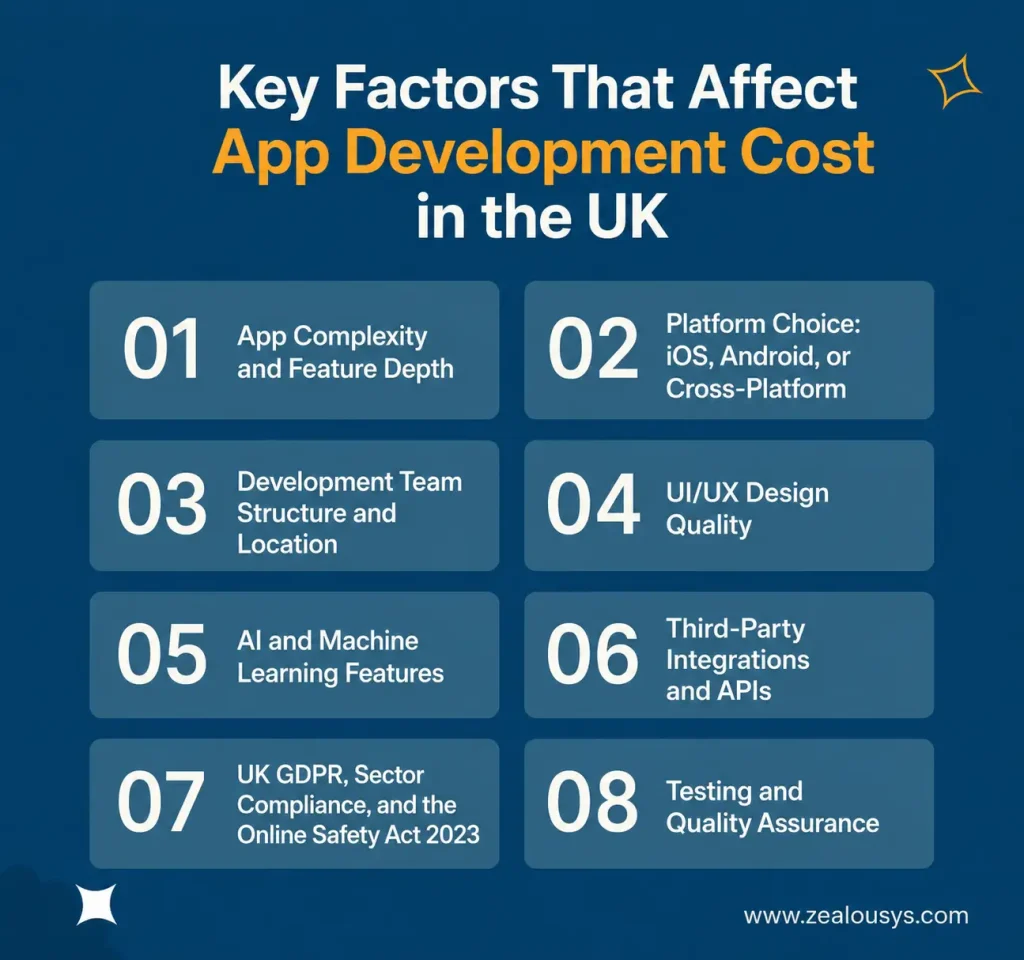
Complexity is the primary cost driver. A simple app with one core user flow and basic content display requires far fewer development hours than a platform with real-time tracking, user-generated content, advanced search, social features, and multi-role dashboards. Most founders describe their app as ‘simple’, then list 40 features in the next sentence. An honest feature audit before approaching agencies is the single most effective way to get accurate quotes.
As a rough guide, a user authentication system takes 15 to 25 development hours. A real-time chat feature takes 40 to 80 hours. Payment gateway integration adds 30 to 60 hours. A full recommendation engine powered by machine learning can add 200 to 400 hours depending on data complexity.
Building separate native apps for iOS and Android roughly doubles development time and cost compared to a single native build. Cross-platform frameworks like Flutter and React Native reduce this to approximately 1.3 to 1.5 times the cost of a single platform, making them the practical choice for most UK startups and SMEs that need to reach both user bases without enterprise-level budgets.
Progressive Web Apps represent the lowest-cost entry point, but they have meaningful limitations around offline functionality, push notifications, and hardware access that make them unsuitable for many business use cases beyond simple content delivery.
A senior London agency developer costs £90 to £130 per hour or more. The same seniority level in Manchester or Leeds typically runs £65 to £85 per hour. An offshore developer in India or Eastern Europe costs £20 to £60 per hour depending on seniority. The cost gap is real, but so is the management overhead that offshore teams introduce through timezone differences, communication friction, and the requirement for tighter specification.
The hybrid model is increasingly the default for UK scale-ups: a UK-based project manager and product owner maintaining culture, compliance, and stakeholder communication, with offshore or nearshore developers executing the build. This structure typically reduces total project cost by 25 to 40% compared to a fully UK-staffed team.
Research consistently shows that 88% of users will not return to an app after a poor user experience. Investing in professional UI/UX design is not optional for any app that needs to compete for attention. Budget £5,000 to £20,000 for design depending on scope, with higher investment warranted for consumer apps where first impressions drive retention, and lower investment appropriate for internal business tools where functionality matters more than visual polish.
AI integration has become a meaningful cost driver in UK app development in 2026. Specialist AI, ML, and AR developers charge £80 to £150 or more per hour in the UK. Adding an AI-powered recommendation engine, natural language search, predictive analytics, or an on-device machine learning model to an app typically adds 20 to 40% to the development cost compared to an equivalent app without AI features. For apps using generative AI APIs such as OpenAI, ongoing usage costs also need to be budgeted from day one.
Every third-party service you connect adds design, build, and testing time. A payment gateway integration such as Stripe or Braintree adds £5,000 to £10,000 to a project budget. Social login, push notification infrastructure, mapping services, and analytics platforms each add £500 to £3,000 depending on complexity. Apps requiring CRM or ERP integration with systems like Salesforce or SAP can add £10,000 to £30,000 or more depending on the depth of the integration.
UK GDPR applies to every app that handles personal data about UK users. Initial compliance work, including data protection impact assessments, privacy policy drafting, consent mechanism implementation, and ICO registration, typically costs £3,000 to £7,000 upfront with annual maintenance of £1,500 to £5,000. Failing to budget for this is not a cost-saving measure. The average UK data breach cost £3.58 million in 2024.
Regulated industries carry additional compliance costs. Fintech and financial services apps must comply with FCA guidance on algorithmic fairness and data handling, typically adding 10 to 20% to total project cost. Healthcare apps connecting with NHS systems must meet NHS Digital data standards. Apps with user-generated content, including messaging, reviews, or media sharing, now fall under the Online Safety Act 2023, with Ofcom’s fee regime live from April 2026.
WCAG 2.2 accessibility compliance is mandatory for public-sector apps and commercially expected for consumer apps. Building accessibility in from the first sprint typically adds 5 to 10% to design and build cost. Retrofitting it after launch costs 15 to 25% of the original build.
QA is the phase most commonly cut when projects run over budget, and consistently the decision that creates the largest post-launch costs. Proper testing including unit tests, integration tests, user acceptance testing, device compatibility testing, and load testing typically costs £5,000 to £20,000 depending on project scope. Security testing and penetration testing for regulated sector apps add £1,500 to £10,000 on top of functional testing costs.
The build cost is only part of your total financial commitment. The items below are consistently underestimated or omitted entirely from initial app development budgets, yet they are predictable and can be planned for from day one.
| Hidden Cost Category | Typical Amount | Why It Is Often Missed |
|---|---|---|
| Annual app store fees | Apple £79/yr, Google £25 one-off | Small but required for every live app on every platform |
| Cloud infrastructure (AWS / Azure / GCP) | £200 to £2,000+/month | Scales with users; easy to underestimate at low traffic stages |
| Third-party API usage fees | £100 to £5,000+/month | Stripe, Twilio, Google Maps, OpenAI all charge on usage |
| GDPR compliance and legal review | £3,000 to £7,000 upfront, £1,500 to £5,000/yr | Required by law for any app handling UK user personal data |
| Security audits and penetration testing | £1,500 to £10,000 per project | Needed before regulated sector launch; often quoted separately |
| UK GDPR breach cost (average) | £3.58 million (2024 ICO data) | Financial consequence of skipping compliance, not a development cost |
| App store revenue cut | 15 to 30% of in-app purchases | Apple and Google take a percentage of every subscription |
| VAT on agency invoices | 20% on all UK agency invoices | Non-VAT-registered businesses cannot reclaim this |
| Accessibility compliance (WCAG 2.2) | 5 to 10% added if built in; 15 to 25% to retrofit later | Public sector apps must comply; all apps benefit commercially |
| Online Safety Act 2023 compliance | Varies by scope, Ofcom fees from April 2026 | Applies to any app with user-generated content, messaging, or media |
| Annual maintenance | 15 to 20% of build cost per year | OS updates, security patches, new device compatibility |
A minimum viable product focuses on the single core feature that defines your app’s value and gets it in front of real users as quickly and cheaply as possible. Feedback from real usage is worth more than any amount of upfront planning. An MVP in the £15,000 to £40,000 range that validates your core assumption before you commit to a £120,000 full build is almost always the more cost-efficient path, even when the MVP features are later rebuilt.
For most business applications, an eCommerce platform, a booking tool, a productivity app, or an internal operations dashboard, Flutter or React Native delivers a near-native experience at 30 to 40% lower cost than two separate native builds. Reserve native development for apps where maximum device hardware access, platform-specific performance, or advanced animation fidelity is genuinely central to the user experience.
Pairing a UK-based project manager with offshore or nearshore developers typically reduces total project cost by 40 to 45% compared to an all-London team, while keeping GMT-compatible working hours and full UK legal and GDPR coverage.
Many UK businesses building custom apps are eligible for meaningful financial support that significantly reduces the net cost of development. R&D Tax Credits under the HMRC ERIS scheme can return up to 33% of eligible spend for loss-making R&D-intensive SMEs. Innovate UK Smart Grants fund qualifying digital innovation projects. Most UK businesses are unaware of or do not pursue these programmes, leaving significant money unclaimed.
| Funding Source | Type | What It Covers | Potential Value |
|---|---|---|---|
| HMRC R&D Tax Credits (SME scheme) | Tax credit / relief | Software development, testing, AI integration, technical uncertainty | Up to 33% of eligible spend for loss-making R&D-intensive SMEs (ERIS) |
| Innovate UK Smart Grants | Grant funding | Product innovation, digital tools, app development for UK businesses | Grants from £25,000 to £500,000+ for qualifying projects |
| UK Export Finance (UKEF) | Finance support | Export-focused digital product development | Project-specific; check UKEF eligibility tool |
| Local Growth Hubs and Devolved Funds | Regional grants | Regional business digitisation and technology investment | Varies by region; check your Local Enterprise Partnership |
Scope creep is the most common cause of app development projects running over budget. Businesses that come to agencies with a documented feature list, user story map, and definition of done consistently receive more accurate quotes and experience fewer cost surprises during development. Commission a discovery phase, typically £2,000 to £8,000, before committing to a full development contract. This investment almost always saves more than it costs.
Leveraging established open-source libraries for authentication, payment processing, mapping, push notifications, and analytics avoids rebuilding functionality that already exists in well-maintained form. The time saved directly reduces development cost. Ask any agency you engage to document which third-party libraries and frameworks they use and why: a good agency will have considered answers, and this question also reveals how they approach build efficiency.
A single senior London developer in-house costs over £100,000 annually in total compensation before recruitment costs, office overhead, and management time. A full in-house team for a medium-complexity app typically requires three to five people across engineering, design, and product management.
Outsourcing to a UK agency provides a complete team with project management, QA, and accountability under a single contract, at higher hourly rates but without the fixed overhead of permanent headcount. Offshore outsourcing offers the lowest headline rates but introduces timezone friction, communication overhead, and in some cases GDPR and IP ownership complications that add hidden costs through rework and delay.
For most UK SMEs building their first or second app, outsourcing to a reputable agency, onshore, nearshore, or hybrid, produces better outcomes than attempting to build an in-house team from scratch. The exception is businesses for whom the app is the core product and continuous, rapid iteration defines their competitive advantage: for these organisations, an in-house team pays for itself over time.
A portfolio of 200 marketing websites tells you little about a company’s ability to build a regulated fintech platform. Ask for specific examples of apps similar in complexity, sector, and feature set to what you are building. Request access to live apps they have built and test them yourself. Check Business profile reviews for verified client feedback, paying particular attention to how the agency handled problems during delivery, not just whether projects completed on time.
Agencies that rush to quotation without a structured discovery process consistently produce inaccurate estimates and difficult projects. An agency that proposes a paid discovery phase before quoting, or that asks detailed questions about your users, data, compliance requirements, and success metrics before any pricing conversation, is demonstrating the professional discipline that protects your budget.
If your app handles personal data, processes payments, operates in financial services, connects with healthcare systems, or will have user-generated content, confirm before signing any contract that the agency has specific experience with the relevant compliance requirements: UK GDPR, ICO registration, FCA guidance, NHS Digital standards, PCI DSS, or the Online Safety Act 2023. Ask them to walk you through how they handle data protection impact assessments and what their approach to privacy-by-design looks like in practice.
Ask every agency to quote not just for the initial build but for annual maintenance, hosting, third-party API management, and how they handle OS updates that break existing functionality. An agency that quotes attractively for the build but makes ongoing support expensive or difficult is a common trap. The relationship with your development partner is a long-term one: choose for compatibility and transparency, not just the lowest initial number.
iOS development is generally 5 to 15% less expensive than Android in the UK in 2026, reflecting the more uniform device landscape on iOS compared to Android’s broader device fragmentation, which requires more extensive compatibility testing across different screen sizes, OS versions, and manufacturer customisations. However, the platform cost differential is often less significant than the difference between native and cross-platform development approaches.
For UK businesses deciding which platform to launch on first, the choice should be driven by where your target users are. If your audience skews toward higher-income demographics, older users, or creative and media sectors, iOS has a stronger UK market share. If your audience spans a wider UK demographic or is primarily under 30, Android serves a broader share of UK users. For most UK business apps, launching on both platforms simultaneously via a cross-platform framework is the most cost-efficient approach.
App development in the UK costs between £15,000 for a simple MVP and £500,000 or more for an enterprise platform. The average UK app project budget according to Clutch data is approximately £90,780, with most SME projects sitting between £30,000 and £80,000.
UK agencies charge £50 to £150 per hour depending on location and seniority. Offshore developers in India or Eastern Europe typically charge £15 to £60 per hour for equivalent roles. The cost difference is real, but so is the management overhead. A hybrid model using UK project management with offshore execution typically delivers 40 to 45% cost savings while reducing the coordination risks of a fully offshore model.
Based on multiple 2026 sources, the average mobile app development cost in the UK ranges from £40,000 to £120,000 for a standard business application built by a professional agency. Simple MVPs can be built for £15,000 to £40,000. Complex enterprise or regulated sector apps typically cost £150,000 to £500,000 or more.
A simple MVP or single-workflow app typically takes 8 to 14 weeks from kickoff to submission. A standard SME business app takes 14 to 24 weeks. Complex platforms or regulated sector apps with compliance requirements commonly take 6 to 18 months including discovery, design, development, testing, and launch. Rushed timelines increase cost by 20 to 40% through overtime and parallel workstreams.
Yes. UK GDPR compliance adds £3,000 to £7,000 upfront for a standard business app, covering data protection impact assessments, privacy policy implementation, consent management, and ICO registration. Annual maintenance runs £1,500 to £5,000. Regulated sectors including fintech and healthcare carry additional compliance costs of 10 to 25% above standard development rates. Skipping this is not a saving: the average UK data breach cost £3.58 million in 2024.
The most cost-effective approach for most UK businesses is to build an MVP using a cross-platform framework like Flutter or React Native with a hybrid development team combining a UK project manager with offshore developers, then apply for R&D Tax Credits and Innovate UK grants to reduce the net cost further. Starting with an MVP development services rather than a full-feature build reduces upfront risk and allows you to validate the core concept before committing to the full investment.
Annual maintenance typically runs 15 to 20% of the initial build cost, covering OS updates, security patches, bug fixes, and minor feature improvements. Cloud infrastructure costs £200 to £2,000 or more per month depending on usage. App store fees are Apple £79 per year and Google Play £25 as a one-time fee. Third-party API usage fees scale with your user base. In total, budget 25 to 40% of the build cost for Year 1 post-launch expenses.
Yes. UK businesses building apps may be eligible for HMRC R&D Tax Credits returning up to 33% of eligible development spend under the ERIS scheme for qualifying R&D-intensive SMEs, and Innovate UK Smart Grants for qualifying digital innovation projects. Most businesses that could benefit from these programmes do not apply.
An app is worth building when the specific experience it enables, such as push notifications, hardware access, offline functionality, or biometric authentication, creates meaningful value that a mobile website cannot deliver. It is not worth building when a responsive web application would serve your users equally well at a fraction of the cost. The right starting question is not ‘should we build an app’ but ‘what would our users do differently if they had an app, and is that difference valuable enough to justify the investment’.
UK AI integration typically adds 20 to 40% to the cost of an equivalent app without AI features. Specialist AI and ML developers charge £80 to £150 or more per hour in the UK. Ongoing usage-based costs for generative AI APIs including OpenAI, Google AI, and Azure OpenAI must also be budgeted from day one, as they scale directly with your user volume.
The most expensive app projects in the UK are not the ones that cost the most upfront. They are the ones that underbudgeted, cut the wrong corners, skipped compliance, and discovered what a realistic budget actually looks like three months into a failed delivery.
The businesses that get the most value from app development in the UK are those that scope honestly, choose a development model that matches their budget and risk tolerance, plan for post-launch costs from the start, and treat compliance as a built-in cost rather than an optional extra.
Zealous System builds mobile and web applications for UK businesses across fintech, healthcare, retail, logistics, and SaaS. Our hybrid delivery model combines UK-standard project management and communication with experienced offshore engineering teams, giving you enterprise-grade development at a cost point that suits growing businesses. If you are planning a UK app project and want a detailed cost estimate based on your specific requirements, contact us at Team Zealous for a free scoping consultation.
Our team is always eager to know what you are looking for. Drop them a Hi!

Raj Kewlani is a Project Manager and Mobile & Open Source Development Lead at Zealous System, specializing in agile-driven digital solutions. He focuses on delivering high-quality mobile apps and open-source projects that align with business goals.




Comments